
Most homeowners don’t think about their gutters until something goes wrong — a waterfall spilling over the edge during a rainstorm, paint peeling off the fascia, or a soggy flower bed that never quite dries out. By the time those signs appear, the damage is often already underway. Gutters are one of those systems that quietly protect everything else: your foundation, your siding, your roofline, your landscaping. When they stop working, the consequences don’t stay contained to the gutter itself.
That’s why gutter replacement isn’t just a maintenance item to check off a list. It’s a decision that deserves a real diagnostic approach, honest material guidance, and installation practices that treat your home as a system — not a series of isolated parts. Generic advice about “sagging” and “rust” only gets you so far. What most homeowners actually need is a clear-eyed framework for evaluating what’s failing, why it’s failing, and what a correctly executed replacement looks like from start to finish.
That’s exactly what this guide is designed to provide.
We’ll walk through the structural and mechanical reasons gutter systems reach end-of-life, the often-overlooked role your fascia boards play in whether a replacement holds up long-term, how to right-size your new system for your specific roof and climate, and what separates a quality installation from one that’ll have you calling for help again in two years. Whether you’re comparing quotes, evaluating a contractor’s proposal, or just trying to understand what you’re dealing with, this is the resource that gives you straight answers.
Before you can make a smart replacement decision, it helps to understand what’s actually going wrong — not just what it looks like from the ground, but what’s happening at a structural and material level. Most gutter failure isn’t sudden. It’s the cumulative result of physical stress, chemical degradation, and installation shortcomings compounding over years.
Gutters live an unusually hard life for an exterior building component. They’re cantilevered off the fascia, exposed to UV radiation, thermal cycling, debris loading, and the sheer weight of standing water — all while being expected to hold precise geometry over runs that may span 40 feet or more.
Thermal expansion and joint stress are among the most underappreciated failure drivers. Aluminum expands and contracts with temperature changes. On a long sectional gutter run, that movement puts constant stress on the sealed joints between sections. Over time, those seals fatigue and crack, creating the leak points that homeowners typically notice first. This is one of the strongest structural arguments for seamless gutters — eliminating those joints removes the highest-probability failure points from the system entirely. It’s not a cosmetic preference; it’s an engineering advantage.
Fastener pullout is the mechanical failure behind sagging and separation. Gutters are typically secured with spike-and-ferrule fasteners or hidden hanger brackets driven into the fascia. As fascia wood softens with age or moisture intrusion, those fasteners lose their bite. The gutter doesn’t fall immediately — it begins to shift, losing its slope alignment first. Water starts pooling. The pooled water accelerates deterioration at the gutter base. The weight increases. Eventually the system pulls away from the house entirely. By the time the separation is visible, the underlying fascia is almost always compromised.
Galvanic corrosion is a failure mode that appears at metal-to-metal contact points — particularly where dissimilar metals meet, such as aluminum gutters installed with steel fasteners, or where copper flashing contacts aluminum channels. The electrochemical reaction between dissimilar metals accelerates oxidation at the contact point. It’s slow and invisible until the corrosion has done meaningful structural damage.
UV degradation primarily affects vinyl gutters. UV radiation breaks down the polymer chains in vinyl over time, causing the material to become brittle, fade, and eventually crack — especially at connection points and end caps where stress concentrates. Vinyl gutters in high-sun climates or southern exposures tend to show this failure mode earlier than those in shaded or northern exposures.
This distinction is the one that saves homeowners from unnecessary replacement on one hand, and from delaying necessary replacement on the other.
Cosmetic failures that can often be repaired:
– Isolated joint leaks on sectional gutters where the sealant has failed but the gutter body is intact
– Loose hangers on sound fascia wood where refastening will restore proper alignment
– Minor surface oxidation on aluminum that hasn’t compromised wall thickness
– Downspout disconnection or blockage causing overflow
Structural failures that indicate replacement is the right call:
– Gutters pulling away along extended runs (not just one isolated hanger) indicating fascia degradation
– Cracking, warping, or significant deformation of the gutter body itself
– Visible rust-through or perforation on steel gutters
– Widespread sealant failure on a heavily sectional system where re-sealing every joint exceeds the practical value of the remaining gutter life
– Any gutter system installed on fascia that has failed — because no repair to the gutter itself solves the substrate problem
The honest truth is that a skilled contractor should be able to walk this line with you clearly. If a repair will buy you another 8 to 10 years of reliable performance, that’s worth knowing. If the system is fundamentally compromised, you deserve that straight answer too.
Here’s something that separates experienced exterior contractors from average ones: before a single measurement is taken for a replacement quote, the fascia boards behind the existing gutters need to be evaluated. Not glanced at — evaluated.
Fascia is the vertical board that runs along the roofline where the gutters attach. It’s the structural anchor for your entire gutter system. If it’s compromised, no gutter — regardless of quality or material — will perform correctly over time.
The problem is simple: fascia sits directly behind the gutter. Once gutters are in place, fascia is largely hidden from view. Most homeowners have never seen theirs, and some contractors give it only a passing glance during an estimate — particularly if the existing gutters are still attached and obscuring access.
The actual probe test is straightforward. Once the gutter is removed (or even with a flashlight and tool through a gap), pressing a screwdriver tip firmly against the fascia face tells you immediately what you’re working with. Healthy, sound wood resists the pressure — you’ll feel firm resistance across the grain. Rotted wood accepts the tip under hand pressure alone, sometimes sinking a quarter inch or more without significant force. That soft wood has lost its structural integrity, meaning any lag screws or hanger brackets driven into it are anchored in compromised material.
Installing new gutters on rotted fascia is one of the most common reasons a “new” gutter system begins sagging, leaking at the fastener points, or pulling away within two years of installation. The gutters themselves weren’t defective — the substrate they were attached to was. If you’re weighing the full scope of this kind of work, our article on fascia and soffit repair walks through what that repair process actually involves and what to expect cost-wise.
When fascia rot is present, the right sequence is:
Any contractor who skips this diagnostic and offers a replacement quote without addressing fascia condition is either rushing the job or hasn’t looked closely enough. Either way, it’s a flag worth raising directly.
Most gutter replacement conversations focus on material and color. Very few address whether the gutter profile — the actual physical size and shape — is correct for the home. This is a hydraulic engineering question that has real consequences for system performance.
The purpose of a gutter is to capture and redirect roof runoff before it can damage the structure or foundation. That means the gutter must have enough capacity to handle the peak volume of water coming off the roof during a significant storm event. If it can’t, overflow occurs — and overflow defeats the entire purpose of having gutters in the first place.
Three variables determine whether your gutter is sized correctly:
1. Drainage area — the square footage of roof surface that drains to a single gutter run. This isn’t the same as your home’s footprint. A steeply pitched roof has significantly more surface area than a low-slope roof over the same floor plan.
2. Roof pitch multiplier — steeper roofs shed water faster. A 12/12 pitch delivers water to the gutter at a much higher peak flow rate than a 4/12 pitch, even if the roof square footage is identical. Industry sizing charts apply pitch multipliers to account for this acceleration effect.
3. Regional rainfall intensity — measured in inches per hour during a design storm event (typically a 5-year or 10-year storm). A home in coastal North Carolina faces dramatically different peak rainfall intensity than one in the mountain foothills, even though both are in the same state.
When these three factors are calculated together, the correct gutter profile and downspout frequency become an engineering determination — not a preference.
| Feature | K-Style Gutter | Half-Round Gutter |
|---|---|---|
| Cross-section shape | Flat back, ogee (S-curve) front | Semicircular trough |
| Hydraulic capacity (5-inch) | ~1.2 gallons/second | ~0.8 gallons/second |
| Typical application | Most modern residential homes | Historic, craftsman, or high-end custom homes |
| Debris accumulation | Corners collect debris more readily | Cleaner self-flushing profile |
| Structural strength | Higher rigidity due to profile shape | Requires more hanger frequency |
| Seam vulnerability | Sectional corners are prone to joint failure | End cap seals are primary leak points |
| Material compatibility | Aluminum, steel, copper, vinyl | Aluminum, copper (most commonly) |
| Seamless availability | Standard | Available but less common |
| Common residential sizing | 5-inch (standard), 6-inch (high-capacity) | 5-inch, 6-inch |
For most homes in the NC Triad, K-style gutters in a 5-inch or 6-inch profile represent the right combination of capacity and practicality. The 6-inch profile is often the correct technical answer for steeper roofs, larger drainage areas, or homes that have experienced chronic overflow with a standard 5-inch system — even when the previous installer never questioned it.
A correctly sized gutter attached to undersized or improperly spaced downspouts will still overflow. Downspout capacity and placement are part of the same hydraulic system.
General guidance:
– One downspout per 20 to 30 linear feet of gutter run, depending on drainage area and rainfall intensity
– Downspout outlets positioned at low points in the gutter slope, not at arbitrary locations
– On runs exceeding 40 feet, a single-direction slope creates a visible drooping effect at the midpoint. The correct installation uses a center-high, valley layout: the gutter peaks at the center and slopes toward downspouts at both ends. This keeps the visual line true and eliminates the pooling that occurs at the far end of an overlong single-direction run.
Where the downspout discharges matters just as much as where it starts. Extensions, splash blocks, and underground drainage connections all affect whether the water is actually being moved away from the foundation — or just moved a few feet and re-concentrated at the footing. For homeowners considering a cleaner, more permanent solution, our guide to buried gutter downspouts covers the full process of underground drainage installation and what it costs.
The gutter material conversation tends to get oversimplified into a price-based ranking. The more useful framework is matching material properties to your specific environmental conditions, maintenance preferences, and how long you plan to stay in the home.
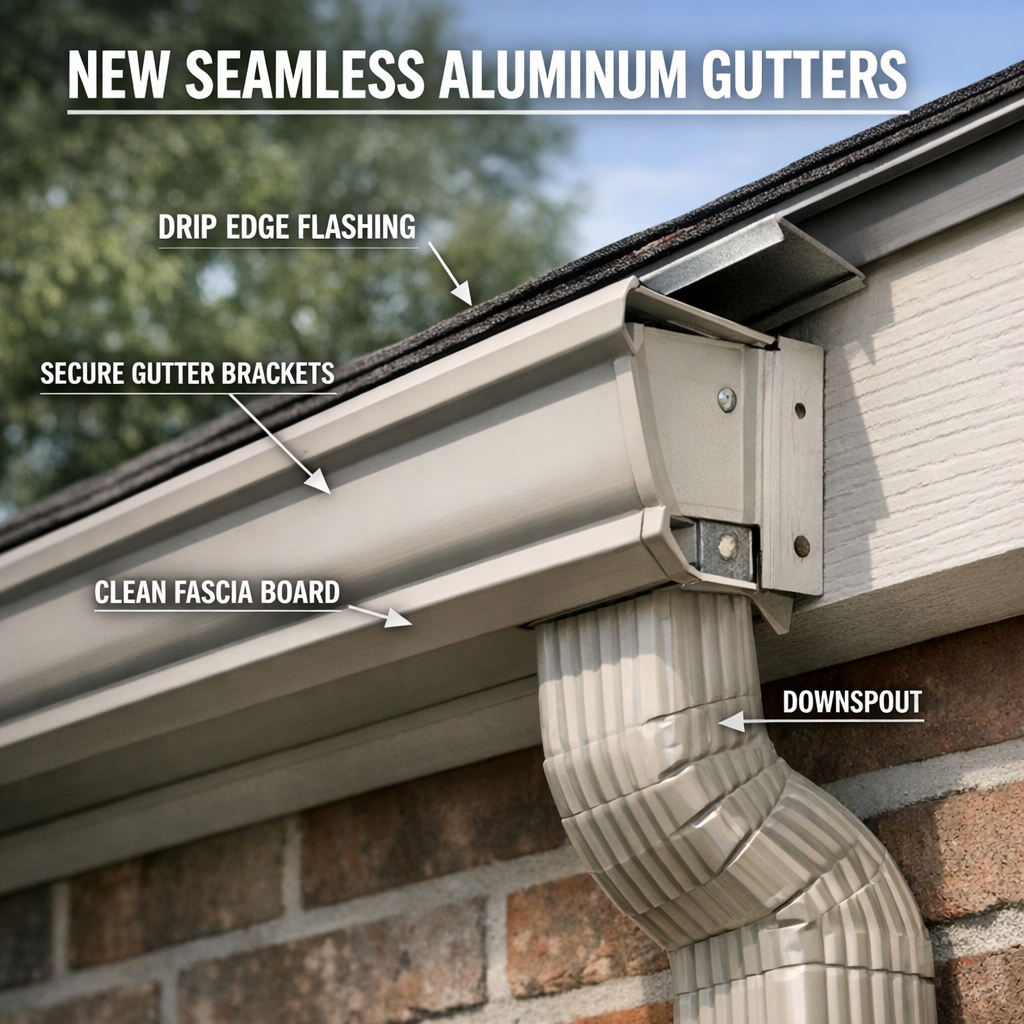
Aluminum is the dominant residential gutter material, and its longevity in that position is earned. It’s lightweight enough to minimize fascia stress, resistant to rust (it oxidizes rather than rusts, forming a protective surface layer), and available in seamless form — which is how most professional installations should be done. It accepts paint well and comes from the factory in a wide range of baked-on colors that hold up reliably in the Piedmont climate.
Thicker-gauge aluminum (0.032-inch) is meaningfully more durable than the thinner stock material used in lower-cost installations. This is one of those specification details worth asking about when comparing quotes — it won’t be visible once installed, but it affects how the gutter holds up to physical loading from ice, debris, and ladder contact over the years.
Vinyl gutters are inexpensive upfront and easy to install, which makes them common in builder-grade construction. But the material has real limitations that matter for long-term value. UV exposure causes vinyl to become brittle and fade, particularly in southern exposures. Color options are limited and the color is surface-deep — scratches and chips are visible. Perhaps most critically, vinyl expands and contracts significantly with temperature swings, stressing connection points over time and making it difficult to maintain watertight seals on sectional systems.
For a homeowner who needs a low-cost short-term solution, vinyl is an option. For anyone focused on performance over a 15- to 25-year horizon, it tends to underdeliver relative to its initial cost savings.
Copper gutters are a legitimate premium choice for the right application — historically significant homes, high-end custom construction, or homeowners who want a material that develops a distinctive patina and will outlast the building it’s attached to. Copper is highly durable, naturally antimicrobial (which reduces algae buildup), and develops its characteristic green patina through natural oxidation. The primary considerations are weight (requiring closer hanger spacing), cost, and the galvanic corrosion risk if copper contacts aluminum or steel components. On the right home with properly matched materials throughout, copper is exceptional. On a standard residential replacement, it’s rarely the most practical answer.
Knowing what to look for after the crew packs up is the final piece of the puzzle. A well-executed gutter replacement has observable indicators that any homeowner can check — you don’t need a contractor’s license to verify that the work was done right.
This isn’t about being difficult with a contractor — it’s about knowing what a professional job looks like and being able to verify it. Any contractor doing quality work will welcome the questions, because the answers confirm their standards.
Gutter replacement decisions aren’t made in a vacuum, and they shouldn’t be made with generic national advice as the primary reference point. The NC Triad has specific environmental conditions that influence both material selection and installation specifications.
Summer storm intensity in the Piedmont is significant. High-volume, fast-moving thunderstorms are the norm from spring through early fall, which means gutter capacity — not just material durability — is a real performance concern. Homeowners who have watched water cascade over the front edge of their gutters during a heavy summer storm may not have a clogged or aging gutter problem; they may have an undersized gutter problem.
Deciduous tree canopy is dense across much of the Triad. Oak, sweet gum, and pine debris loads are heavy and frequent, particularly in fall. This affects both maintenance frequency and the case for gutter protection systems — which are worth evaluating at the time of replacement rather than as an afterthought.
Freeze-thaw cycling in the Triad is moderate compared to more northern climates, but winter ice events do occur. Standing water in gutters with insufficient slope will freeze during these events, adding significant weight loading and potentially accelerating fastener fatigue at the connection points. It’s another reason slope precision and hanger spacing matter — not just for aesthetics but for handling the mechanical stresses your specific climate imposes.
A contractor who knows this region — who has seen how these houses perform through the seasons — brings a different quality of judgment to a replacement project than one applying generic specifications across every market they serve. Smithrock Roofing’s gutter services are built around exactly this kind of local expertise.
As you move toward a gutter replacement decision, three specific steps will put you in the strongest position heading into the next storm season.
1. Schedule a Pre-Season Assessment Before Spring
Winter and very early spring represent the best window for gutter inspections and replacement scheduling. Contractors are less backlogged, weather delays are more predictable to plan around, and any work completed before the Triad’s spring storm season means your new system is fully functional when it matters most. Contact local roofing and exterior contractors in January or February to get ahead of the spring scheduling rush.
2. Request a Site-Specific Water Management Evaluation
Rather than asking only for a gutter replacement quote, ask contractors to evaluate your full drainage picture — downspout placement, discharge locations, grading conditions near the foundation, and whether your current gutter sizing is appropriate for your roof’s actual drainage load. This broader conversation costs nothing extra but produces far more useful guidance than a replacement quote in isolation.
3. Evaluate Gutter Protection Systems Alongside Replacement
If your property has significant tree canopy — particularly oak, sweet gum, or pine — the replacement appointment is the right time to assess gutter protection options. Installing protection on an old system often makes little sense. Installing it on a new system at the same time can extend service life and reduce maintenance demands significantly. Ask for a side-by-side comparison so you can make an informed decision rather than a reactive one later.
Localized damage — a single leaking seam, one cracked section, or a loose downspout bracket — is typically repairable. Replacement becomes the more practical choice when damage is widespread, when the gutters are showing consistent sagging or separation from the fascia along multiple sections, or when the system is older and repairs would simply delay the same conversation by a season or two. A straightforward inspection by a qualified contractor will clarify which situation you’re in. Any contractor recommending full replacement on a system with genuinely isolated damage should be able to explain the specific reasoning clearly.
The standard residential gutter is five inches wide, and it handles typical rainfall loads on moderate roof pitches reasonably well. Six-inch gutters move significantly more water volume and are worth serious consideration for homes with steeper roof pitches, larger drainage areas, or histories of overflow during heavy storms. In the NC Triad, where summer thunderstorms can deliver high-intensity rainfall in short windows, undersized gutters are a more common problem than many homeowners realize. Sizing should be calculated based on your roof’s actual square footage and pitch, not assumed from what was previously installed.
Aluminum gutters installed correctly with quality materials and appropriate hanger spacing typically last two decades or more under normal conditions. Steel and copper systems can exceed that range with proper maintenance. Lifespan is heavily influenced by installation quality — gutters with inadequate slope, insufficient fastener support, or poorly sealed joints will fail prematurely regardless of material grade. Regional factors like debris load and freeze-thaw cycling also affect longevity, which is why maintenance frequency and gutter protection choices matter as much as the initial material selection.
Not always, but it should be inspected before new gutters are mounted. Fascia boards that have experienced prolonged moisture exposure — often the result of gutters that were already failing — can develop rot that compromises the structural connection point for the new system. Installing new gutters on deteriorated fascia is a shortsighted approach that will accelerate fastener failure and potentially allow the system to pull away from the roofline. A thorough contractor will identify fascia condition during the assessment and include any necessary repairs in the project scope rather than discovering the issue mid-installation.
Gutter replacement is one of those projects where the gap between adequate and excellent is difficult to see from the street but significant in every practical outcome — how long the system lasts, how well it protects your foundation and interior, and how rarely it demands your attention after installation. The right contractor, the right materials for your specific conditions, and a rigorous installation process are what separate a durable solution from one that revisits these same decisions in a few years.
If you’re ready to have a straightforward conversation about your home’s specific situation, we’re here for it. Contact Us

Smithrock Roofing © Copyright 2026 • All Rights Reserved • Privacy Policy • Maintained by Mongoose Digital Marketing