Replacing a roof is one of the largest home improvement decisions most homeowners will ever make — and in Greensboro, High Point, Winston-Salem, and the surrounding NC Triad communities, that decision comes with more variables than most people expect. You’re not just buying shingles. You’re buying a system, and every component of that system has its own set of cost drivers.
The problem is that most of what’s written about roof replacement costs online is really just price-anchoring dressed up as education. You get a materials table, a size estimate, and a nudge to request a quote. What you rarely get is a genuine explanation of why two homes of the same size, in the same neighborhood, with the same type of shingles can produce dramatically different replacement scopes — and dramatically different outcomes for the homeowner.
That’s what this article is actually about.
At Smithrock Roofing, we’ve spent decades working on homes across the Triad — from aging ranch-style neighborhoods in High Point to newer subdivisions in Kernersville and Clemmons. With 60-plus combined years of experience and CertainTeed PREMIER ShingleMaster Certification, we’ve seen every cost variable play out in the real world. What follows is the honest, field-level breakdown that will help you walk into any roofing conversation prepared.
Before getting into individual cost factors, this point needs to be made clearly: the components of your roof don’t function independently. Shingles, underlayment, decking, flashing, ventilation, and ridge caps are interdependent. When one fails, others are already under stress. And when a contractor scopes a replacement by treating these as separate line items rather than a connected system, homeowners end up paying twice — once for the initial job, and again when a deferred component fails prematurely.
This matters for cost conversations because many competitive bids look lower on paper specifically because they’re scoping fewer components. Understanding why those components interact is what gives you the ability to evaluate a bid honestly.
Your home’s footprint doesn’t translate directly to your roof’s surface area. Roofing is measured in “squares” — one square equals 100 square feet of roof surface. A home with a large footprint and a steep pitch can have significantly more roof area than its floor plan suggests, and that gap directly affects material quantities and labor hours.
Roof pitch is the steepness of the slope, expressed as a ratio of rise to run. In Greensboro’s housing stock — which runs heavily toward ranches, split-levels, and cape cods built between the 1960s and 1990s — pitches around 6/12 are common. Above that, you’re working on roofs where safety equipment, slower movement, and specialized installation techniques increase labor time measurably.
Pitch also intersects with climate in ways most homeowners don’t consider. Greensboro sits in the Piedmont Triad, where freeze-thaw cycling occurs more frequently than coastal NC but less predictably than the mountains. At moderate-to-steep pitches, water drains more efficiently, which reduces ice damming risk. But improperly ventilated roofs at those same pitches trap heat in ways that accelerate shingle granule loss — one of the most common premature failure patterns we see on homes built before 2000 in Guilford County.
A simple gable roof is the least complex roof to replace. Every additional feature adds labor time:
A home with a straightforward shape and one or two penetrations is a fundamentally different project than a home with four dormers, a chimney, and multiple valleys — even if the square footage is identical.
Most cost articles treat architectural shingles as one category with one price point. That’s not accurate, and it leads homeowners into apples-to-oranges bid comparisons.
Within architectural (dimensional) shingles alone, manufacturers offer distinct product lines that differ in:
The warranty tier decision deserves particular attention. A homeowner choosing between a 30-year architectural shingle and a lifetime architectural shingle is not just buying more years on paper. They’re often buying a fundamentally different product with a higher impact resistance rating, different granule bonding, and transferable warranty coverage — which has real value at resale. A contractor who doesn’t explain this distinction isn’t giving you the information you need.
At Smithrock Roofing, we install CertainTeed Landmark shingles — a product line with a track record in NC’s climate and backed by a limited lifetime manufacturer warranty. That choice is intentional, and we’d rather explain why it matters than just quote you a tier you didn’t know to ask about.
| Material | Durability Profile | NC Triad Consideration |
|---|---|---|
| Architectural asphalt shingles | 25–30+ years with proper ventilation | Most common; performs well when installed with full system attention |
| Metal (standing seam) | 40–70 years | Excellent in hail corridor; higher upfront investment, lower lifecycle cost |
| Metal (exposed fastener panels) | 25–40 years | More accessible cost point; fastener maintenance is a long-term factor |
| Impact-resistant shingles (Class 4) | 30+ years | May qualify for homeowner insurance discounts; relevant in Greensboro’s hail zone |
| Synthetic slate/shake | 30–50 years | Lightweight alternative where traditional slate weight is a structural concern |
| Natural slate | 75–150 years | Rare in Triad housing stock; requires structural assessment before installation |
| Wood shake | 20–30 years | Declining use; fire code restrictions in some Guilford County municipalities |
For a deeper breakdown of how these materials compare in NC’s climate, the NC Homeowner’s Guide to Shingle Roof Replacement Costs and Process covers the full decision framework across material types.
Every competitor article tells you that hidden damage is discovered after tear-off. What they don’t tell you is that a homeowner can often anticipate the likelihood of additional scope before a contractor sets foot on the property.
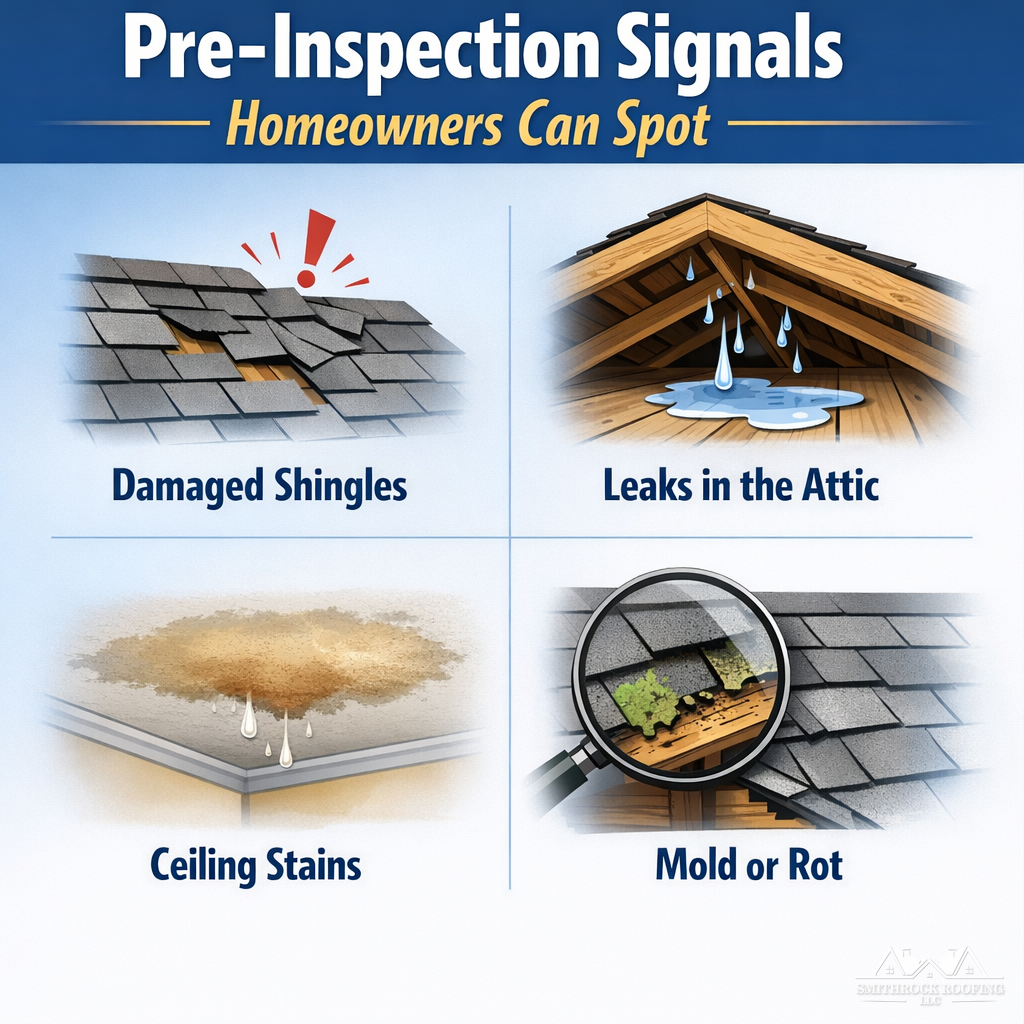
Here are diagnostic signals worth noting before your roof inspection:
In your attic:
– Daylight visible through the decking boards (skip sheathing common in pre-1980 construction)
– Staining patterns on the underside of the decking that extend in horizontal lines (moisture wicking, not just isolated leak points)
– Insulation compression directly against the underside of the decking (blocks airflow, accelerates decking decay)
– Evidence of previous repairs using spray foam or caulk at penetrations
On your exterior:
– Granules accumulating in gutters or at downspout exits (normal aging at end of life; accelerated granule loss may signal ventilation problems)
– Shingles with a cupped or curled edge (moisture cycling, often ventilation-related)
– Visible “shadowing” or discoloration patterns on roof planes that don’t follow rake edges (may indicate concealed flashing that was buried during previous re-roofs)
– Soft metal surfaces — gutters, vent caps, pipe flashings — with dimpling or irregular surface texture (adjuster-recognizable hail indicators)
Your home’s history:
– Previous roofs installed without full tear-off (meaning layers are present)
– Permits pulled without full scope (common in DIY or lower-tier contractor work)
– No record of previous ventilation upgrades when the roof was last replaced
None of these signals guarantee specific scope additions. But they do give you a realistic sense of what questions to ask and what to expect when a contractor delivers their assessment.
If you take one thing from this article, make it this: attic ventilation is not a peripheral upgrade. In Greensboro’s climate, it is one of the primary drivers of premature shingle failure — and it is the most commonly under-scoped item in lower bids.
Greensboro’s summers are humid and sustained, with attic temperatures that can reach well above ambient air temperatures without adequate airflow. That heat and moisture combination breaks down the bonding agents in shingle granules, accelerates adhesive strip failure (reducing wind resistance), and creates the moisture cycling that causes decking to swell and contract beyond its design tolerance.
In winter, the Triad sees periodic hard freeze events — not as consistent as the mountains, but sufficient to create ice damming risk on homes where warm attic air is melting snow at the roof surface. That meltwater refreezes at the cold eave overhang, backs up under shingles, and causes interior water intrusion that’s often misattributed to “shingle failure” rather than its actual cause.
Most Greensboro homes built before 2005 rely on static ventilation systems — box vents near the ridge combined with soffit vents. This system works adequately when the ratio of intake to exhaust is properly balanced and when soffit vents aren’t blocked by insulation. In practice, many homes we inspect in Guilford, Forsyth, and Alamance Counties have compromised soffit ventilation and insufficient net free area to meet current North Carolina Residential Building Code standards.
The alternative — a continuous ridge vent with balanced baffle-controlled soffit intake — creates a convective airflow path across the entire underside of the decking. The performance difference in Greensboro’s climate is significant, particularly for shingle longevity.
Here’s the practical consequence for cost: many shingle manufacturer warranties — including CertainTeed’s — require that installation meet minimum ventilation standards. A roof installed without adequate ventilation may not qualify for full warranty coverage, regardless of what the installer tells you. That’s not a minor footnote. It means a lower bid that skips ventilation scope may come with a warranty that is functionally unenforceable.
A contractor who doesn’t address ventilation in their initial scope is either unfamiliar with the warranty requirements or is competing on price at the homeowner’s long-term expense.
The number of existing layers affects tear-off labor and disposal costs — most articles stop there. What experienced contractors know is that the number of layers is less important than what those layers reveal about a home’s maintenance history.
In Greensboro’s housing stock, which skews heavily toward ranches, cape cods, and split-levels built in the 1970s through the 1990s, the presence of two or more roofing layers is a diagnostic indicator. It typically means:
The right question for a homeowner isn’t “how much does the extra layer add to cost?” It’s: “What has been hidden by those layers, and for how long?” That reframe moves you from a cost complaint to a structural due diligence exercise — and that’s where a contractor’s field experience either earns your trust or doesn’t.
Decking replacement is priced per sheet or per board when using plank sheathing, and the extent of needed replacement can’t be fully known until tear-off is complete. What can be assessed in advance — through the attic inspection and the pre-inspection signals listed above — is the likelihood of decking involvement. A contractor who builds some probability of decking into their scope communication before tear-off is being honest with you. One who doesn’t mention it and then surprises you with a change order is not.
Flashing is the sheet metal system that seals roof transitions — around chimneys, at walls, in valleys, and around every penetration. In Greensboro’s rainfall pattern, flashing failure is the most common cause of functional roof leak regardless of shingle condition.
Flashing cost is driven by:
The cost decision around flashing often comes down to whether existing flashing is reused or replaced. Reusing existing flashing reduces cost but carries risk — particularly on older homes where original flashing may be galvanized steel that is corroding at seams. A CertainTeed-certified installer is trained to assess and communicate that risk rather than default to cost-cutting. For homeowners dealing with chimney-related flashing concerns specifically, the article on chimney flashing repair cost walks through what NC homeowners should expect to pay and why those costs vary.
This is the area where homeowners most often make costly decisions without the information they needed to make them well.
Guilford County and the surrounding Triad communities fall within a documented hail and straight-line wind corridor that has produced multiple named storm events in the past decade. Many homeowners are carrying storm damage that falls within the claims window but haven’t acted — either because they don’t know damage is present or because they don’t know how to evaluate whether it meets an adjuster’s standard.
What adjusters look for isn’t just “hail hit your roof.” Documented, claim-viable damage is assessed by measurable indicators:
Two homeowners with identical storm damage can have dramatically different out-of-pocket costs based on one policy distinction that most people don’t notice until they file a claim.
Actual Cash Value (ACV) policies pay the depreciated value of the damaged roof. If your roof is 15 years old and its expected life is 25 years, you may receive a payment that reflects the remaining value — not the full cost of replacement. The homeowner absorbs the depreciation gap.
Replacement Cost Value (RCV) policies pay to replace the damaged roof at current material and labor rates. However, most RCV policies release the full payment in two stages: an initial payment minus depreciation (similar to ACV), followed by a recoverable depreciation payment only after the replacement is completed and documented. This means RCV coverage has a time-sensitive component — if you don’t complete the replacement within the policy’s specified window, you may forfeit the recoverable depreciation.
Understanding which policy you hold before you call a contractor is relevant to how you plan the project financially. A contractor who has experience with insurance-supported replacements — one who has been present for adjuster meetings and understands the documentation process — can help you navigate that conversation accurately. For a full breakdown of how to navigate the claims process without leaving money on the table, the article Don’t Get Ripped Off: The Essential Steps for Your Roof Insurance Claim is worth reading before you file anything.
Roof replacements in Greensboro, High Point, Winston-Salem, and other Triad municipalities generally require permits when they involve full replacement rather than minor repair. Permit fees vary by jurisdiction and scope, and they add a real cost line to the project.
More importantly, permitted work requires inspection — which means your installation is verified for code compliance. This matters for:
Work done without permits — whether by a homeowner or a contractor — creates problems at resale, may void manufacturer warranties, and leaves you with no third-party verification of the installation. A contractor who suggests skipping the permit to save time or money is creating a liability, not a convenience.
The contractor you choose affects not just the quality of the installation but the validity of the warranty you receive at the end of it.
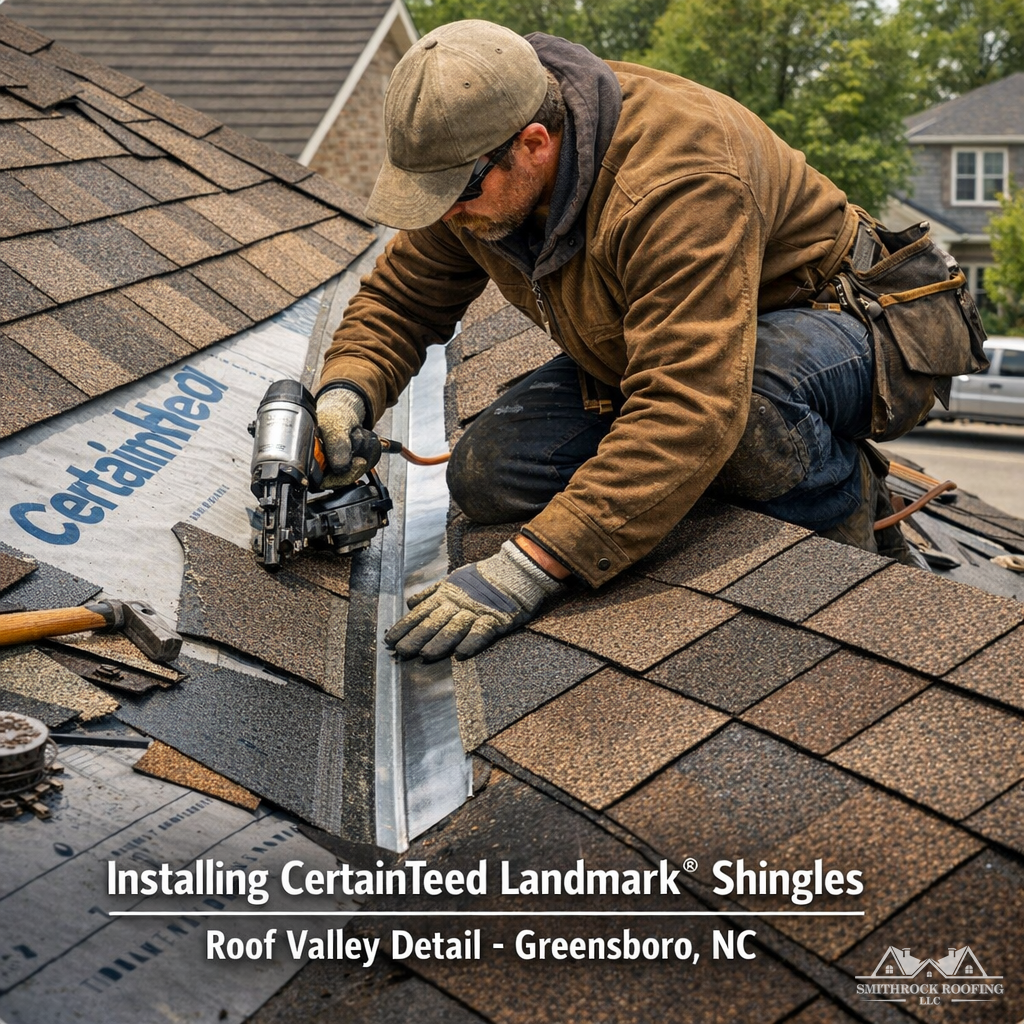
CertainTeed, for example, offers tiered installer certification programs. A PREMIER ShingleMaster-certified contractor — the designation Smithrock Roofing holds — has met verified installation volume and quality standards that allow them to offer the manufacturer’s highest warranty tier to customers. An uncertified contractor installing the same shingles cannot offer the same warranty coverage, even if the product is identical.
This matters for cost because a warranty is only as valuable as its enforceability. A labor warranty and a manufacturer’s limited lifetime warranty from a credentialed installer are materially different documents than a handshake guarantee from an uncredentialed crew.
When evaluating contractors across the Triad, ask specifically:
– Are you licensed and insured in North Carolina?
– What is your manufacturer certification level, and what warranty tier does that allow you to offer?
– Do you pull permits for full replacements in this municipality?
– What does your labor warranty cover, and for how long?
Smithrock Roofing backs every full replacement with a 5-year labor warranty in addition to the manufacturer warranty — because we understand that workmanship failures often don’t show up on day one.
Roof replacement cost in Greensboro and the NC Triad isn’t determined by one variable. It’s the result of how your home’s size, geometry, existing condition, material selection, ventilation needs, insurance situation, and contractor’s credential level interact.
The homeowners who navigate this process most confidently are the ones who walked in knowing what to look for, what to ask, and what a real bid should include. The ones who walk in looking only at the bottom line often discover later that the lower number was lower for a reason.
If you’re ready to have a straightforward conversation about what your specific roof actually needs — from a team that has been doing this work in these neighborhoods for decades — Smithrock Roofing serves Greensboro, Winston-Salem, High Point, Kernersville, Clemmons, Rural Hall, King, and the surrounding Triad communities. We’re here to give you the honest picture, not just a number.
As you move toward a roof replacement decision in the coming months, three steps will put you in the strongest possible position before you sign anything.
1. Request a Documented Inspection Report, Not Just a Verbal Assessment
Many contractors will walk a roof and give you an opinion on the spot. In 2026, the standard should be higher. Ask for a written inspection report that documents deck condition, ventilation measurements, flashing status, and any code concerns specific to your municipality. This report becomes your baseline — and if multiple contractors are reviewing the same home, you’ll be able to compare their findings directly rather than comparing disconnected line items.
2. Verify Contractor Credentials Through the NCRLA and Manufacturer Portals
Before accepting any bid, confirm the contractor’s North Carolina license status through the NC Licensing Board for General Contractors or the NCRLA, and verify their manufacturer certification level directly through the manufacturer’s contractor locator tool. This takes less than ten minutes and eliminates a significant category of risk.
3. Run Your Existing Policy and Any New Bid Through an Independent Insurance Review
If your replacement involves an insurance claim — or if you’re considering updating your coverage after the replacement — have an independent agent review the scope of coverage before work begins. What your current policy covers, and what a new roof might change about your premium or claim eligibility, is worth understanding before you’re in the middle of a process.
The largest variables are the total square footage of your roof, its pitch and complexity, the roofing material you select, the condition of the existing deck and underlayment, and whether the project requires permit fees or ventilation upgrades. Material choice alone can shift the overall scope of a project significantly — architectural shingles, metal roofing, and premium designer products all carry different labor and material profiles. A thorough on-site inspection is the only reliable way to understand how these factors interact on your specific home.
It depends on the cause of damage and the age of your current roof. Most standard homeowner’s policies in North Carolina cover storm and hail damage when documented properly, but many policies have shifted to actual cash value calculations for older roofs rather than full replacement cost. A Greensboro-area roofing contractor who is experienced with the insurance process can help you document damage accurately and communicate directly with your adjuster — which matters more than most homeowners realize before they’re in the middle of a claim.
Start with the basics: a valid North Carolina contractor’s license, active general liability insurance, and workers’ compensation coverage. Beyond that, ask about manufacturer certification level — certified installers have met training and installation volume requirements that allow them to offer higher warranty tiers that uncertified crews cannot. Requesting proof of permits for full replacements and asking for references from recent local projects are also reasonable standards to hold any contractor to before signing an agreement.
Most standard residential replacements in the NC Triad are completed in one to two days under normal weather conditions. Larger homes, complex roof geometries, significant deck repairs, or projects that require additional code-related work can extend that timeline. Seasonal scheduling — particularly during active storm seasons — can also affect lead times, so getting on a contractor’s schedule earlier than you think necessary is generally the better approach.
Choosing the right roofing contractor in the Triad comes down to finding a team that knows these neighborhoods, holds the credentials that protect your investment, and gives you a straight answer about what your roof actually needs. Smithrock Roofing has been doing exactly that for homeowners across Greensboro, High Point, and the broader Triad for decades — and that local experience shows up in every inspection, every installation, and every conversation. When you’re ready to get a clear, honest picture of your roof’s condition and what a proper replacement would involve, Get a Free Estimate and let’s start there.

Smithrock Roofing © Copyright 2026 • All Rights Reserved • Privacy Policy • Maintained by Mongoose Digital Marketing