
If you’ve ever watched water pour over the edge of your gutters during a summer thunderstorm, you already know something isn’t working the way it should. Maybe the gutters are clogged, undersized, or poorly pitched. Maybe the downspouts are dumping runoff directly against your foundation. Whatever the cause, the effect is the same — water ends up somewhere it shouldn’t be, and your home pays the price.
Here in the NC Triad, gutters aren’t just a nice-to-have accessory. They’re a critical line of defense against the specific climate, soil, and tree canopy conditions that Winston-Salem and the surrounding communities throw at a house year-round. The problem is that most gutter content you’ll find online treats every home in every city the same. It gives you a list of services, tells you seamless gutters are great, and calls it a day.
That’s not good enough for a Winston-Salem homeowner trying to make a genuinely informed decision.
This guide goes deeper — covering the local rainfall patterns, soil conditions, tree species, and installation standards that actually determine whether your gutter system protects your home or quietly fails it over time.
Winston-Salem receives approximately 44 to 47 inches of rainfall annually — a figure that sounds manageable until you understand how that rain falls.
The Piedmont Triad is no stranger to convective summer thunderstorms. These are fast-moving, high-intensity events that can drop one to two inches of rain in under 30 minutes. That kind of sudden volume doesn’t give water time to trickle politely through your gutters. It surges. And if your gutter system isn’t sized and configured correctly for those peak-load moments, it will overflow — regardless of how clean it is.
This is the number most homeowners never hear: gutter performance isn’t primarily about annual rainfall. It’s about peak storm intensity, and Winston-Salem’s summer storm pattern is one of the most demanding in the Southeast for residential drainage systems.
The default option for residential gutter installation across most of the country is a 5-inch K-style gutter. On a modest, low-pitch roof with short gutter runs, that may be perfectly adequate. But Winston-Salem’s older neighborhoods — Ardmore, Buena Vista, West End, Sherwood Forest, Sunset Hills — are full of homes with steeper roof pitches, longer eaves, and larger drainage areas that concentrate runoff before it ever reaches the gutter.
On a roof pitched steeper than 6:12, the effective drainage area increases because water accelerates down the slope. A standard 5-inch gutter serving that kind of roof in a high-intensity storm event is frequently undersized. The result: overflow that looks like gutter failure but is actually a sizing problem.
In those situations, 6-inch gutters or high-capacity half-round profiles may be the right answer — not an upsell, but a genuine engineering match for the roof and storm conditions involved.
Proper gutter sizing isn’t guesswork. The industry relies on guidelines published by the Sheet Metal and Air Conditioning Contractors’ National Association (SMACNA) — a technical body whose rainfall intensity tables account for regional storm data. The NC Triad has its own place in those tables, and a contractor sizing your gutters correctly should be referencing that data, not just defaulting to whatever size they happen to stock.
You won’t hear this from most gutter companies in Winston-Salem. But it’s the standard that separates a system designed to perform from one designed to look installed.
Properly sized gutters are only half the equation. Where the water goes after it leaves your downspout matters just as much — and this is where Winston-Salem’s soil conditions create a hidden risk that almost no local competitor discusses.
The Piedmont Triad sits on dense Piedmont clay soils, including the Enon and Iredell soil series that are characteristic of this region. If you’ve ever dug a hole in your yard and hit that red-orange, dense clay layer a few inches down, you’ve met it firsthand.
Here’s the problem: clay soil doesn’t absorb water quickly the way sandy coastal soils do. When a downspout discharges directly against a foundation on clay-heavy ground, the water has nowhere to go straight down. Instead, it spreads laterally along the surface and subsurface, following the path of least resistance — which is often directly toward your foundation wall or under your slab.
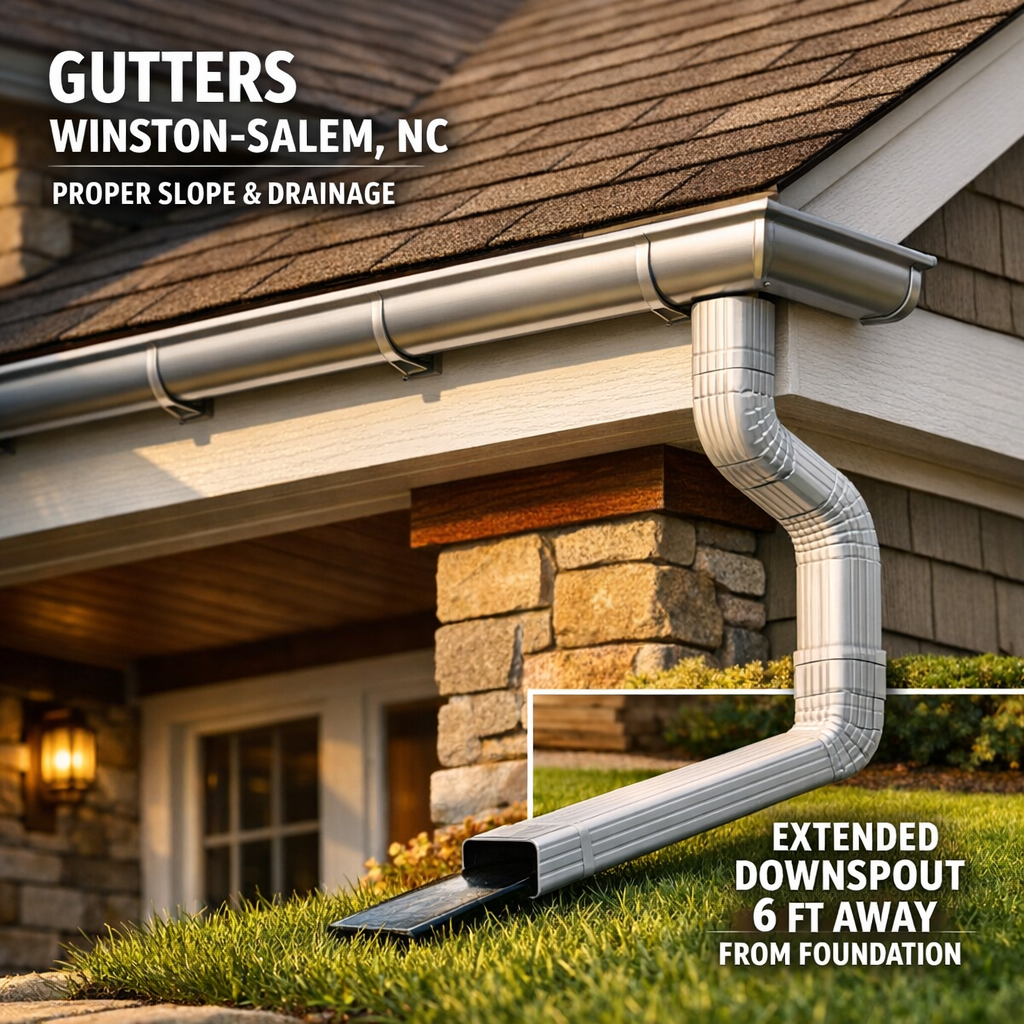
In Winston-Salem’s soil conditions, the standard advice to “extend downspouts away from the foundation” needs a specific number attached to it: a minimum of six feet. That’s the baseline extension length to move water far enough from the foundation that lateral migration back toward the structure becomes less of a concern.
In practice, this means:
Older Winston-Salem homes in neighborhoods like Ardmore, West End, and Buena Vista are particularly vulnerable. Many of these homes have aging foundations, lower grades adjacent to the structure, and original downspout configurations that were never updated. Basement moisture intrusion and crawl space dampness in these areas are frequently traceable back to inadequate downspout management — not a failed waterproofing membrane. For a deeper look at how underground routing can solve persistent drainage problems, the article Bury Your Downspouts: Keep Your Foundation Dry and Your Yard Tidy covers the process in detail.
Winston-Salem has one of the highest urban tree canopy coverages in the NC Piedmont, and the city has made a real effort to protect and expand that canopy. For residents, that means beautiful, shaded neighborhoods. For gutters, it means a debris challenge that runs twelve months a year — not just in the fall.
The key is that different tree species create different debris problems. A gutter guard or cleaning schedule that works well for one yard may be completely wrong for the yard next door, depending on what’s growing nearby.

The gutter guard industry markets products as though one solution fits every home. In Winston-Salem’s tree canopy environment, that’s simply not accurate. Here’s a practical breakdown of how the most common guard types perform against the debris you’re actually likely to see:
| Tree Species | Primary Debris Type | Standard Screen Guard | Micro-Mesh Guard | Open-Face K-Style (No Guard) |
|---|---|---|---|---|
| Willow Oak | Fine needle-like leaves | Poor — debris passes through | Better — mesh traps fine material, but can bridge over time | Poor — fine debris accumulates rapidly |
| White Oak | Large, mat-forming leaves | Moderate — leaves sit on top | Good — sheds most leaves in rain | Poor — mats form at downspout throats |
| Loblolly Pine | Continuous needle shed | Poor — needles slip through or bridge mesh | Moderate — requires regular clearing of surface buildup | Poor — year-round manual cleaning required |
| Sweetgum | Spiky seed balls (gumballs) | Poor — lodge in screen openings | Good — seed balls roll off micro-mesh surface | Poor — block downspout throats regularly |
| Mixed canopy | Multiple debris types | Poor overall | Best overall performance, but not maintenance-free | Highest ongoing maintenance burden |
The honest takeaway from this table: micro-mesh guards perform best in Winston-Salem’s mixed-canopy environment, but they are not maintenance-free. Loblolly pine especially creates a surface buildup on micro-mesh that still needs periodic clearing. Any contractor telling you a guard system eliminates all maintenance in this area isn’t being straight with you. If you’re weighing your options, the article Gutter Guards vs Leaf Guards: Which Is Right for You? breaks down the differences in a way that’s worth reading before you commit to a product.
Every gutter company in Winston-Salem claims to install gutters correctly. Very few explain what that actually involves. Here’s what a professionally installed gutter system requires — and what to ask about if you’re evaluating a contractor.
Gutters need to slope toward their downspouts. That sounds obvious, but the tolerance is tighter than most homeowners realize. The industry standard is a drop of 1/16 inch per linear foot of gutter run. On a 40-foot gutter run, that’s 2.5 inches of total drop from high end to low end — enough to keep water moving without creating a visible sag.
Too little slope and water sits in the gutter. Standing water is a mosquito breeding ground, it accelerates corrosion in aluminum gutters, and it adds weight that loosens hangers over time. Too much slope and the gutter looks visibly tilted, which becomes a real aesthetic concern on a prominent roofline.
Getting this right requires measurement and adjustment during installation — not an eyeball approximation.
Gutter hangers secure the channel to the fascia board. The standard installation interval is every 24 to 36 inches, with tighter spacing in areas that receive heavy debris loads or experience ice. In Winston-Salem, where we do see occasional ice storms, erring toward the tighter end of that range makes sense.
Under-spaced hangers are a common cost-cutting shortcut. Gutters with inadequate hanger support pull away from the fascia progressively — accelerated by the weight of debris, standing water, or ice — until they’re visibly sagging or fully detached.
The generally accepted guideline in the trade is one downspout per 20 to 30 linear feet of gutter, adjusted for roof pitch and drainage area. That ratio shifts when you’re dealing with steeper roof pitches or sections of gutter that receive concentrated runoff from valleys.
A single 2×3-inch downspout serving a valley-fed gutter run — where two roof planes converge and pour toward one point — is undersized by design. Valleys concentrate enormous volumes of water during high-intensity storms, and the downspout serving them needs to reflect that load, either through a larger outlet size or an additional downspout.
This is the issue that separates honest gutter contractors from the ones who just want to close the job quickly: the condition of your fascia board.
Gutters are anchored to the fascia — the horizontal board that runs along the edge of your roofline. In older Winston-Salem homes, especially those built before 1980 in neighborhoods like Ardmore, Sherwood Forest, and Sunset Hills, fascia boards made of wood have often experienced years of moisture exposure. The result is soft, rotted, or delaminated wood that won’t hold a hanger screw properly.
A new gutter hung on compromised fascia will fail. Not eventually — within two to three years, often sooner. The fasteners pull out, the gutter separates, and the homeowner is left wondering why their brand-new installation is already coming apart.
The right process is to assess fascia condition before the first hanger goes in. Where it’s soft or rotted, the board needs to be replaced first. That’s not an upsell — it’s the only way a new gutter installation holds up over time.
Seamless gutters are mentioned by nearly every gutter contractor in the Triad. The explanation for why they outperform sectional gutters is almost never included.
Sectional gutters are assembled from pre-cut lengths joined together with connectors and sealants. Every joint is a potential failure point. In Winston-Salem’s climate — with hot, humid summers and occasional hard freezes — those joint sealants experience significant thermal expansion and contraction cycling throughout the year. Over time, that cycling degrades the sealant bond, and joints begin to separate and leak.
Seamless gutters are fabricated on-site in a single continuous length, custom-fit to your roofline. The only joints in the system are at corners and downspout connections — unavoidable but minimal. Fewer joints means fewer leak points. In a climate that cycles between summer heat and winter ice, that’s a meaningful structural advantage, not a marketing phrase.
Choosing a gutter contractor in the Triad isn’t just about price — it’s about whether the company actually understands what your specific home and property require. A few questions worth asking:
At Smithrock Roofing, we’ve spent decades working on homes throughout Winston-Salem, Greensboro, High Point, Kernersville, Clemmons, Rural Hall, and King. Our gutter services are informed by the same local knowledge we bring to every exterior project — roofing, siding, windows, and custom chimney caps included. That means real conversations about what your specific home needs, not a templated estimate that ignores the oak tree overhanging your roofline or the soft fascia behind your existing gutters.
For homeowners who want to understand more about proper residential drainage standards, the American Iron and Steel Institute’s residential steel framing and drainage resources offer useful technical context on how gutter systems are engineered to perform.
If your gutters are overflowing, pulling away from the fascia, or you simply haven’t had them properly evaluated in a few years, it’s worth getting a qualified set of eyes on the full system — not just the gutters themselves, but the fascia, the downspout routing, and how water is leaving your property.
As you evaluate your home’s gutter system heading into the next year, three steps are worth prioritizing:
1. Schedule a Full Exterior Drainage Audit
Rather than addressing gutters in isolation, ask your contractor to evaluate the complete water management picture — gutters, downspouts, fascia condition, splash block placement, and grading near your foundation. Winston-Salem’s clay-heavy soil makes this holistic review especially valuable before the spring rainy season.
2. Consider a Gutter Protection Assessment
If you have mature trees near your home — particularly the oaks and maples common throughout Forsyth and Guilford Counties — have a professional evaluate whether your current setup, with or without gutter guards, is actually keeping debris out or simply trapping it differently. Not every protection system performs the same way under a heavy leaf canopy.
3. Document Your System Before Problems Surface
Take photos of your gutters, downspout exits, and the area around your foundation after a significant rain. A simple visual record helps any contractor you work with understand your drainage patterns over time — and gives you something concrete to reference when describing issues.
Most homes in the Winston-Salem area benefit from at least two inspections per year — once in late fall after the leaves have dropped and once in early spring before heavier rains arrive. Homes with significant tree coverage or older fascia boards may need more frequent checks. The goal isn’t just cleaning; it’s confirming that hangers are secure, seams are sealed, and water is routing away from your foundation correctly.
If your gutters are pulling away from the fascia repeatedly, showing visible rust or holes, sagging in multiple sections, or overflowing even after cleaning, replacement is often the more practical path. Repeated repairs on a system that’s structurally compromised tend to cost more over time than addressing the root issue. A qualified contractor should also check the fascia behind your gutters — if it’s soft or damaged, that needs to be resolved before any new gutter system is installed.
Yes, significantly. A steeper roof pitch moves water off your surface faster and in greater volume, which means undersized gutters will overflow even when they’re clean. Winston-Salem homes with complex rooflines, multiple valleys, or steep pitches often require 6-inch gutters or larger downspouts to handle peak flow. Contractors who recommend the same size gutter for every home regardless of pitch or run length are skipping an important step in the assessment.
Winston-Salem’s soils have a high clay content, which means water doesn’t absorb quickly into the ground the way it might in sandier regions. If your downspouts are terminating too close to your foundation, or if the grading around your home slopes inward rather than away, you can end up with water pooling against your slab or basement wall over time. Proper downspout extensions — routed to direct water well away from the structure — are a particularly important detail in this area.
Smithrock Roofing has built a reputation across Winston-Salem, Greensboro, High Point, and Kernersville by treating every exterior project — gutters included — as part of the larger picture of how a home holds up against the weather it actually faces. If you’re in the Triad and want a straightforward evaluation of your gutter system from a team that knows local conditions, we’re ready to help. Get a Free Estimate and let’s take a look at what your home needs.

Smithrock Roofing © Copyright 2026 • All Rights Reserved • Privacy Policy • Maintained by Mongoose Digital Marketing