Most homeowners in Winston-Salem don’t think much about their gutters until something goes wrong — water pouring over the front edge during a summer storm, paint peeling off the fascia, or a section of gutter pulling away from the roofline. By that point, the damage is already done, and the question shifts from “should I replace these?” to “how bad is it underneath?”
That’s the honest reality of gutter failure in the NC Triad. What looks like a straightforward swap-out often involves a cascade of connected issues — compromised fascia boards, undersized downspouts, outdated hanger systems — that go unaddressed when a contractor focuses only on the gutter itself.
This guide is designed to help Winston-Salem homeowners understand what’s actually happening when gutters fail, how to evaluate whether repair or full replacement is the right call, and what separates a proper installation from one that will be back in trouble within a few years. We’ll cover the technical realities that most contractors don’t explain — not because it’s complicated, but because taking the time to educate homeowners is simply the right way to do business.
If you live in an older neighborhood in Winston-Salem — Buena Vista, Ardmore, Sherwood Forest, or any of the subdivisions built primarily between the 1970s and 1990s — there’s a good chance your gutters were installed with a spike-and-ferrule hanger system. And there’s an equally good chance those hangers are quietly failing right now, even if you can’t see it yet.
Here’s why.
The spike-and-ferrule system is exactly what it sounds like: a long aluminum spike driven through the front lip of the gutter, through a cylindrical sleeve (the ferrule) inside the gutter, and into the fascia board behind. It’s a simple, inexpensive installation method that was the industry standard for decades.
The problem isn’t the design concept — it’s physics.
Aluminum gutters expand and contract with temperature. In Winston-Salem’s transitional climate — hot, humid summers regularly pushing into the 90s, followed by hard freezes in January and February — a standard 40-foot run of K-style aluminum gutter can expand and contract by up to three-quarters of an inch across a full seasonal cycle. That’s not a flaw in the material; it’s just how aluminum behaves.
A spike-and-ferrule hanger grips the gutter at a single penetration point. Every time the gutter expands slightly in summer heat and contracts in winter cold, that rocking motion works the spike back and forth in the fascia wood. Over 10 to 15 years, the spike essentially carves out a slightly enlarged hole in the fascia fiber. Once the wood can no longer grip the spike, the hanger pulls free — and the section of gutter it was supporting begins to sag, separate, or pull away entirely.
This is not installer negligence. It is the predictable physical outcome of using a static fastener in a dynamic thermal environment.
Because so many homes in the Triad were built in the same general era and installed with the same hanger technology, hanger failure tends to occur across entire neighborhoods at roughly the same age window — not randomly, but as a climate-driven cycle. When your neighbor replaces their gutters, and the house two doors down does the same the following spring, it’s rarely coincidence. It’s the thermal expansion cycle reaching its end point across homes of similar age.
The practical implication: if your home was built between 1970 and 1995 and you’re seeing one or two hangers pull free, it’s worth treating that as a system-wide signal rather than an isolated repair situation. Individual hanger replacement on an aging spike system is often a temporary measure that delays the inevitable.
Hidden hanger systems — where a bracket clips inside the gutter and fastens to the fascia with a screw rather than a spike — distribute load across a wider contact surface and accommodate thermal movement without progressively enlarging the fastener hole. They represent a meaningful upgrade over spike systems for exactly this reason.
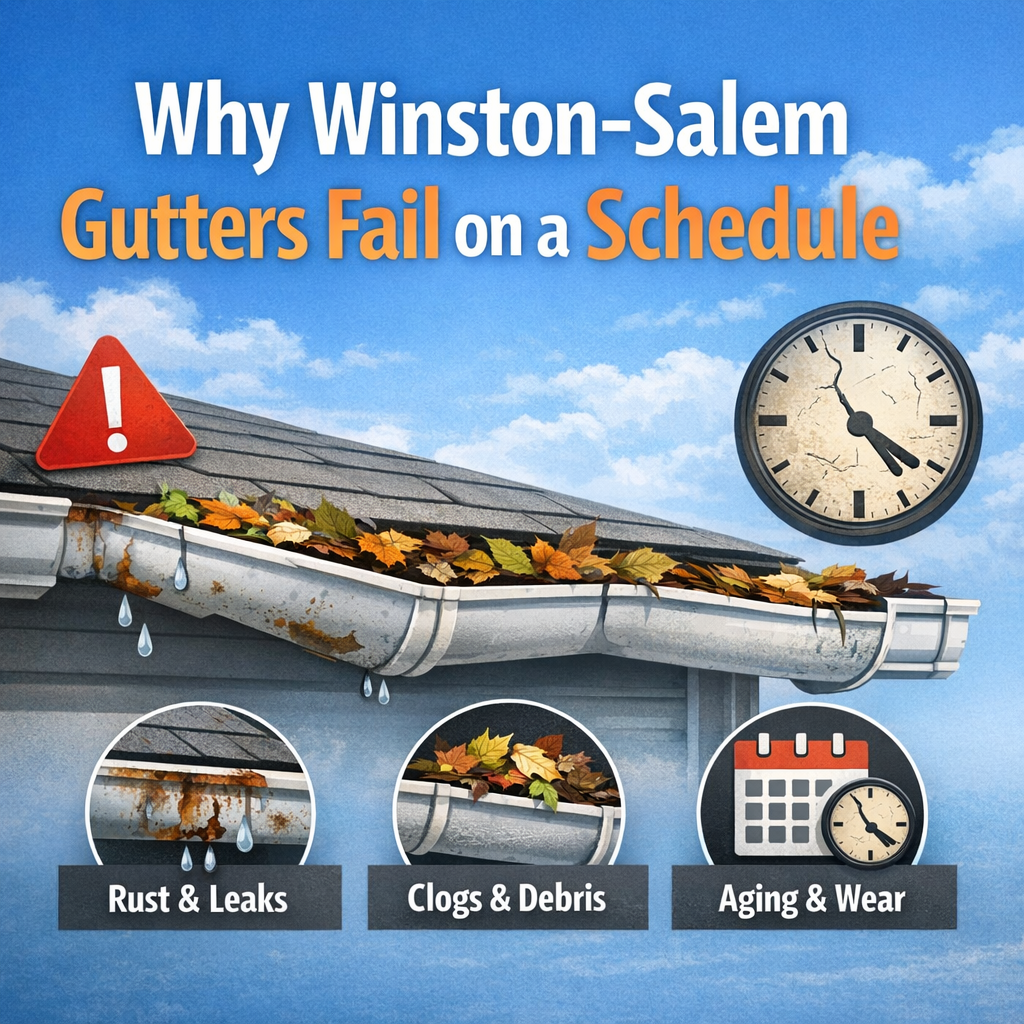
The most common question homeowners ask is simple: do I need to replace everything, or can I get away with repairs? The honest answer depends on four variables working together — and getting the decision right requires evaluating all four, not just the most visible one.
| Variable | Repair May Be Sufficient | Replacement Is Likely Warranted |
|---|---|---|
| System Age | Under 12 years; spike system under 8 years | 15+ years; spike system 10+ years showing multiple failures |
| Material Type | Aluminum or steel in sound structural condition | Vinyl (brittle with age); severely oxidized or dented aluminum |
| Failure Distribution | One or two isolated hangers; single seam separation | Multiple hanger failures across different runs; widespread seam leaking |
| Fascia Condition | Solid, paint-intact, no soft spots on probe | Soft or spongy wood; visible staining; end-grain decay at run low points |
The key insight in this matrix is that no single variable makes the call alone. A 20-year-old gutter with solid fascia and only one failed hanger may legitimately need only a repair. A 10-year-old gutter over rotted fascia may require full replacement — not of the gutter, but of the substrate it mounts to, followed by new gutters regardless of the existing system’s apparent condition.
Isolated failure presents as a single section of gutter pulling away from the fascia, or a visible seam separation at one joint. The surrounding hangers are flush against the gutter lip, the gutter pitch is consistent along the run, and the fascia behind the failed area is sound on probe.
Systemic failure is harder to see from the ground but reveals itself on closer inspection: multiple sections of gutter sitting slightly away from the fascia, inconsistent pitch along the run (water pooling rather than draining), widespread seam staining indicating long-term slow leaks, and fascia paint that is bubbled or peeling in more than one location. When failure is distributed across the system rather than concentrated at one point, individual repairs become an exercise in playing catch-up.
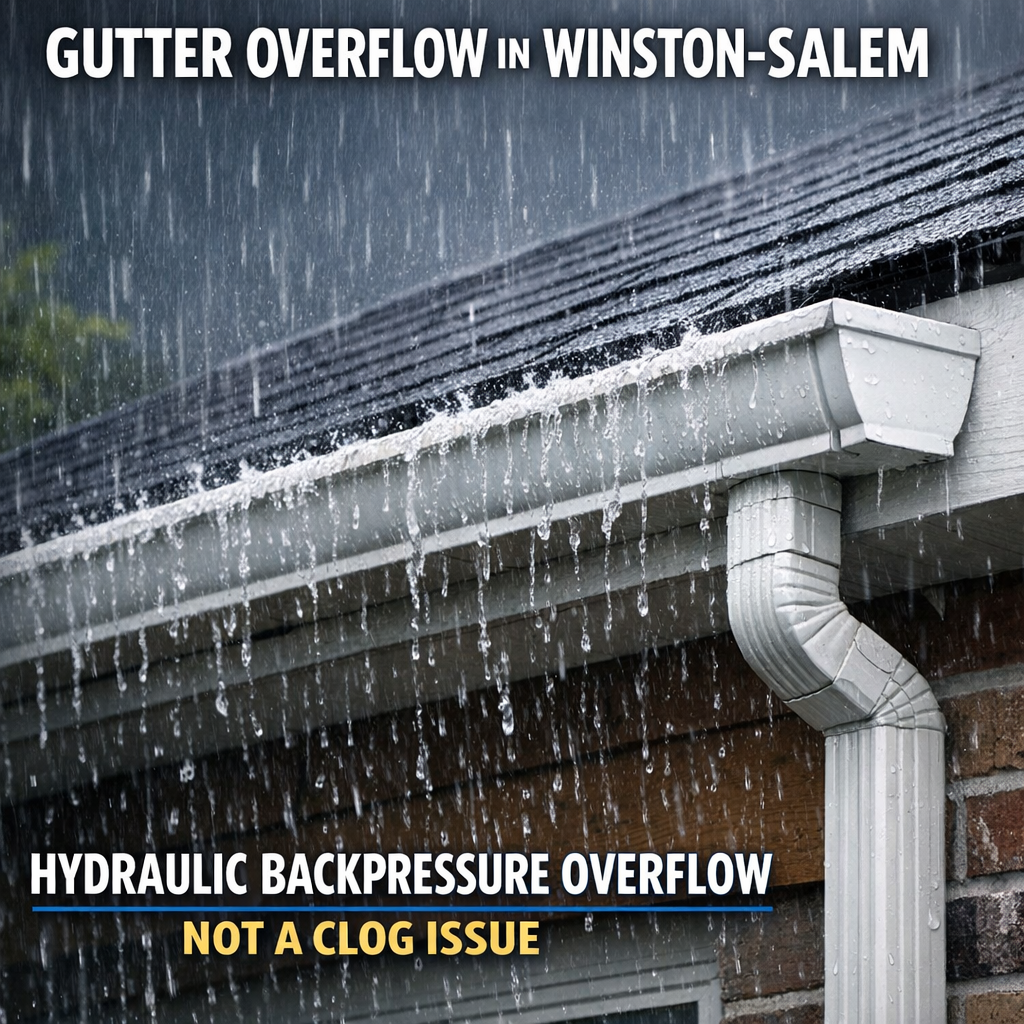
Here is a diagnostic insight that most Winston-Salem homeowners never hear from a contractor: a significant percentage of “overflowing gutter” complaints during heavy rain are not caused by clogged gutters. They’re caused by undersized or restricted downspout outlets creating hydraulic backpressure within the gutter run.
When a downspout outlet is too small relative to the volume of water being collected from the roof drainage plane, water can’t exit the system fast enough. It backs up within the gutter run and eventually crests over the front lip — often in a smooth, consistent sheet along the downslope section of the run.
This looks almost identical to overflow caused by debris blockage. The difference is in the pattern:
Cleaning gutters that are already clean — because the real problem is downspout sizing — is a frustrating and expensive lesson that many homeowners learn the hard way.
Industry standards provide clear guidance that many original Triad-area installations simply didn’t follow:
Many homes built across Winston-Salem, Kernersville, and High Point in the 1970s and 1980s were installed with downspout spacing of 50 to 60 feet — structurally inadequate under the convective storm conditions that the NC Piedmont regularly produces in spring and summer. If your gutters overflow during heavy rain and cleaning hasn’t resolved it, downspout outlet sizing should be calculated and verified before any other work is authorized. For a deeper look at how downspout discharge affects your foundation over time, the article Bury Your Downspouts: Keep Your Foundation Dry and Your Yard Tidy covers the topic in useful detail.
New gutters installed over compromised fascia will fail faster than the system they replaced. This is the sequencing reality that most replacement conversations skip entirely — and it’s one of the most consequential things a homeowner can understand before signing any contract.
Original wood fascia on Winston-Salem homes built between roughly 1965 and 1995 is typically nominal 1-inch pine. It performs well when properly painted and maintained. But when gutter sealant fails and water pools at the low end of a gutter run — which it will, because water always finds the low point — that moisture begins infiltrating the end grain of the fascia board.
The decay pattern is predictable and frequently underestimated on visual inspection:
A probe test — pressing a screwdriver or awl firmly against the face of the fascia at multiple points along the run — is the reliable diagnostic. Sound wood will resist; compromised wood will allow penetration without significant force.
If fascia replacement is warranted, the material selected has direct implications for how the new gutter system should be installed. This is a detail that genuinely matters and that few contractors discuss openly.
Nominal Wood (Pine or Similar)
– Traditional replacement in kind
– Holds screws and hanger fasteners well when properly seasoned
– Requires painting and ongoing maintenance to prevent recurrence
– Hidden hanger spacing: standard 24-inch intervals are appropriate
PVC Cellular Trim Board
– Moisture-impervious — will not rot regardless of water exposure
– Requires pre-drilling before fastener installation to prevent face-cracking
– Holds screws adequately but does not grip as aggressively as dense-grain wood
– Hanger spacing should be reduced to 18-inch intervals with appropriately sized screws to compensate for reduced holding power
– Has a higher thermal expansion coefficient than wood — relevant for long runs in full sun exposure
Composite Trim Board
– Midpoint between wood and PVC in terms of fastener performance
– More dimensionally stable than wood across seasonal moisture cycles
– Appropriate for standard hanger spacing in most applications
The reason this matters: a contractor who installs new gutters over fresh PVC fascia using the same hanger spacing and fastener type as the previous wood system may be creating a new failure point before the first rainy season is over. The material changed; the installation method should account for it.
When a contractor recommends a specific gutter profile, there should be reasoning behind it — not just “that’s what we use.” The two primary residential profiles have genuinely different performance characteristics that align differently with the housing stock common across the NC Triad.
K-style gutters — named for the profile shape of their back and front faces — have a flat back that mounts directly against the fascia, an ogee-shaped front face, and a flat bottom. They’re the dominant residential gutter profile across the Triad for several practical reasons:
The trade-off: the internal corners of K-style gutters accumulate debris more readily than the smooth interior of half-round profiles. This makes gutter guard compatibility a more relevant consideration for K-style systems on lots with significant tree canopy — which describes much of older Winston-Salem. If you’re weighing your options, the article Gutter Guards vs Leaf Guards: Which Is Right for You? breaks down the practical differences worth understanding before you decide.
Half-round gutters are exactly what the name suggests — a semicircular trough that allows debris to pass through more freely and self-cleans somewhat better under normal rainfall. They are the historically appropriate choice for homes with:
For most Winston-Salem homeowners replacing standard aluminum systems on homes built after 1960, K-style 6-inch is the technically appropriate recommendation. But if you’re on a home with architectural character that calls for half-round — particularly in neighborhoods with pre-war housing stock — that’s a conversation worth having with your contractor rather than defaulting to whatever’s fastest to fabricate.
Before any replacement decision is finalized, a thorough inspection should evaluate seven distinct components — not just the gutter trough itself. If a contractor provides a replacement recommendation based on a visual assessment from the ground, that’s not sufficient basis for a decision.
Hanger system type and failure distribution — Are failures isolated or systemic? Are existing hangers spike-and-ferrule or hidden hanger? What is the current hanger spacing, and is it appropriate for the fascia material present?
Gutter pitch and slope consistency — A properly installed gutter slopes toward the downspout at roughly one-quarter inch per 10 linear feet. Standing water in the gutter trough (visible as a waterline stain) indicates incorrect pitch, which may be a fascia deflection issue rather than a gutter problem.
Seam condition on sectional systems — Where seams exist, are they weeping, stained, or separated? Seam failure is the primary failure mode in sectional aluminum systems and is the core argument for seamless fabrication.
Fascia board condition along the full run — Probe test at minimum three points per run: both ends and the midpoint. Pay particular attention to the low end, where water pools longest.
Soffit condition adjacent to the gutter line — Soffit damage adjacent to failing gutters often indicates that water has been overtopping the gutter and running behind it. If soffit is compromised, the repair scope expands.
Drip edge integration — New gutters should be installed so that the drip edge at the roofline sheds water into the gutter, not behind it. On older homes, drip edge may be absent or incorrectly positioned, requiring roofing-line work before new gutters can be properly positioned.
Downspout outlet sizing, spacing, and discharge termination — Are outlets sized for the roof drainage plane they’re collecting? Where do downspouts terminate — against the foundation, into underground drainage, or at a splash block? Foundation-adjacent termination without adequate grade slope away from the home redirects the problem rather than solving it.
Contractors across Winston-Salem will recommend seamless gutters as a matter of course. That recommendation is correct — but homeowners deserve to understand why, not just be told to trust it.
Sectional gutter systems are manufactured in fixed lengths — typically 10 to 12 feet — and joined at seams with sealant. Every seam is a potential failure point. Sealant degrades over time with UV exposure and thermal cycling. As sealant fails, seams weep, then open, then allow water to contact the fascia directly at the joint location — exactly the scenario that drives wood decay.
Seamless gutters are fabricated on-site from a continuous coil of aluminum, cut to the precise length of each run without joints (except at corners and downspout connections, which are unavoidable). The elimination of mid-run seams removes the primary failure mechanism of sectional systems. For a home in Winston-Salem with multiple long runs — say, across the full width of the rear roofline — the difference between one seam and eight seams over a 20-year service life is not trivial.
The on-site fabrication process also allows the gutter to be cut to exact length, which means no cutting, trimming, or fitting in the field that could compromise the material.
At Smithrock Roofing, we’ve been working on homes across Winston-Salem, Greensboro, High Point, Kernersville, Clemmons, Rural Hall, and King long enough to understand the specific challenges the Triad climate creates for exterior systems. Our team brings over 60 combined years of experience to every inspection — and that experience means we don’t just look at the gutter. We evaluate the full system: fascia condition, hanger integrity, downspout sizing, drip edge position, and discharge termination, before we make any recommendation.
Our approach is straightforward. We tell you what we find, explain what it means, and let you make an informed decision. No pressure, no overselling, no replacement recommendations for systems that genuinely only need a repair.
For further reference on industry standards for gutter installation and performance, the Sheet Metal and Air Conditioning Contractors’ National Association (SMACNA) publishes installation guidelines used by professional contractors across the industry. The National Roofing Contractors Association (NRCA) also provides technical guidance relevant to drip edge integration and roofline water management.
If your gutters are showing signs of failure — or if you simply haven’t had them properly inspected in several years — contact Smithrock Roofing for a thorough evaluation. We serve the full NC Triad area and we’ll give you a straight answer about what your home actually needs.
As gutter systems across the Triad continue to age and Piedmont weather patterns remain demanding, here are three specific steps worth taking in the year ahead:
1. Schedule a Full Roofline Inspection Before Spring Storm Season
Winter freeze-thaw cycles in Winston-Salem put real stress on hangers, seams, and fascia boards. Before the heavy spring rainfall arrives, arrange a comprehensive inspection that covers not just the gutters themselves but the drip edge alignment, fascia integrity, and downspout discharge points. Problems caught in late winter are almost always simpler to correct than failures discovered mid-storm season.
2. Evaluate Your Downspout Discharge Strategy
Many homes in the Triad were built with downspouts that terminate too close to the foundation. In 2026, consider having your discharge points evaluated for extension, underground routing, or redirection to areas where water can dissipate safely away from the structure. This single improvement prevents a significant share of the foundation moisture problems we see repeatedly across Winston-Salem and Kernersville neighborhoods.
3. Transition Any Remaining Sectional Systems to Seamless
If your home still has older sectional gutters with visible lap joints and sealant patches, 2026 is a practical window to replace them before accumulated joint failures accelerate water intrusion into the fascia and soffit. Seamless aluminum gutters fabricated on-site offer a service life that sectional systems simply cannot match over the long run, particularly given Triad rainfall totals.
The honest answer depends on what the inspection reveals rather than the age of the system alone. Localized damage — a single cracked joint, one section pulling away from the fascia — is often repairable. But widespread sagging, extensive sealant failure at multiple seams, rust penetration through the gutter floor, or fascia rot behind the system typically indicates that repair is working against diminishing returns. A thorough inspection that evaluates the full roofline system, not just the visible gutter face, is the only reliable way to make that determination.
The Triad region receives meaningful rainfall across all four seasons, and that sustained exposure stresses every joint in a sectional system over time. Seamless gutters eliminate the lap joints where sealant eventually breaks down and leaks begin. Because seamless gutters are fabricated in a single continuous run on-site, there are no seams along the horizontal lengths — only at the corners and downspout connections — which dramatically reduces the points where failure can originate.
Most residential applications in this region use either 5-inch or 6-inch K-style gutters, with the right choice depending on roof pitch, drainage area, and the intensity of rainfall the system needs to handle. Homes with steep roof pitches or large roof planes generate significantly higher water volume during heavy storms, which can overwhelm a 5-inch system that might be perfectly adequate on a different roofline. Downspout sizing and spacing matter equally — an undersized or poorly positioned downspout creates backflow conditions even when the gutter itself is appropriately sized.
For most single-family homes in the Winston-Salem area, a full gutter replacement can be completed in a single day. The seamless fabrication process happens on-site using a portable roll-forming machine, so material is cut to exact length and installed efficiently without extended lead times. Homes with complex rooflines, multiple stories, or significant fascia repair work needed before installation may require additional time, but your contractor should be able to give you a clear timeline after the initial inspection.
When your home needs gutter replacement done right — with honest assessment, quality materials, and workmanship that holds up through years of Piedmont weather — Smithrock Roofing brings the experience and local knowledge that Winston-Salem and Greensboro homeowners can rely on. We’ve built our reputation across the NC Triad by giving straight answers and doing thorough work, and that’s exactly what you’ll get from the first inspection through the final downspout connection. Reach out today and let us take a proper look at your system — Get a Free Estimate and we’ll tell you exactly what your home needs.

Smithrock Roofing © Copyright 2026 • All Rights Reserved • Privacy Policy • Maintained by Mongoose Digital Marketing