Replacing a roof is one of the largest single investments a homeowner makes. It is also one of the most opaque. You call a few contractors, three people walk your roof for twenty minutes each, and then you receive quotes that may vary by a significant margin — with no clear explanation of why. That uncertainty is not your fault. It exists because most of the information available to homeowners on this topic stops well short of actually explaining what is happening on the contractor’s side of the table.
This guide is different. Rather than presenting a table of material types with price ranges attached — information that is already everywhere and helps very little when you are standing in your driveway comparing two bids — we are going to walk you through the mechanics that actually drive what you pay. By the time you finish reading, you will understand how estimates are built, what predictably causes projects to grow in scope, how building codes interact with your project, and what the smart way to evaluate competing quotes actually looks like.
We serve homeowners across Winston-Salem, Greensboro, High Point, Kernersville, Clemmons, Rural Hall, King, and the surrounding NC Triad communities. The specifics in this article reflect the real-world conditions and local market realities our crews work in every day.
This is the question homeowners almost never get a straight answer to. You show two contractors the same 2,000-square-foot ranch house, give them the same afternoon, and receive quotes that leave you wondering if they even looked at the same structure. Here is what is actually happening.
Every professional roofing estimate is a construction of individual line items, not a single number arrived at by eyeballing the square footage and multiplying. Understanding those components shifts you from a passive quote recipient to an informed buyer.
Material quantity with waste factor built in. No experienced contractor quotes material at exact square footage. Industry standard practice adds a waste factor — typically in the range of ten to fifteen percent — to account for cutting around valleys, hips, ridges, and penetrations. A contractor who skips this is either gambling on running short or planning to stretch materials thin. Both outcomes hurt you.
Material tier selection. Not all shingles are equivalent, even within the same product category. Architectural shingles, for example, vary considerably by manufacturer quality, wind resistance rating, and warranty terms. A contractor using a premium product like CertainTeed Landmark shingles is quoting against a different cost basis than one sourcing from a mid-tier distributor. The visual result on day one may look similar. The performance difference shows up over years.
Crew composition and travel overhead. A roofing crew is not a uniform unit. The number of workers, their experience levels, and how far they are traveling from a home base all factor into the labor portion of a bid. Larger, established companies with local crews carry different overhead structures than small operations that subcontract labor project by project.
Subcontractor markup chains. Some contractors you call are general coordinators who hire subcontracted roofing crews. That arrangement adds a markup layer. It does not automatically mean worse work, but it does mean a portion of your payment is covering coordination rather than installation. Knowing whether the crew on your roof works directly for the company you hired is a reasonable question.
Profit margin by company size and market position. A two-person operation working out of a pickup truck has lower overhead and may quote a tighter margin — but also carries different risk if a warranty claim arises years later. An established company with a physical office, a service department, and a reputation to protect builds a different margin structure into its bids for good reason.
When two quotes look dramatically different, those are the variables at work. Before assuming the lower number is the better deal, it is worth understanding which of those line items accounts for the gap.
Every article on this topic lists the same factors. We are going to go a level deeper on each one.
Roofing is measured in squares — one roofing square equals one hundred square feet of surface area. Your roof surface area is not the same as your home’s footprint. A ranch house with a steep-pitched roof may have significantly more measurable surface area than its floor plan suggests. Contractors use a combination of on-site measurement and satellite measurement tools to arrive at a precise square count. The accuracy of that measurement is the foundation of a reliable bid.
This is where most homeowners focus their comparison — and where most articles give you a table and leave you to figure out what it means. Here is the framework that actually matters.
Instead of comparing the upfront price of two materials, compare the annualized cost: what the total project cost divided by the expected service life produces as a cost-per-year figure. A material that costs meaningfully more but lasts twice as long frequently produces a lower annualized cost than the budget option. This calculation changes the entire framing of the material decision.
| Material Type | Typical Service Life | Key Performance Factors for NC Triad Climate |
|---|---|---|
| Architectural Asphalt (Standard) | 20–30 years | Good baseline performance; quality varies significantly by manufacturer |
| Architectural Asphalt (Premium, e.g. CertainTeed Landmark) | 30+ years | Higher wind resistance, algae resistance; better suited to NC humidity and storm exposure |
| Metal (Standing Seam) | 40–70 years | Exceptional longevity; performs well in wind and hail; higher upfront, strong annualized value |
| Metal (Exposed Fastener) | 25–40 years | Lower entry point than standing seam; fasteners require periodic inspection |
| Concrete / Composite Tile | 30–50 years | Heavy; requires structural assessment; excellent durability in varied climates |
| Natural Slate | 75–100+ years | Exceptional lifespan; very heavy; premium installation skill required; highest upfront cost |
| Wood Shake | 20–30 years | Aesthetic appeal; requires maintenance; fire rating considerations in some jurisdictions |
The NC Triad sits in a climate zone that sees hot, humid summers, occasional remnant tropical storm wind events, periodic hail, and cold snaps in winter. Premium architectural shingles with high wind ratings are the floor for responsible material selection in this market — not an upgrade.
Every cost article mentions complexity as a factor. Very few define it usefully. Contractors assess complexity by counting and categorizing the following elements:
A simple gable roof — two planes meeting at a single ridge — is the fastest and most economical configuration to replace. A house with multiple dormers, a chimney, several plumbing penetrations, and a hip-and-valley structure on a steep pitch is a fundamentally different labor proposition. The more penetrations and directional changes, the more hand-work required — and hand-work costs time.
Roof pitch is expressed as a ratio — the number of inches of vertical rise per twelve inches of horizontal run. A 4:12 pitch is walkable for an experienced crew. A 9:12 or steeper requires safety rigging, slower movement, and different equipment. That is not just a safety consideration; it is a direct productivity impact that properly shows up in labor cost.
The Triad is a competitive roofing market with a healthy concentration of contractors — which is generally good for homeowners seeking multiple bids. However, labor pricing is not static. After a major hail event moves through Guilford, Forsyth, or Davidson County, demand for qualified roofing crews spikes sharply in a compressed window. During those periods, the same job that might take three weeks to schedule in a normal month can face a six-to-eight-week backlog, and contractors working at capacity have less pricing flexibility in the homeowner’s favor. Timing your replacement outside of storm-recovery demand spikes — when possible — is a real strategic consideration.
This is the piece most homeowners never hear until they are already in the middle of a project, which is the worst possible time to hear it. Understanding this before you sign a contract changes your experience significantly.
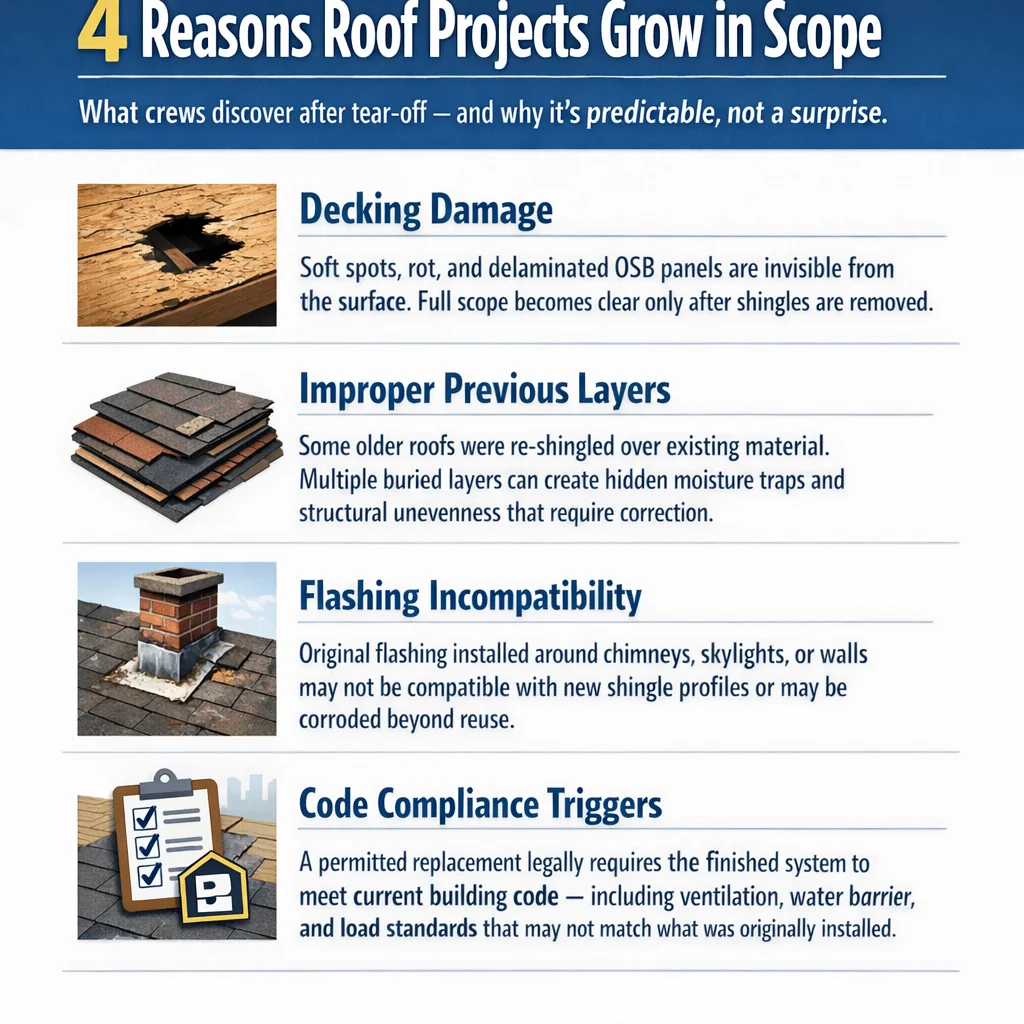
Your roof deck — typically OSB panels or plywood — is the structural substrate that everything else attaches to. Its condition is not fully assessable from the outside. Soft spots visible from the attic, surface delamination in OSB, or areas of rot hidden beneath seemingly intact shingles become apparent only after tear-off begins.
Experienced contractors develop a strong working sense of what they expect to find based on the age of the roof, the home’s attic ventilation history, and visible exterior indicators. But even the most thorough initial assessment cannot guarantee a final number before the existing material comes off. What separates professional contractors from less experienced ones is whether they explain this reality honestly before work begins — including how they price additional decking repair if it is needed — rather than presenting it as a surprise change order mid-project.
Common decking failure patterns:
A reputable contractor will walk you through what they found and show you the affected areas before proceeding. That is not a contractor trying to pad a bill — it is the professional standard.
Attic ventilation directly affects shingle longevity. Inadequate ventilation causes heat and moisture to build up beneath the deck, which accelerates shingle degradation from below while outdoor weather attacks from above. Many older homes in the NC Triad — particularly those built in the 1970s and 1980s — were constructed before modern ventilation standards became routine.
When a full replacement is underway, a professional crew will identify ventilation deficiencies that were not visible without the roof being open. Correcting them at that stage is far more efficient than addressing them separately. Leaving them uncorrected means a new premium roof is operating in the same conditions that degraded the old one. Our article on roof vent installation cost and what drives the price breaks down what addressing those deficiencies typically involves and costs.
This is one of the most consistently overlooked topics in roof replacement guidance, and it has real consequences for project scope and total cost.
In most jurisdictions across Forsyth, Guilford, and Davidson Counties, a full roof replacement requires a building permit. The permit is not merely a fee — it is a legal declaration that the finished work will meet current applicable building codes. That distinction matters because codes are updated on a cycle, and the standards in effect when your home was originally built may differ substantially from what is required today.
When a permit is pulled for a roof replacement, the following categories are commonly subject to current code requirements — even if they were not part of the original scope:
Ventilation standards under current IRC requirements. The International Residential Code specifies ventilation ratios for attic spaces. If your current ventilation falls below those ratios, a compliant replacement must address it. This is not an optional upgrade; it is a code-required scope item.
Secondary water barrier requirements. Modern roofing codes in North Carolina often require a self-adhering underlayment at eaves, in valleys, and around penetrations — providing a water-resistant layer below the shingles. Homes built before this was standard code will require this added layer as part of a permitted replacement.
Load-bearing assessments for material changes. If you are transitioning from lightweight asphalt shingles to a significantly heavier material — tile or slate — a structural assessment of your rafter and decking system may be required to confirm adequate load capacity. The permit process is where this gets surfaced and documented.
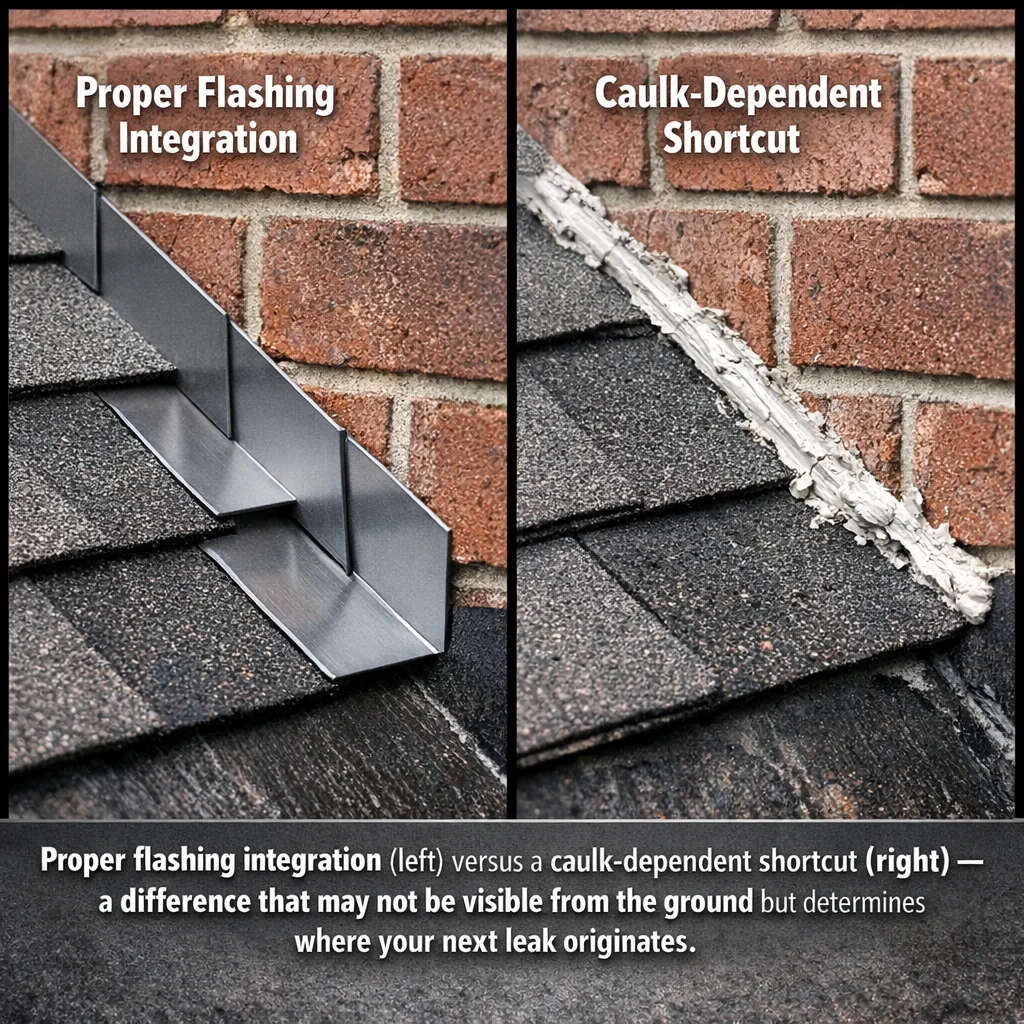
Flashing and edge detail standards. Current code specifies how flashing must be integrated at walls, chimneys, and penetrations. If existing flashing does not meet those standards, a compliant permitted job cannot leave it in place.
The takeaway here is not that permits are a problem — they are a protection for you. A permitted job means an inspector verifies that your roof meets code. An unpermitted job means you take on that uncertainty yourself, which surfaces at the worst time: during a home sale inspection or an insurance claim. The right contractor pulls permits as a matter of professional standard, not as an optional extra.
Most homeowners approach competing quotes by looking at the final number and picking the middle one. That approach leaves significant quality risk on the table. Here is a more useful framework.
1. Who is the crew that will be on my roof?
Are they direct employees of the company, or a subcontracted team? What is their experience with the specific material being installed? This is not a hostile question — it is a basic professional inquiry.
2. What is your approach to decking repair if damage is found during tear-off?
A professional contractor should have a clear, pre-established answer: typically a per-sheet price for replacement that is disclosed before work begins. Vague answers here are a flag.
3. What underlayment system are you specifying?
Standard felt underlayment and a synthetic underlayment system are not equivalent. Premium installations include self-adhering membrane at vulnerable points. Ask what is in the bid.
4. Are you pulling a permit for this project?
The answer should be yes for a full replacement. A contractor who routinely skips permits is either unaware of or indifferent to local code requirements — neither of which belongs on your roof.
5. What does your warranty actually cover, and who backs it?
Manufacturer warranties cover materials. Labor warranties cover the installation. These are separate. Ask what the labor warranty period is and get it in writing. At Smithrock Roofing, we stand behind our installation work with a five-year labor warranty, backed by the craftsmanship credentials of our CertainTeed PREMIER ShingleMaster certification — because the quality of the installation is just as important as the quality of the materials we use.
Different homeowners face genuinely different priority structures. Before contacting a single contractor, it is worth knowing where you fall.
If your roof is approaching or past its expected service life: Material longevity and annualized cost per year of service should be your primary comparison axis. Saving on material tier here is a short-term calculation with a long-term cost.
If your home is in a high-wind or hail-exposure area: Wind resistance ratings and impact resistance classifications on shingles matter more than aesthetic options. The NC Triad’s position in a region that periodically sees remnant tropical activity makes this a relevant consideration for most homeowners here.
If you are planning to sell the home within five to ten years: Warranty transferability and buyer perception of the roofing brand both become relevant factors. A known, reputable manufacturer and a transferable warranty add documentable value to the transaction.
If your home has a complex structure with multiple penetrations: Labor quality and crew experience with detailed flashing work should weigh heavily. This is where installation skill variation produces the largest performance difference.
If you have any reason to suspect existing ventilation or decking issues: Start with a thorough assessment conversation before price is even the topic. Understanding the full scope before you receive a bid is the only way to compare bids on equal footing.
Two bids can specify identical material. The installation can still produce completely different outcomes over a ten-year horizon. This is the most uncomfortable truth in roofing for homeowners, because there is no line item on a quote that says “installation quality.”
What determines installation quality in practice:
Nail placement depth and pattern — Improper nailing is the leading cause of shingle blow-off in high-wind events. Nails driven too deep cut through the shingle mat; nails driven too shallow create a raised fastener that compromises the shingle above it. Correct nail placement follows manufacturer specifications for both depth and placement zone — a detail that is invisible from the street on day one and fully visible after the first major storm.
Shingle alignment and exposure consistency — Beyond aesthetics, inconsistent exposure affects water-shedding performance. Shingles that drift in alignment over a roof section create irregular water paths.
Starter strip and edge installation — The first course of a shingle installation is disproportionately important to long-term performance at the eave and rake edges. Cutting corners here is one of the most common places budget installations save time.
Flashing integration technique — Step flashing at wall junctions, counter-flashing at chimneys, and collar flashing at penetrations are the most common origin points for roof leaks when done incorrectly. Correct flashing is a trained skill, not a finishing detail. Our article on roof repair around chimneys and how to fix leaks that last covers in detail why this is where inferior installations fail first.
At Smithrock Roofing, our 60-plus combined years of experience in this region means our crews have handled the full range of NC Triad roof conditions — from straightforward gables on new construction to complex historic Craftsman homes in Winston-Salem neighborhoods with multiple dormers, original brick chimneys, and decades of previous installation layers to work through. CertainTeed PREMIER ShingleMaster certification is not a marketing designation — it reflects verified installation training and quality standards that CertainTeed monitors through actual project reviews.
The goal of this entire guide is to get you to a place where you can walk into contractor conversations as an informed homeowner rather than an anxious one. You now understand how bids are built, what causes projects to expand, how the permit process interacts with your project scope, and how to evaluate quality factors that never appear on a quote sheet.
When you are ready to talk through your specific roof — whether you are in Winston-Salem, Greensboro, High Point, Kernersville, Clemmons, Rural Hall, or anywhere across the NC Triad — our team is here for a straightforward conversation. No pressure, no upsell, just an honest assessment of what your home needs and what that involves. That is how we have earned 312-plus five-star reviews, and it is how we intend to keep earning them.
If your roof is showing signs of age or you are actively planning a replacement for the coming year, these three actions will put you in the strongest possible position before you ever speak with a contractor.
1. Request a professional inspection before soliciting bids. A documented inspection — separate from any contractor’s sales visit — gives you an independent baseline. You will know the current condition of your decking, existing flashing, ventilation, and underlayment before anyone hands you a quote. That knowledge protects you from surprise scope expansions and gives you leverage to ask the right questions.
2. Pull your home’s permit history through your county building department. In Forsyth, Guilford, and surrounding NC Triad counties, permit records are often accessible online. Knowing whether your previous roof installation was permitted and inspected tells you something important about the quality of work that is already under your current shingles — and helps your contractor anticipate what they may encounter.
3. Research your shingle manufacturer’s warranty terms before you choose a product. Not all limited lifetime warranties are structured the same way. Transferability, workmanship coverage, and wind or algae resistance provisions vary significantly between product lines. Understanding those terms before your installation means you are choosing a product intentionally rather than defaulting to whatever a contractor recommends without context.
Most standard residential roof replacements in the Winston-Salem and Greensboro area are completed in one to two days for straightforward gable configurations. More complex rooflines — homes with multiple dormers, steep pitches, chimneys, or significant accessory structures — can extend that timeline. Weather windows also play a role, particularly in spring and fall when afternoon storms are common across the Piedmont. Your contractor should give you a realistic project window, not just an optimistic best-case day count.
Insurance coverage for roofs depends entirely on the cause of damage and the specific terms of your policy. Sudden storm damage from wind, hail, or fallen trees is commonly covered, while damage that develops gradually from wear, age, or deferred maintenance generally is not. Policies also vary in whether they pay actual cash value — which accounts for depreciation — or replacement cost value. Before assuming your replacement will be covered, review your policy directly and have a candid conversation with your insurance agent about what documentation they require.
An estimate is a preliminary projection of scope and cost based on a visual assessment. A contract is a legally binding document that should specify the exact materials being installed including manufacturer and product line, the scope of labor, how unforeseen conditions like decking replacement will be handled and priced, the payment schedule, warranty terms for both materials and workmanship, and the contractor’s licensing and insurance information. Never authorize work to begin based on an estimate alone. A reputable contractor will provide a clear written contract before any materials are ordered or work begins.
The honest answer is that this depends on several factors that require an in-person assessment: the age of the existing roof relative to its expected lifespan, the extent and distribution of damaged areas, the condition of the underlayment and decking beneath the shingles, and whether existing flashing is salvageable. Isolated damage on an otherwise sound roof that still has meaningful life remaining is often a legitimate repair candidate. Widespread granule loss, systemic moisture intrusion, sagging areas, or a roof that is already beyond its design lifespan typically points toward replacement as the more cost-effective long-term decision. Our article on roof repair vs. replacement and how to choose walks through the specific criteria that separate a repair situation from a replacement situation. A qualified inspector can give you an honest read on which situation you are actually facing.
Smithrock Roofing has built its reputation one honest conversation at a time, serving homeowners across Winston-Salem, Greensboro, High Point, Kernersville, and the broader NC Triad with the kind of straightforward guidance and verified installation quality that holds up long after the crew has left your driveway. If your roof is on your mind — whether that means a question, an inspection, or a full replacement estimate — we are ready to help you move forward with confidence. Get a Free Estimate and find out exactly what your home needs from a team that will give you a straight answer.

Smithrock Roofing © Copyright 2026 • All Rights Reserved • Privacy Policy • Maintained by Mongoose Digital Marketing