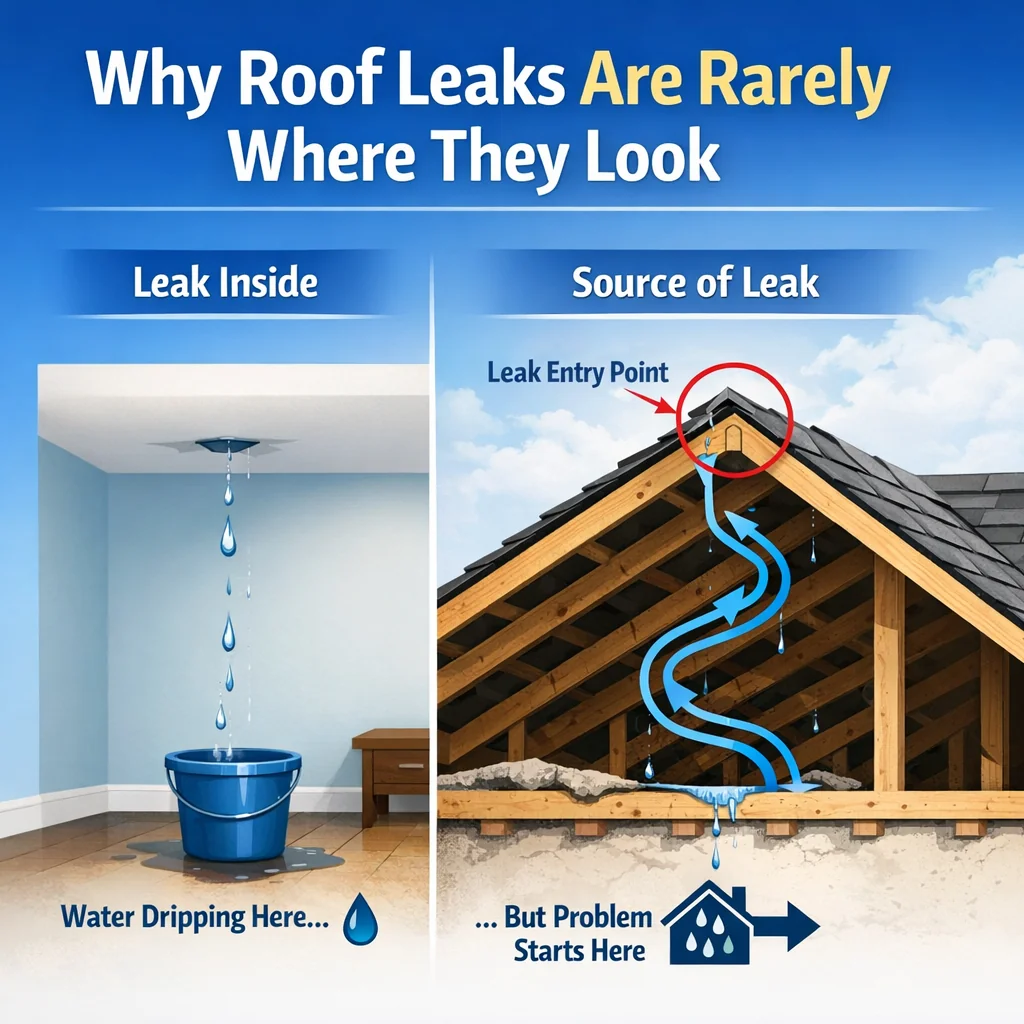
A roof leak starts small and gets worse quietly. Water finds the path of least resistance through your roofing system, travels horizontally across sheathing, and eventually shows up as a stain, a drip, or a soft spot somewhere that may have nothing to do with where the breach actually is. By the time you notice it inside the house, the damage has usually been building for longer than it looks.
This article explains how qualified roof leak repair contractors find the real source of a leak, how they decide whether repair or replacement is the right answer, and what you should verify before you hire anyone. If you are a homeowner in Winston-Salem, Greensboro, High Point, Kernersville, Clemmons, Rural Hall, King, or anywhere else in the NC Triad, this is the information you need before you make that call.
The most common misunderstanding about roof leaks is that they are straightforward to locate. They are not. The breach in your roofing system and the point where water appears inside your home are frequently in different places entirely.
Here is why: when water gets past your roofing material, it does not fall straight down. It follows the slope of the roof deck, runs along rafters, soaks into insulation, and eventually finds an opening through your ceiling. A drip appearing near a light fixture in the middle of a room could originate from a failed flashing joint at the chimney several feet away, a cracked rubber boot around a plumbing vent, or a shingle seam that has lifted at the ridge.
This is why a visual inspection from inside the house or a quick look at the area above the stain rarely tells the full story. An experienced contractor traces the path water would travel under your specific roof configuration, not just where it shows up last.
A surface-only inspection scoped to the area above a visible stain will miss the actual source more often than it finds it. That is not a criticism of any particular contractor; it is a physical reality of how water behaves inside a roofing assembly. The inspection step is not a sales formality. It is the only reliable way to scope a repair that will actually hold. If you want to understand what drives the cost of that work, this article on roof leak repair cost breaks down exactly what you are paying for and why.
Qualified roof leak repair contractors use a combination of methods depending on the roofing system involved and the nature of the suspected failure.
Visual inspection from the exterior covers obvious failures: missing or displaced shingles, visible cracking at flashing joints, deteriorated pipe boot sealants, and granule loss that exposes the base mat. These are starting points, not conclusions.
Attic inspection is often equally important. From inside the attic with a flashlight, a contractor can identify water staining on sheathing, rust trails on fasteners, and areas where insulation has become compressed or discolored. These trails frequently point back toward the actual entry point better than the ceiling stain below.
Probing for soft decking identifies areas where sustained moisture exposure has begun to break down the structural sheathing beneath the shingles. This matters because a repair that covers a failed shingle without addressing softened decking underneath is a repair that will fail again.
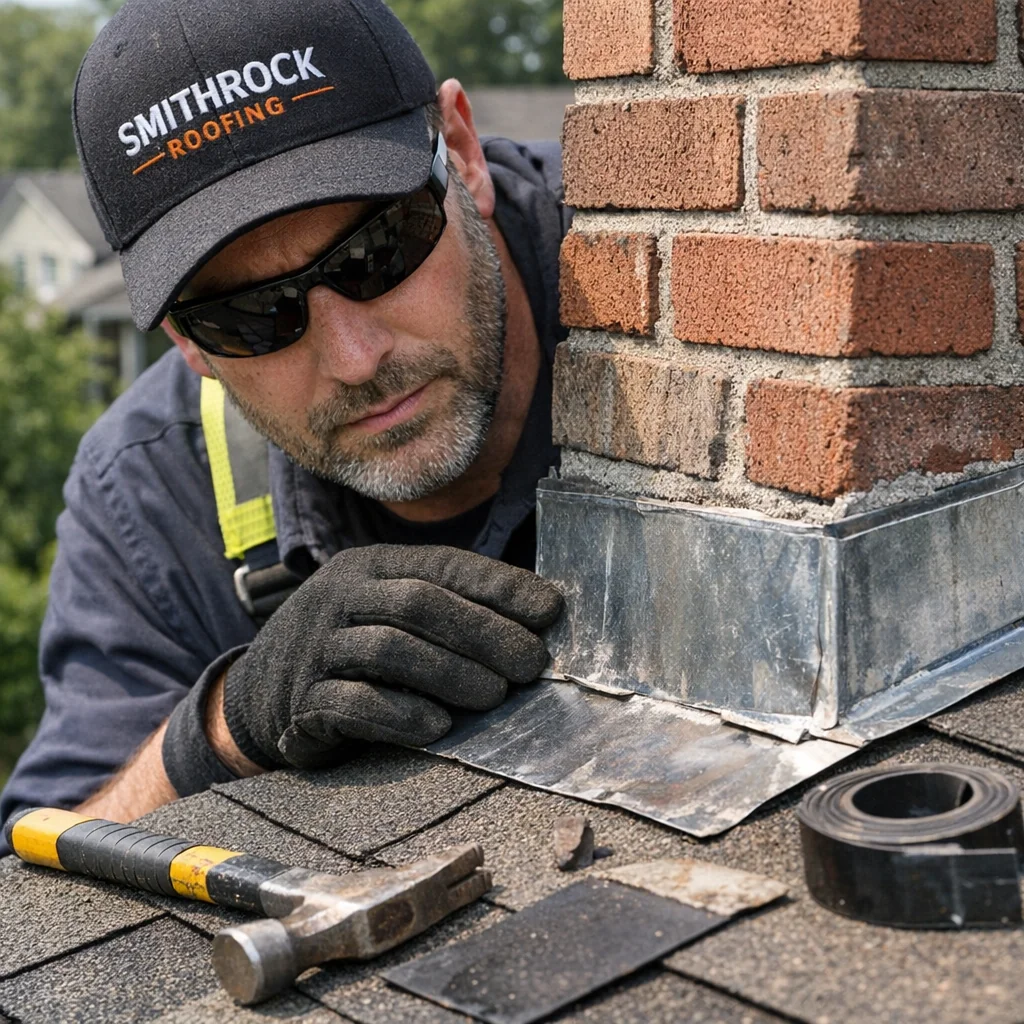
Flashing and penetration review addresses the most common sources of leaks in residential roofing. Anywhere the roofing material meets a vertical surface, a pipe, a skylight, a dormer, or a chimney, there is a transition point that relies on properly installed and maintained flashing. These are the areas that fail first and most often.
Need a hand with this in Winston-Salem, Greensboro and the Triad? Call (336) 971-0464 or request a free estimate. Honest answers, no pressure.
Every homeowner facing a leak eventually asks the same question: is this worth repairing, or is it time for a new roof? The honest answer depends on several factors that a qualified contractor should walk through with you, not just assert.
| Factor | Points Toward Repair | Points Toward Replacement |
|---|---|---|
| Roof age | Less than halfway through expected lifespan | At or past expected lifespan |
| Number of damaged areas | One isolated location | Multiple locations across the roof |
| Decking condition | Sheathing is dry and structurally sound | Soft or deteriorated decking present |
| Flashing condition | Isolated flashing failure, otherwise intact | Widespread flashing failure or corrosion |
| Interior damage extent | Minor, caught early | Insulation, framing, or drywall affected |
| Repair history | First known repair | Repeated repairs to the same or adjacent areas |
No single factor is a definitive answer on its own. A relatively young roof with sound decking and one failed flashing joint is almost always a strong repair candidate. An aging roof with soft decking, multiple compromised areas, and a history of prior repairs is telling you something different. For a deeper look at how these factors play out in real decisions, the article on roof repair vs. replacement in Winston-Salem walks through the comparison in detail.
The contractor’s role in this conversation is to give you the reasoning, not just the recommendation. If you walk away from an inspection knowing only what you need but not why, you do not have enough information to make a confident decision.
If your roof was installed within the last decade or so, there is a real possibility it is still covered under a manufacturer warranty. This creates a qualification requirement that most homeowners do not think to ask about.
Manufacturers typically require that any repair work performed on a warranted roofing system be carried out by a contractor they have licensed or certified. If a non-certified contractor performs the repair, the manufacturer may consider the warranty void from that point forward, regardless of how well the repair was done technically.
Before hiring anyone, it is worth checking whether your roof installation paperwork includes a manufacturer warranty and, if so, which manufacturer issued it. Then verify that the contractor you are considering is certified or licensed by that manufacturer for repair work.
At Smithrock Roofing, we hold CertainTeed PREMIER ShingleMaster Certification, which reflects not just installation standards but a verifiable level of credential that manufacturers recognize. It is the kind of detail that matters when warranty coverage is part of the picture.
Not every contractor who offers roof leak repair has the same qualifications, and the differences are not always obvious from a website or a phone call. Here is what to confirm before you commit:
Smithrock Roofing has served the NC Triad for years with 60-plus combined years of experience across our team, a 5-year labor warranty on our work, and a commitment to leaving every job site clean and every customer clear on what was done and why. Our roofing service covers the full range of residential needs, from targeted leak repairs to complete system replacement, and every project is backed by the same standard of workmanship. We are not the right fit for every project, but we will always tell you honestly whether we are.
If your roof is showing signs of a leak, the right move is a proper inspection before anything else. That inspection is the foundation of any repair that actually solves the problem.
Not every leak signals the end of a roof’s useful life. Many leaks, particularly those traced to damaged flashing, a few missing shingles, or a failed sealant around a penetration, can be resolved with a targeted repair. A proper inspection is the only reliable way to know which situation you are dealing with. A qualified contractor will examine the roof surface and the attic and give you an honest assessment of whether a repair will hold or whether the underlying condition has progressed to the point where replacement makes more sense.
Most residential leak repairs can be completed in a single visit once the source has been properly identified. More complex situations, such as widespread flashing failure or damage that has spread beneath the surface, may require additional time or a follow-up appointment. The inspection phase is what makes the repair phase go smoothly, so it is worth allowing enough time for a thorough look before any work begins.
It depends on the cause. Insurance policies generally cover damage from sudden events, such as wind, hail, or falling debris. Damage that has developed gradually due to age or deferred maintenance is typically not covered. A contractor can document what they find during the inspection, which can be useful when you file a claim, but coverage decisions rest with your insurance carrier.
If water is actively entering the home, focus on limiting interior damage. Move furniture, electronics, and valuables away from the affected area, place buckets or towels to catch dripping water, and use plastic sheeting to protect flooring and belongings. Do not attempt to walk on the roof yourself. A contractor can deploy a temporary protective measure if the situation requires it, but getting on a wet or damaged roof without proper equipment and training is a serious safety risk.
When you need roof leak repair from a contractor who knows the NC Triad, Smithrock Roofing brings over 60 combined years of experience, honest assessments, and work backed by a 5-year labor warranty to every job in Winston-Salem, Greensboro, and the surrounding communities. Whether you are in High Point or need roofing in Kernersville, our team is ready to inspect your roof, identify the actual source of the problem, and repair it the right way. Call us at (336) 971-0464 or Contact Smithrock Roofing to schedule your inspection today.

Smithrock Roofing © Copyright 2026 • All Rights Reserved • Privacy Policy • Maintained by Mongoose Digital Marketing