Deciding whether to repair or replace a roof is one of the more consequential calls a homeowner makes. Get it right and you protect your home and your budget for years. Get it wrong and you either spend money on a repair that fails within a season or replace a roof that had good years left in it. Neither outcome serves you.
The good news is that the decision is not as mysterious as it can feel when you are standing in a wet living room wondering what comes next. It comes down to a disciplined set of questions, applied in the right order, by a contractor who is honest enough to answer them straight. This guide walks you through that reasoning so you can have an informed conversation with any roofer who climbs your ladder, including us.
Most repair-versus-replace conversations get framed around two variables: how old is the roof, and how widespread is the damage? Those are relevant, but they are not the first question to ask.
The first question is: will fixing the visible problem actually solve the root cause?
A leaking roof is a symptom. The source of that leak may be a cracked shingle, but it may also be a flashing joint that was never sealed correctly, a section of underlayment that has absorbed water over multiple seasons, or a deck board that has softened to the point where no surface material will hold fasteners reliably. Each of those root causes calls for a different scope of work. Addressing the symptom without identifying the source produces a repair that looks complete on the surface and fails within a year or two.
This is not a subtle distinction. It is the clearest reason why a thorough inspection matters more than a quick visual estimate, and why the cheapest bid is often the most expensive decision you make.
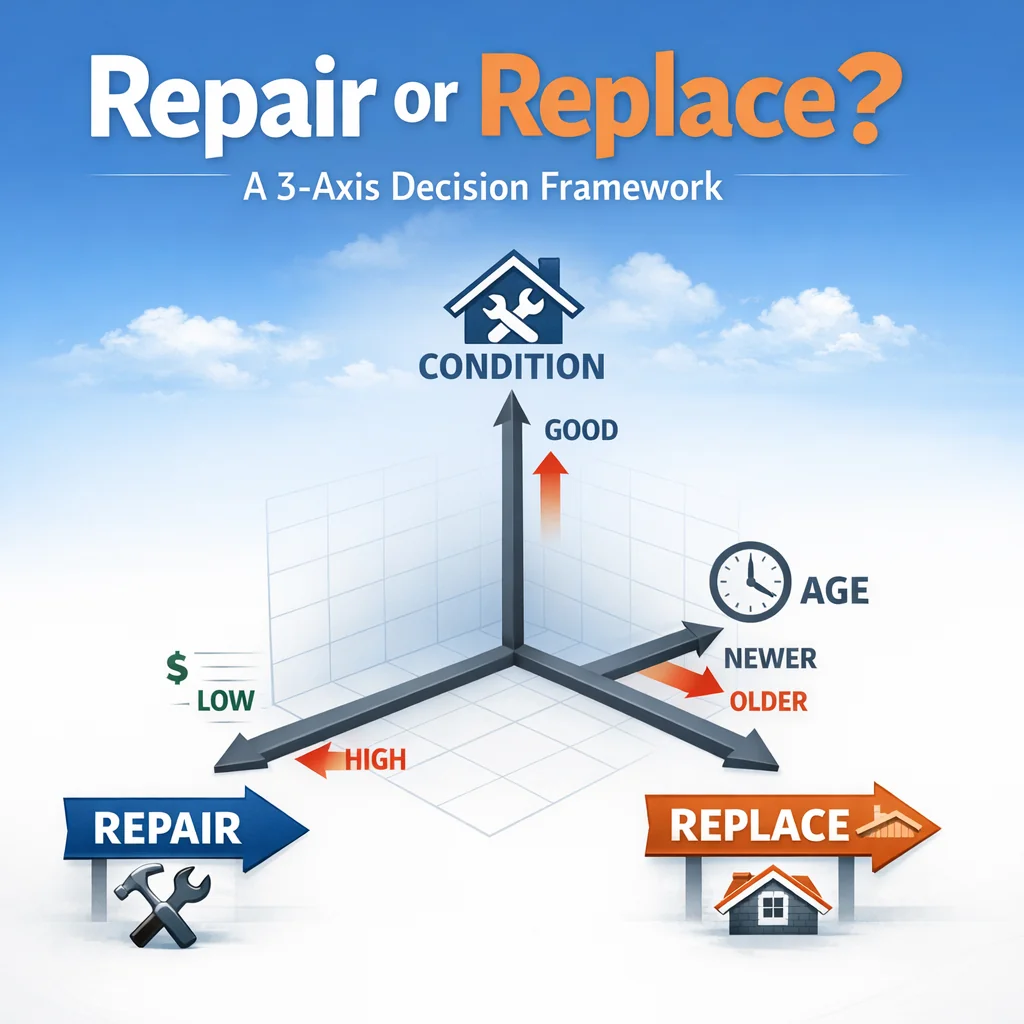
The standard repair-or-replace framework runs on two axes: roof age and damage scope. Older roof plus widespread damage equals replacement. Newer roof plus isolated damage equals repair. That logic is sound as far as it goes, but it ignores a third axis that frequently determines the right answer: how deep does the damage go?
Shingles are designed to be the first line of defense and the first thing to wear. Missing shingles, cracked tabs, heavy granule loss, and visible curling are all meaningful indicators, but they are indicators of what is happening at the surface. A competent inspection does not stop there.
Beneath the shingles sits the underlayment, a water-resistant barrier that catches what the shingles miss. Beneath that is the roof deck, typically OSB or plywood sheeting attached to your home’s structural framing. These layers are not visible from the ground, and they are not visible from a surface-level glance at the shingles. They require hands-on assessment.
When water reaches the deck repeatedly, the wood loses structural integrity. Fasteners no longer hold as designed. New shingles laid over a compromised deck will perform worse than the manufacturer warrants, and the deck may eventually require replacement itself, after you have already paid for the shingles above it.
This is why the conventional repair logic, which focuses entirely on what can be seen from the exterior, sometimes produces recommendations that fail. A repair that addresses the shingles without assessing deck condition is not actually a repair of the problem. It is a repair of the evidence.
The practical test: If a roof inspection does not include any evaluation of the deck and underlayment condition, you do not yet have enough information to make a reliable repair-versus-replace call.
Need a hand with this in Winston-Salem, Greensboro and the Triad? Call (336) 971-0464 or request a free estimate. Honest answers, no pressure.
You will see age benchmarks cited frequently in roofing guidance. Roofs under a certain age are candidates for repair; older roofs are candidates for replacement. These guidelines exist for good reason, but they are probabilistic, not deterministic. What actually changes as a roof ages is worth understanding.
Roofing materials degrade through repeated thermal cycling, UV exposure, moisture absorption, and the mechanical stress of expanding and contracting through temperature changes. An asphalt shingle roof approaches its rated lifespan not because a calendar page turned, but because those cumulative stresses have reduced the material’s ability to shed water reliably. The shingles become more brittle. The granule layer thins. Adhesive strips lose their bond.
Here is the thing: a roof that was installed with premium materials, on a properly ventilated deck, by a skilled crew, will reach that threshold later than a roof that was installed with budget materials on a poorly ventilated deck by the low bidder. Two roofs of the same age can be in dramatically different condition based entirely on what happened during and after installation.
This matters because it changes how you evaluate an age-based recommendation. If your roof is 18 years old but was installed with high-grade shingles, properly vented, and has been maintained, age alone is a weaker argument for replacement than it would be for a 15-year-old roof that was installed over existing layers with inadequate attic ventilation.
Here is an insight that does not appear in most roofing guides, but should: the repair-versus-replace decision begins before anyone climbs your roof. It begins the moment you choose which contractor to call.
Most roofing companies generate the large majority of their revenue from full replacements. That is not a criticism; it reflects how roofing businesses are structured. Replacement jobs are larger, more predictable in scope, and more efficiently staffed. Repair work requires smaller crews who can diagnose and execute targeted fixes quickly, and many companies are not set up to do that profitably.
The consequence is straightforward. If you call a contractor who is primarily set up for storm-damage replacement work, the inspection you receive is conducted by someone whose business model is oriented toward replacement. That does not mean every such contractor will steer you wrong, but it does mean the context is worth understanding.
A contractor who routinely performs repairs, and is transparent about when repair is the right answer, is a different kind of resource. Before you schedule any inspection, it is reasonable to ask directly: do you perform standalone repair work, or is your primary work full replacement? The answer tells you something about what kind of diagnosis you are likely to receive. If you want a deeper look at how these two paths compare in practice, this article on roof repair vs. replacement: how to choose walks through the key distinctions in detail.
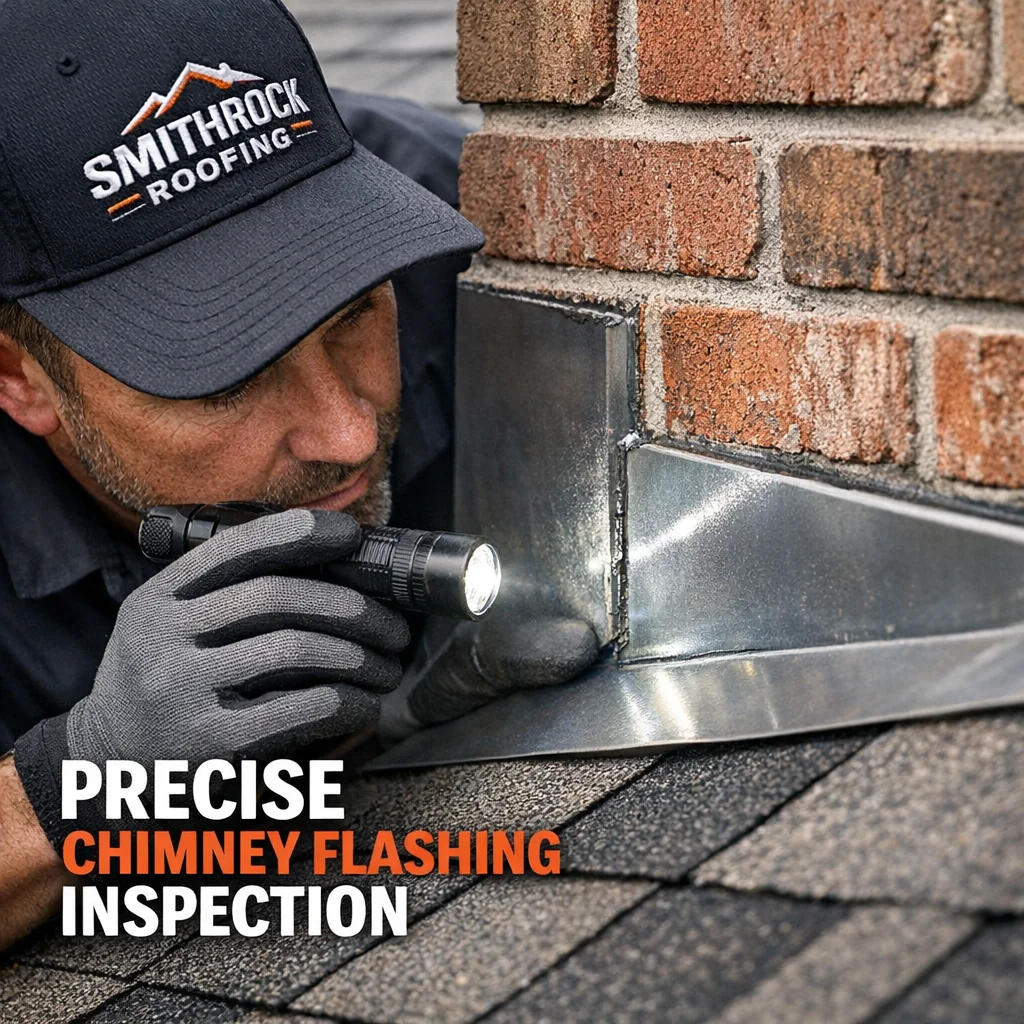
Flashing is the metal material installed at every roof penetration and transition point: around chimneys, along dormers, at valleys, around skylights and vent pipes. Its job is to seal the gaps where the roofing surface meets a vertical surface or a break in the plane of the roof. When it is installed correctly, it works quietly for decades. When it is installed incorrectly or deteriorates, it produces leaks that look like shingle failures.
A significant share of residential roof leaks trace back to flashing problems rather than shingle failures. This matters for the repair-versus-replace decision in a very direct way. If your leak traces to a flashing joint that was improperly installed or has lifted, replacing the shingles in that area will not stop the water. The root cause is still present, and the leak will return.
Correcting a flashing problem is targeted work. It is not a reason to replace the entire roof. But it also is not simply “patching a few shingles.” It requires a technician who understands flashing systems, not just shingle installation.
What this means for your inspection: When a leak is diagnosed, ask your contractor specifically where the water is entering and what is causing it. If the answer is flashing, the appropriate fix is a flashing repair or replacement, evaluated against the condition of the surrounding roof material. If the surrounding shingles are in good shape, a well-executed flashing repair is a complete solution, not a temporary patch.
Every list of warning signs treats each item as equal urgency. They are not. Here is how to think about them in triage order.
When roof damage follows a storm, homeowners often assume the roofing contractor and the insurance adjuster are working toward the same conclusion. They are not, and the difference matters.
A roofing contractor assesses damage from a contractor’s perspective: what does the roof need, and what will it take to return it to a weathertight condition? An insurance adjuster assesses damage from a coverage perspective: what is documented, what is attributable to the covered event, and what does the policy require the insurer to pay for?
These two assessments can produce different scopes of work. A contractor may identify damage that an adjuster does not document. An adjuster may interpret policy language in ways that exclude certain repairs the contractor considers necessary. Neither party’s assessment is automatically correct or final.
What this means practically:
An honest, experience-backed recommendation includes the following elements. If any of these are missing, you do not yet have a complete picture.
| Element | What It Means | Red Flag If Absent |
|---|---|---|
| Documented damage location | Where exactly the damage is, not just that damage exists | Vague references to “general wear” without specifics |
| Identified root cause | What is causing the problem, not just the visible symptom | Recommendation based solely on shingle appearance |
| Deck and underlayment assessment | Confirmation of subsurface condition beneath damaged area | Inspection performed without accessing attic or probing deck |
| Scope of proposed repair | Exactly what will be done and what it will address | Open-ended repair language without defined scope |
| Honest remaining life estimate | A candid assessment of how long the rest of the roof is likely to last | No discussion of overall roof condition beyond the damaged area |
| Repair vs. replace rationale | Clear reasoning for why one path is recommended over the other | Immediate default to replacement without repair discussion |
A roof that was installed with premium shingles by a certified crew performs differently across its lifespan than one installed to meet minimum specifications. This affects repair decisions in a specific way.
When a repair is performed on a quality roof, the repair material can be matched to the existing system, the work holds reliably, and the overall roof continues to perform as intended. When a repair is performed on a roof that was installed with lower-grade materials or poor technique, even a well-executed repair is entering a compromised system. The repair may hold, but surrounding areas may continue to fail.
This is why the conversation about repair versus replacement cannot be limited to the damaged area. It requires an honest evaluation of the broader roofing system those repairs will be part of.
At Smithrock Roofing, our roofing service uses CertainTeed Landmark shingles and is backed by a 5-year labor warranty alongside the manufacturer’s limited lifetime warranty. That is not just a sales point. It reflects a philosophy that every recommendation we make should be one we are willing to stand behind, long after the crew packs up and leaves.
When you are comparing contractor recommendations, pay attention to the materials being proposed and whether the contractor is willing to discuss why those materials are appropriate for your specific roof and home. A contractor who cannot explain the reasoning behind their material selection is a contractor worth questioning.
Serving homeowners across Winston-Salem, Greensboro, roofing in High Point, Kernersville, Clemmons, Rural Hall, King, and the surrounding NC Triad, Smithrock Roofing brings more than 60 combined years of experience to every inspection. We are CertainTeed PREMIER ShingleMark Master Certified, fully licensed and insured, and proud to hold an A+ BBB rating backed by more than 350 five-star reviews. If your roof needs an honest assessment, we are straightforward about what we find, whether that answer is a targeted repair or a full replacement.
The answer depends on several factors beyond the visible damage itself, including the age of the roof, the condition of the underlying materials, how widespread the deterioration is, and the quality of the original installation. A localized issue on a relatively young roof in otherwise sound condition is often a strong candidate for repair. A roof that is aging, showing multiple problem areas, or was installed with lower-grade materials may not respond reliably to continued patching. An honest inspection from a qualified contractor should walk you through each of these factors and explain the reasoning behind their recommendation.
A thorough inspection goes beyond a visual check of the shingles from the ground. A qualified inspector will examine the condition of flashing around chimneys, vents, and skylights, check for signs of moisture intrusion in the attic, assess the ventilation system, and look for indicators of structural movement or decking damage. The goal is to understand how the entire roofing system is performing, not just the areas where damage is already visible.
Coverage depends on the cause of the damage and the specific terms of your policy. Damage resulting from sudden events such as wind, hail, or falling debris is commonly covered. Deterioration that develops gradually over time due to age or lack of maintenance is generally not. After any significant storm, it is worth having your roof inspected by a roofing professional before contacting your insurer, so you have an accurate picture of what the damage actually involves.
A roof is a system, and how well that system holds together over time depends heavily on how it was built from the start. When a repair is introduced into a roof that was installed with quality materials and sound technique, the repair can be properly integrated and is likely to perform well. When the same repair is introduced into a compromised system, surrounding areas may continue to fail regardless of how well the repair itself was executed. This is why material quality and workmanship matter not just at installation, but at every subsequent decision point throughout the life of the roof.
Homeowners in Winston-Salem and Greensboro trust Smithrock Roofing because we give straightforward answers, use materials we stand behind, and bring more than 60 combined years of experience to every job we take on. If you are not sure whether your roof needs a repair or a replacement, the best place to start is an honest inspection from a crew that will tell you what they actually find. Call us at (336) 971-0464 or Contact Smithrock Roofing to schedule your free estimate today.

Smithrock Roofing © Copyright 2026 • All Rights Reserved • Privacy Policy • Maintained by Mongoose Digital Marketing