
You notice a dark stain running down the siding beneath your gutters. It shows up after rain and dries to a faint shadow, easy to ignore. A few months later, the fascia board behind the gutter starts to feel soft when you press it. By the time rot is visible, water has likely been hitting the same spot for a season or more. That stain was the repair window. What follows is a plain explanation of how roof and gutter systems fail, how those failures connect to each other, and how to think through a repair before anyone touches a ladder.
A gutter’s job sounds simple: catch water at the roof edge and move it away from the house. But the system only works when three things are true at the same time. The gutter has to be positioned at the right height relative to the roof plane. It has to be pitched in the right direction toward the downspout. And it has to be supported frequently enough that it holds its shape under load.
When any one of these three conditions fails, the others tend to follow. That sequence matters more than any individual repair.
Homeowners often assume the gutter should sit as high as possible against the fascia to catch as much water as possible. The opposite is true. Water leaves a sloped roof edge and continues in the direction of that slope for a brief distance before gravity takes it straight down. If the gutter’s front top edge sits above the extended plane of the roof slope, water overshoots the gutter entirely and runs down the gap between the gutter back and the fascia board.
This wets the fascia from the front. It looks exactly like gutter overflow from the ground. Homeowners often respond by upsizing to a wider gutter, which solves nothing because the water never entered the gutter to begin with. The correct fix is repositioning the gutter so its front edge aligns with the slope of the roof extended outward, not pressed up against the fascia at the highest point possible.
If fascia rot is present and a gutter that appears to be functioning properly caused it, check height before anything else.
A gutter needs a gentle pitch toward its downspout, typically a quarter inch of drop for every ten feet of run. When that pitch is wrong, water stands in the gutter, stresses the joints, and eventually leaks. Most repair guides stop there. But pitch failures come in two forms, and they have different consequences.
Insufficient pitch means the gutter runs nearly level. Water sits, algae grows, joints carry constant water weight, and freeze-thaw cycles slowly crack the seals. Leaks develop gradually.
Reversed pitch means the gutter slopes the wrong direction. Water actively routes toward a joint or a corner instead of toward the downspout. That water presses against the sealant at that joint rather than merely resting against it. The same joint fails much faster and resealing it will not hold until the pitch is corrected. A reversed-pitch gutter is draining the wrong direction on purpose.
You can check pitch direction from the ground after a rain. If water is pooling visibly in the middle of the run or collecting at a corner rather than running toward the downspout, you have a pitch problem. Whether it is insufficient or reversed requires a level and a straight edge to confirm. For a closer look at how these issues develop and what repairs actually hold, the Gutter Repair Winston Salem Guide walks through the full diagnostic process.
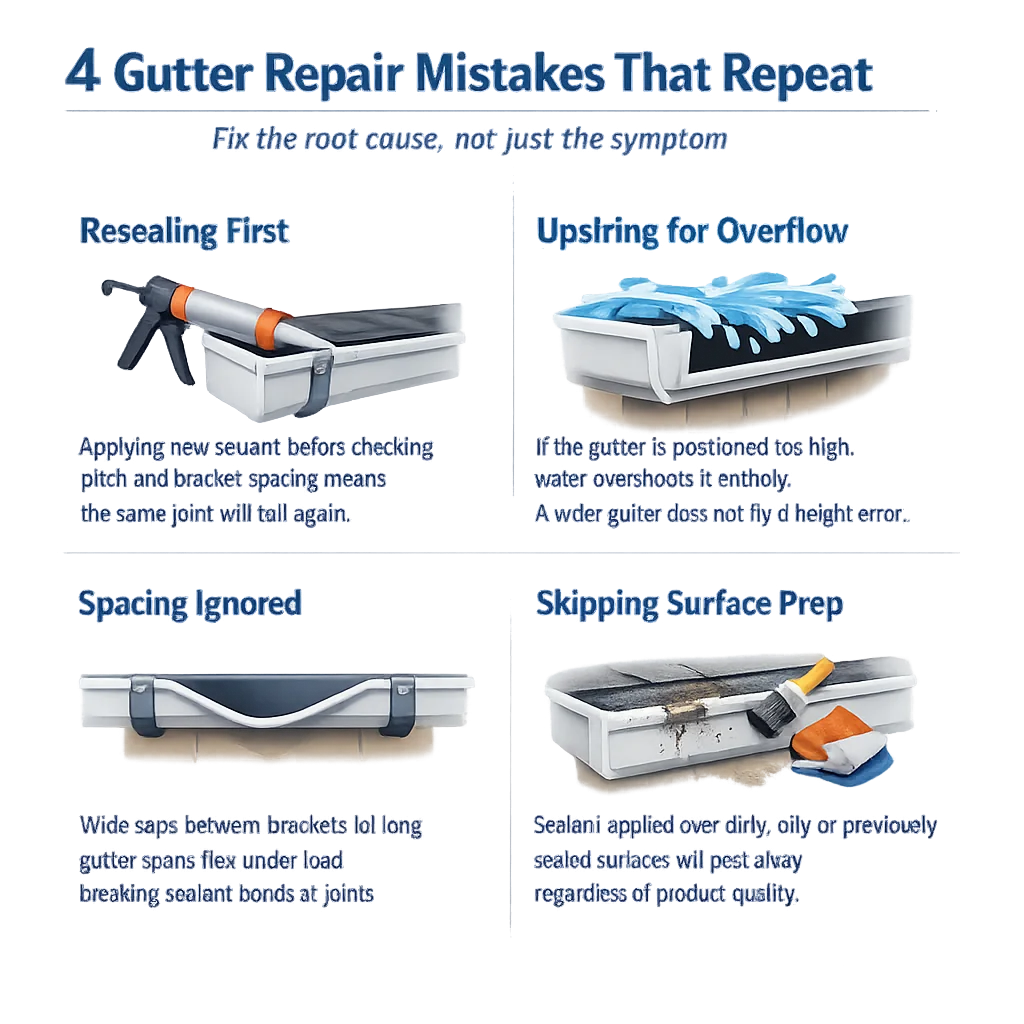
Gutter brackets hold the gutter against the fascia and prevent the channel from sagging between support points. When brackets are spaced too far apart, the gutter span between them is unsupported. Under load from debris, standing water, or the weight of ice, that unsupported span flexes.
Flex concentrates stress at the joints, which are exactly the spots sealed with butyl or urethane sealant. A joint that is both sealed and flexing repeatedly will fail at the sealant bond regardless of the product used. This is why two problems that appear unrelated share one cause: the bracket spacing allowed movement, and the movement broke the seal.
The repair sequence that holds is this: confirm bracket positions, add brackets where spans are too wide, then clean and reseal affected joints. Skipping to the sealant step first is redoing the same repair in a year.
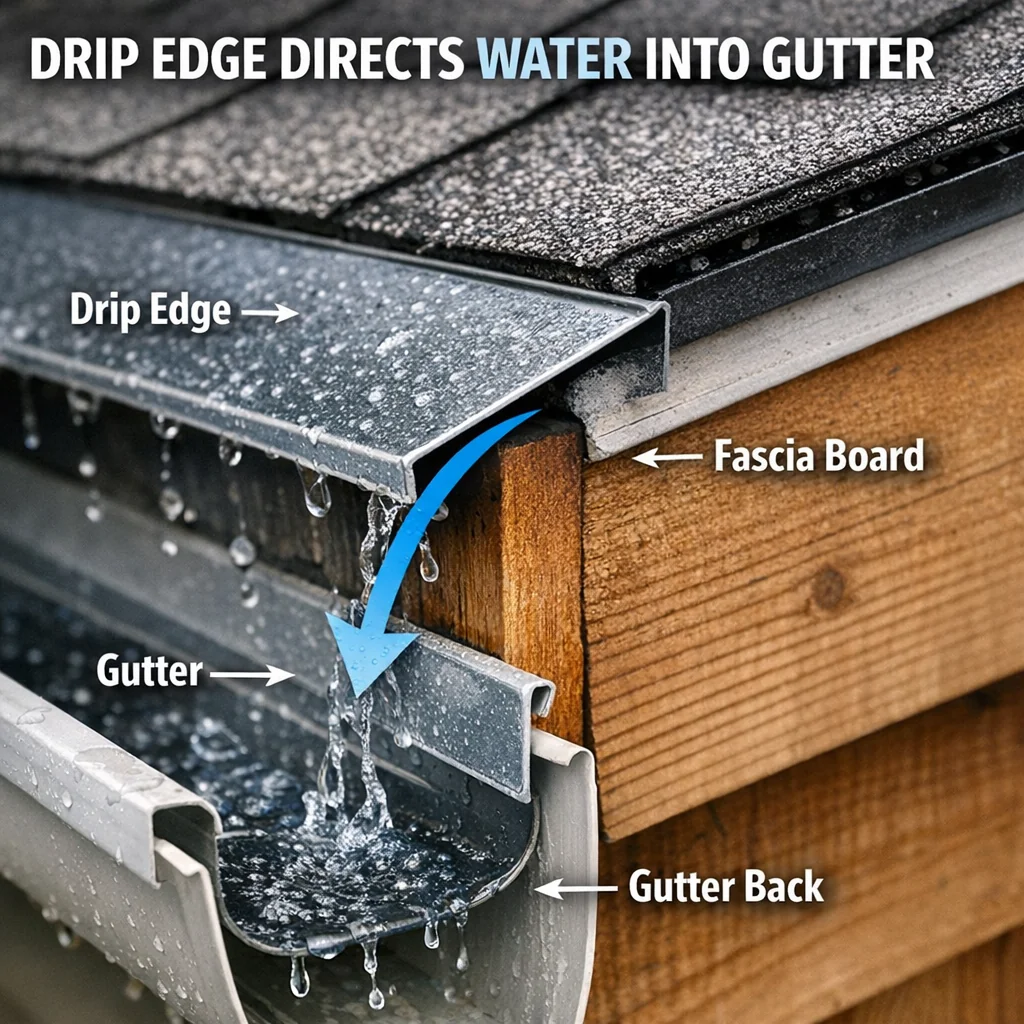
Not every apparent gutter leak starts at the gutter. The drip edge is a metal flashing strip installed at the roof edge that directs water off the decking and into the gutter. When it is missing, undersized, or improperly lapped over the gutter’s back edge, water runs off the roof deck and travels behind the gutter rather than into it. The resulting fascia damage looks identical to the damage caused by a gutter hung at the wrong height. Understanding how the full roofing service integrates with drainage components like the drip edge is essential before any eave-level repair is recommended.
Similarly, valley flashing and step flashing failures can channel concentrated water to specific points along the eave, overwhelming the gutter at a localized spot that would handle normal rainfall without issue. If one section of gutter leaks while adjacent sections hold, the roof drainage above that section deserves inspection before the gutter is replaced.
Need a hand with this in Winston-Salem, Greensboro and the Triad? Call (336) 971-0464 or request a free estimate. Honest answers, no pressure.
Use the following reference to decide where the problem actually sits before scheduling any work.
| Symptom | Likely Cause | First Diagnostic Step |
|---|---|---|
| Fascia rot with gutter appearing functional | Gutter hung too high, water overshooting | Check gutter height against roof plane slope |
| Leak at joint, sealant intact | Bracket spacing too wide, joint flexing | Measure spans between brackets |
| Leak at joint, sealant peeling | Sealant applied over dirty or flexing surface | Check surface condition and spacing |
| Water pooling in gutter mid-run | Insufficient pitch | Check slope with a level |
| Water collecting at corner or end cap | Reversed pitch | Check pitch direction with level and straight edge |
| Water behind gutter, not from overflow | Missing or improperly installed drip edge | Inspect drip edge at roof-gutter junction |
| One section overflows, rest holds | Concentrated roof drainage from above | Inspect flashing at valleys above that section |
| Downspout pulls away from wall | Improperly offset elbows creating lever arm | Inspect elbow angles and strapping |
A proper diagnosis follows that sequence: height, pitch, spacing, sealant, drip edge, then roof drainage. A contractor who skips to a surface-level repair without confirming the upstream cause is not diagnosing the system; they are addressing a symptom.
Smithrock Roofing has served homeowners across Winston-Salem, Greensboro, High Point, Kernersville, roofing in Clemmons, Rural Hall, King, and surrounding communities for years, and the diagnostic pattern above comes up on job sites constantly. A homeowner calls about a gutter leak. The gutter is not the problem. The fascia is already soft because water has been running behind the gutter for months, and the fix needed is repositioning the gutter and replacing the fascia board, not just applying sealant.
That is not a failure of the gutter. It is a failure of diagnosis. With more than 350 five-star reviews and 60-plus combined years of field experience, our team brings that full diagnostic approach to every inspection. We look at the roof plane, the drip edge, the bracket layout, and the pitch before we recommend any repair. No shortcuts, and no guessing.
If you have seen a stain on your siding, soft wood near the roofline, or water pooling in your gutters after rain, the repair is worth doing correctly the first time. Contact Smithrock Roofing to schedule an inspection across our NC Triad service area.
The most reliable indicator is where the water originates, not where it appears. If water is running behind the gutter rather than over the front lip, the issue is almost always related to the drip edge or the roof-to-fascia junction, not the gutter itself. A proper inspection traces the water path from the roof plane downward before any repair is recommended.
Waiting rarely saves money and often increases the scope of the repair. A small leak behind a gutter can saturate a fascia board within a single wet season, which turns a repositioning job into a fascia replacement. Roof flashing failures follow the same pattern, water finds its way to the decking and into the structure before interior staining even appears. If something looks wrong at the roofline, having it evaluated sooner prevents a much larger repair later.
The most common cause is fastener failure driven by wood rot in the fascia behind the gutter. When the fascia softens, screws lose their grip and the gutter begins to separate under the weight of standing water and debris. In some cases, improper hanger spacing or the wrong hanger type for the load accelerates this process. The fix requires addressing the fascia condition before reinstalling the gutter, not simply driving new screws into deteriorated wood.
Yes, directly. A steeper roof pitch delivers water to the gutter at higher velocity, which means the gutter needs to be positioned lower at the fascia line to catch that forward-moving stream rather than letting it overshoot the channel. The gutter pitch itself, the slope along the run toward the downspout, must also be calibrated to move water efficiently without creating low spots where debris accumulates and standing water develops.
Homeowners in Winston-Salem and Greensboro deal with a climate that brings heavy spring rain, storm debris, and temperature swings that wear on roofing systems year after year, and those conditions make proper diagnosis more important than a quick patch. Smithrock Roofing brings more than 60 combined years of field experience to every inspection, looking at the full system from roof plane to downspout before recommending any repair. If you are seeing signs of water damage near your roofline, call us at (336) 971-0464 or Contact Smithrock Roofing to schedule an inspection across the NC Triad.

Smithrock Roofing © Copyright 2026 • All Rights Reserved • Privacy Policy • Maintained by Mongoose Digital Marketing