You are replacing your roof. You have received quotes for asphalt shingles and for metal, and the contractor for each option has told you theirs is the better choice. Neither one has explained why, for your specific house, one material might serve you better than the other. That gap is where this guide starts.
Metal roofing in Greensboro, NC and across the broader NC Triad is a legitimate long-term investment for the right home and the right homeowner. It is not automatically the superior choice for every situation. Understanding the actual decision framework, including the variables competitors rarely spell out, puts you in a much better position before you sign anything.
Asphalt shingles are installed as individual overlapping pieces. Metal roofing comes in several system types, but in every case the material is continuous, interlocking, or panel-based in a way that asphalt is not. That fundamental difference drives most of the performance distinctions.
Metal roofing systems shed water more efficiently because there are fewer seams and no granule surface to degrade over time. They reflect solar energy rather than absorbing it. They do not support moss or algae growth the way organic granule surfaces can. And when the panels are properly fastened and sealed, they resist wind uplift that would strip individual shingles.
Longevity is the most frequently cited advantage. A properly installed metal roof with a quality underlayment can remain serviceable well beyond the replacement cycles typical for asphalt, which usually runs between 20 and 30 years depending on material grade and conditions. For a homeowner who intends to stay in their home long-term, that extended lifecycle changes the financial picture significantly, even if the upfront investment is higher. If you are weighing your options, exploring our roofing service is a strong starting point for understanding what a full system installation involves.
Metal roofing makes the most sense when several of these conditions are true:
Conversely, if you are planning to sell within a few years and buyers in your neighborhood are not actively seeking metal roofs, the return on the added investment may be limited. If your roof has meaningful life remaining, a full replacement in metal may not be the right timing. A contractor worth trusting will tell you both sides of that equation.
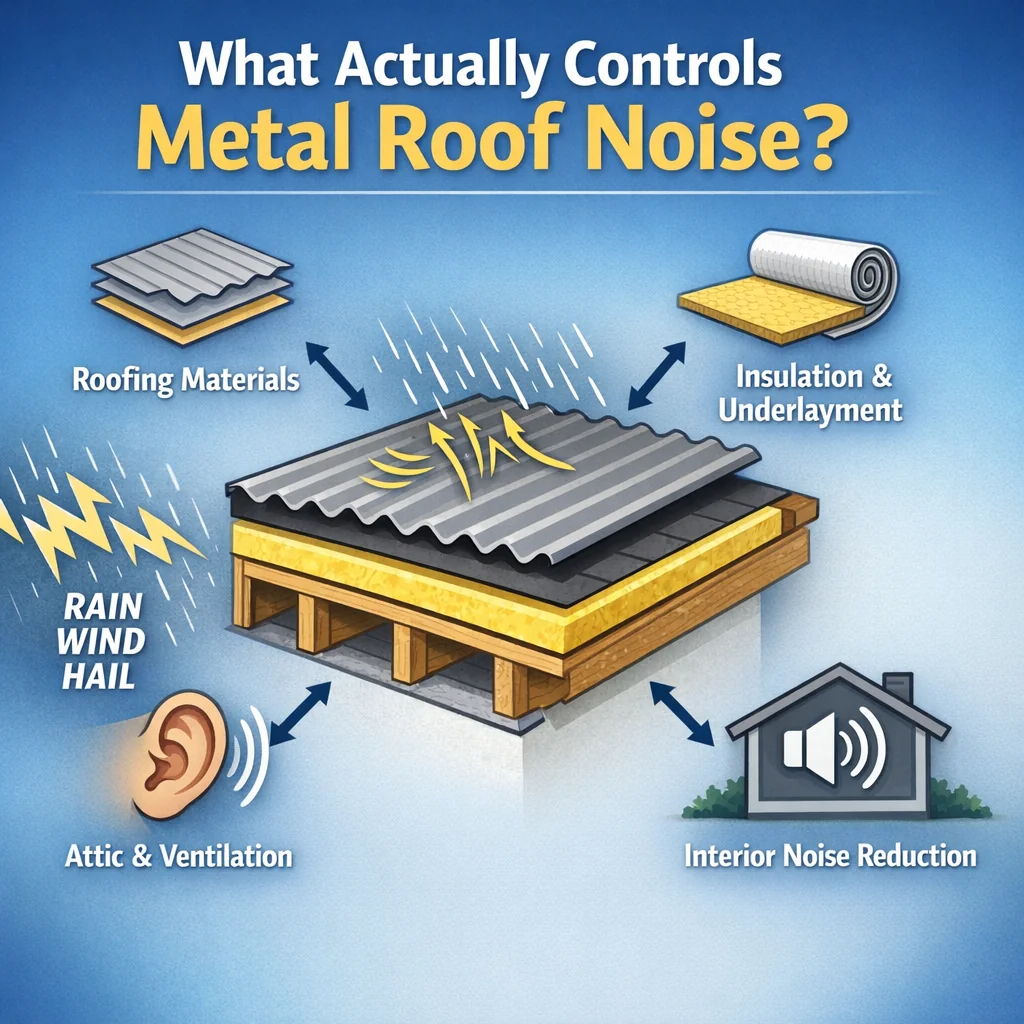
One competitor says metal roofing is no noisier than asphalt on a rainy day. Another says metal, with solid sheathing, will silence noise better than other materials. These are contradictory statements, and both are conditionally accurate. The condition neither one discloses is the installation substrate.
A metal panel installed over open purlins, the way agricultural and barn roofs are often built, has an air gap beneath it that acts as a resonance chamber. Rain sounds loud because there is nothing between the metal and the interior to absorb or break up the sound wave.
A metal roof installed over solid OSB or plywood decking, with a quality underlayment beneath the metal, behaves very differently. The decking eliminates the air gap. The underlayment adds another layer of acoustic dampening. If the attic beneath also has adequate insulation, the sound reaching living spaces is comparable to what you hear under asphalt shingles.
The noise question is not a metal question. It is an installation-design question. Before installation begins, ask your contractor to confirm the decking specification, the underlayment product being used, and whether your attic insulation will contribute to acoustic performance. Those three variables determine the answer, not the metal itself. For a closer look at how installation choices affect real-world outcomes, the article on how to install metal roofing and avoid costly mistakes covers these decisions in practical detail.
Need a hand with this in Winston-Salem, Greensboro and the Triad? Call (336) 971-0464 or request a free estimate. Honest answers, no pressure.
If you are considering metal roofing after a hail or wind event, you need to understand how insurance claim math works before making a material decision.
When an adjuster evaluates storm damage, they calculate a replacement value based on like-for-like material. If your existing roof was asphalt shingles, your claim is calculated using asphalt shingle replacement costs. The insurance company is not obligated to pay for an upgrade in material.
Choosing to install metal instead of asphalt means you are responsible for the difference between what insurance pays for asphalt and what metal actually costs. In insurance terminology, this is sometimes called a betterment or upgrade situation. It is not a problem, but it is a reality that no competitor in the metal roofing space explains clearly, even the ones who market “insurance claim support” as a primary service.
Here is what to clarify before proceeding:
An honest contractor will walk you through this before you sign a contract, not after.
The biggest information gap in metal roofing content is what happens after a homeowner decides they want metal. The profiles available, standing seam, metal shingles, shake profiles, slate profiles, and others, are usually presented as aesthetic options. They are not only that.
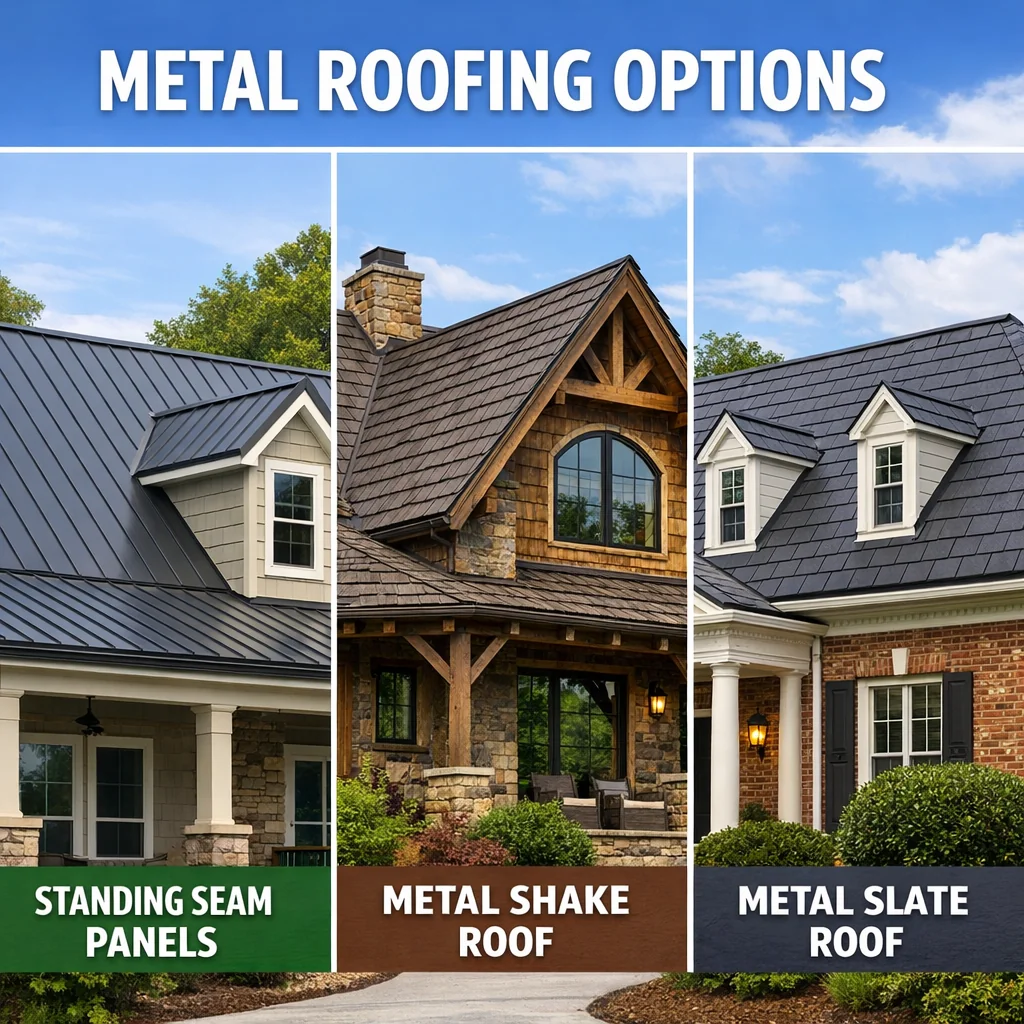
| Profile Type | Best Roof Pitch | Fastener Style | Key Advantage | Watch For |
|---|---|---|---|---|
| Standing Seam | Low to moderate | Concealed clips | Handles thermal expansion well; clean modern look | Not ideal for very steep pitches where panel length is limited |
| Interlocking Shake/Slate | Moderate to steep | Concealed | Shadow lines read well on steeper pitches; traditional appearance | Requires experienced installer familiar with interlocking systems |
| Exposed Fastener Panels | Low to moderate | Exposed screws | Lower material complexity | Fasteners require periodic inspection for sealing integrity |
| Aluminum Shingle Systems | Moderate to steep | Varies | Lightweight; corrosion resistant; no paint-through concerns | Expansion coefficient differs from steel; not all contractors are familiar |
| Solid Copper | Any | Varies | Exceptional longevity; develops natural patina | Entirely different cost and maintenance category; must avoid contact with dissimilar metals |
Beyond aesthetics, the right profile choice involves five practical questions:
The word “lifetime” appears in nearly every metal roofing warranty description. It is also one of the least informative terms in the industry when used without context.
Ask these specific questions before treating any warranty as a differentiator:
A warranty is only as useful as your understanding of what it actually promises. Any contractor who cannot answer these questions directly is not the right contractor for a long-term investment like metal roofing.
Homeowners across roofing in Greensboro, Winston-Salem, High Point, Kernersville, Clemmons, Rural Hall, and King trust Smithrock Roofing because we answer the questions other contractors avoid. With more than 350 five-star reviews, 60-plus combined years of experience, and the craftsmanship credentials to back every recommendation, we show up to educate first and sell second. If you are weighing metal roofing for your home, we would rather spend time walking you through the real decision than hand you a brochure and a contract.
Most metal roofing systems installed in the Piedmont Triad region perform well for 40 to 50 years or longer when properly installed and maintained. The climate in Greensboro and surrounding areas, with its mix of humid summers, occasional ice storms, and high-wind events, is well within the performance range that metal roofing is designed to handle. The key factors affecting longevity are material quality, installation precision, and proper attic ventilation rather than climate alone.
This is one of the most common concerns homeowners raise, and the answer depends largely on the installation method. Metal roofing installed over a solid deck with proper underlayment is typically no noisier than an asphalt shingle roof. The bare-metal-on-open-framing sound associated with older agricultural buildings does not apply to modern residential metal roofing systems installed according to current standards.
Metal roofing generally has a positive effect on resale value, and for buyers who understand roofing, it can be a meaningful selling point. The durability, reduced maintenance expectations, and potential insurance benefits are factors that informed buyers weigh seriously. Transferable warranties, where applicable, can add further value at the point of sale. That said, buyer perception varies, and the quality of installation matters as much as the material itself when it comes to how a metal roof is received during a home inspection.
Metal roofing requires significantly less maintenance than asphalt shingles, but it is not entirely maintenance-free. Homeowners should have the roof inspected periodically, keep gutters clear to prevent water backup, ensure debris does not accumulate in valleys, and check that any sealants around penetrations remain intact. Most manufacturer warranties also include specific ventilation and maintenance requirements that, if neglected, can affect coverage. Staying current with these simple tasks is the best way to protect both the roof and the warranty behind it.
Smithrock Roofing has built its reputation across Greensboro, High Point, and the broader Piedmont Triad by doing this work the right way, showing up, being honest about what homeowners actually need, and standing behind every project with both the credentials and the track record to prove it. If you are ready to talk through whether metal roofing is the right fit for your home, our team is here to help you make that decision with confidence. Call us at (336) 971-0464 or Contact Smithrock Roofing to get started with a free estimate.

Smithrock Roofing © Copyright 2026 • All Rights Reserved • Privacy Policy • Maintained by Mongoose Digital Marketing