
When you need to classify a point relative to a set, three questions settle it: Does the point sit inside the set with room to spare? Does it sit exactly on the edge? Or does it sit clearly outside with open space separating it from the set entirely? The answer to that third question is where the concept of an exterior point lives, and getting it right requires more than just checking whether the point is a member of the set.
This matters in topology and real analysis because the distinction between exterior, boundary, and interior points is not a matter of intuition. It is a precise, decision-ready framework with a specific test for each category. Understanding exterior points correctly, including the one condition that most informal explanations skip, gives you a reliable classification tool that works across Euclidean geometry, metric spaces, and general topology.
An exterior point of a set S in a topological space is a point p such that there exists an open neighborhood of p that is entirely disjoint from S. That means the neighborhood contains no elements of S at all, not even one.
This definition has two working parts. First, the neighborhood must be open. Second, the intersection of that neighborhood with S must be empty. Both conditions must hold simultaneously. If even one point of S falls inside every neighborhood of p, then p is not exterior, it is a boundary point.
The most common shortcut that breaks this reasoning is treating “not in S” as equivalent to “exterior to S.” That equivalence does not hold. A point can be outside S and still have every open neighborhood touch S at some element. In that case the point sits on the boundary, not in the exterior. The neighborhood condition is the only reliable test.
In a metric space, the open neighborhood of a point p with radius r is the open ball B(p, r), which contains all points within distance r of p. For p to be an exterior point of S, you need to find at least one value of r, however small, such that B(p, r) and S share no points. The ball sits entirely in the complement of S.
In general topology, the same logic applies using open sets rather than open balls. The point p is exterior to S if there is some open set U containing p such that U and S do not intersect. The openness of U is not a technicality. It is the operative condition, because closed neighborhoods can graze the boundary of S without the point itself being a boundary point, which would produce a false classification.
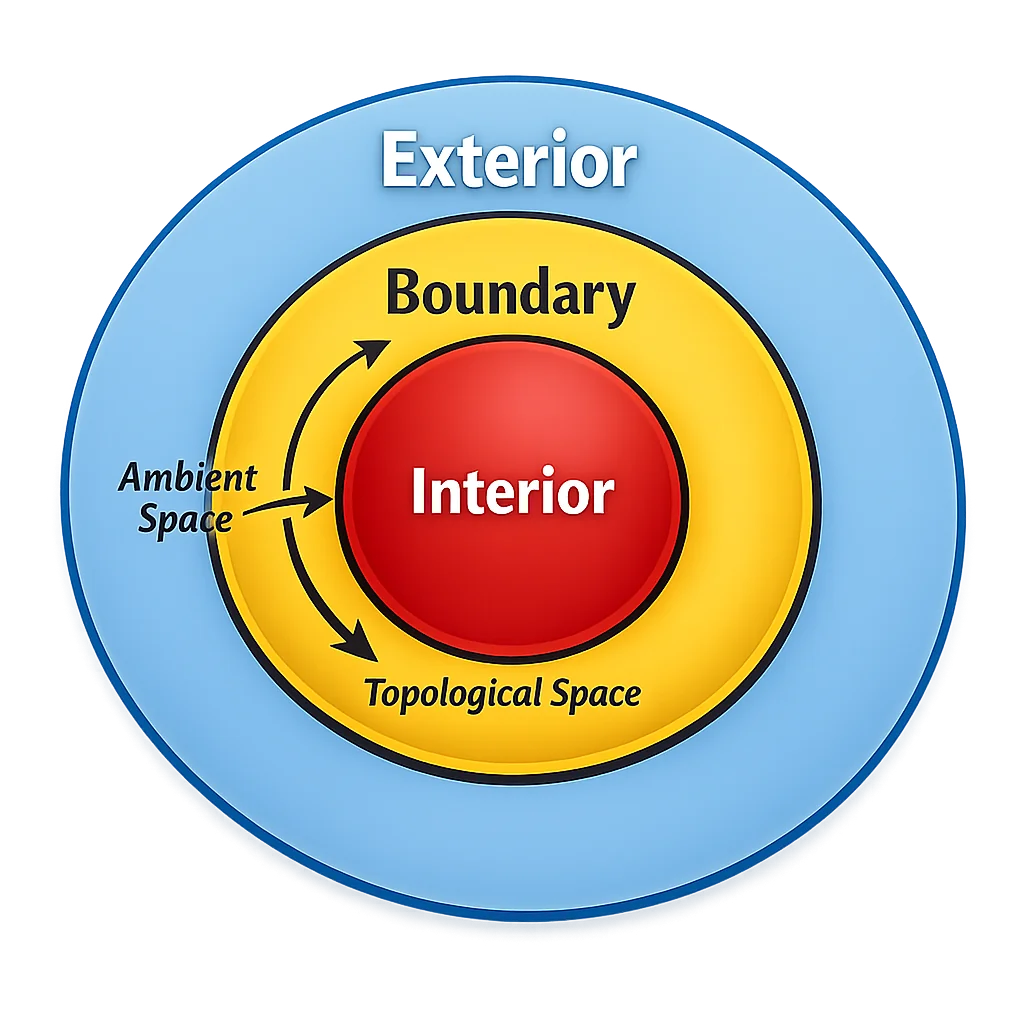
The interior, boundary, and exterior of a set together partition the entire topological space. That word, partition, carries precise meaning: every point in the space belongs to exactly one of the three regions, and no point belongs to two.
This partition structure makes classification work as a diagnostic checklist. If you can establish that a point is not interior and not a boundary point, you have proven it is exterior without needing to directly construct a disjoint neighborhood. Conversely, if you know a point is exterior, you immediately know it is not a boundary point and not interior. The three categories are mutually exclusive and collectively exhaustive.
Here is how the elimination logic works in practice:
This checklist approach is more reliable than trying to apply the exterior definition in isolation, particularly when working near the edges of a set where intuition about “inside” and “outside” can mislead.
Need a hand with this in Winston-Salem, Greensboro and the Triad? Call (336) 971-0464 or request a free estimate. Honest answers, no pressure.
The exterior of a set S has a direct relationship to open sets that makes it especially useful in proofs. The exterior of S is precisely the interior of the complement of S. Written formally: ext(S) = int(S complement).
This equivalence is not just a neat symmetry. It is a working tool. When you want to show that a point is exterior to S, you can instead show that the same point is interior to the complement of S. Since interior points are often easier to work with directly, this reframing can simplify arguments considerably.
It also explains why the exterior of a set is always an open set. The interior of any set is open by definition in standard topology, so the exterior inherits that openness from the interior of the complement. For a deeper look at how exterior materials behave in similarly layered systems, the article on durable exterior cladding explores how these boundary-and-layer principles translate into real-world material performance.
| Property | Interior of S | Boundary of S | Exterior of S |
|---|---|---|---|
| Open neighborhood exists within S | Yes | No | No |
| Open neighborhood disjoint from S | No | No | Yes |
| Every neighborhood intersects S | No | Yes | No |
| Every neighborhood intersects complement | No | Yes | No |
| Always an open set | Yes | Not always | Yes |
| Equivalent to | int(S) | S minus int(S) minus ext(S) | int(complement of S) |
A point’s classification as exterior is not a fixed property of the point or even of the set alone. It depends on the ambient topological space. Change the topology on the space and the open sets change, which means the neighborhoods change, which means the classification of points can change.
A simple example: in the standard topology on the real line, a point strictly between two rational numbers may be exterior to the set of integers. Place a different topology on the same underlying set, such as the discrete topology where every subset is open, and the classification shifts entirely. Every point becomes both open and isolated, and the notion of “exterior” restructures itself completely.
This space-dependence is why exterior points are always discussed relative to a specific topological space. The phrasing matters: a point is exterior to S in space X, not exterior to S in the abstract. Omitting the ambient space from the description is an imprecision that causes errors in more advanced arguments, particularly when working with subspace topologies.
In convex analysis, the term “exterior point” carries a subtly different meaning than in general topology. In that context, an exterior point of a convex set is sometimes defined as a point that can be separated from the set by a hyperplane, or alternatively as a point not in the closure of the set. This is not the same as the topological definition, which requires only a disjoint open neighborhood.
When reading material that spans both areas, pay attention to which framework is in use. A point that qualifies as exterior under the convex geometry definition will typically also qualify under the topological definition, but the reverse is not guaranteed. The topological definition is the broader and more foundational one.
Understanding which definition applies in a given proof or problem prevents classification errors that can propagate through an entire argument. When in doubt, default to the neighborhood-based topological definition and verify that the source you are working from shares that framework. Just as precision in definitions protects the integrity of a mathematical argument, precision in materials and installation protects your home, something our roofing service is built around.
An exterior point of a set S in a topological space X is a point that has at least one open neighborhood contained entirely within the complement of S. In other words, the point lies outside S and can be surrounded by an open set that never touches S at all. Every exterior point is, by definition, a point of the complement, but not every point of the complement qualifies as exterior, points on the boundary of S belong to neither the interior nor the exterior.
A boundary point of a set S is a point where every open neighborhood intersects both S and its complement. An exterior point, by contrast, has a neighborhood that avoids S entirely. The distinction matters because boundary points are often the most analytically sensitive locations in a problem, while exterior points are cleanly separated from the set and its closure.
Yes. The same point in the same underlying set can be an exterior point under one topology and a boundary point or even an interior point under a different topology applied to the same ambient space. This is why careful mathematical writing always specifies the ambient space and the topology when classifying points. Dropping that context from a statement or proof can introduce errors that are difficult to trace.
Not exactly. Convex geometry sometimes defines an exterior point in terms of hyperplane separation or exclusion from the closure of a convex set, which is a more specialized condition. The topological definition, requiring only a disjoint open neighborhood, is broader and applies to any topological space regardless of convexity. A point that is exterior under the convex geometry definition will generally satisfy the topological definition as well, but the two frameworks are not interchangeable, and confirming which one a source is using prevents misclassification errors.
Understanding concepts like exterior points builds the kind of precise spatial reasoning that carries over into real-world problem-solving, and that same attention to boundaries, edges, and transitions matters enormously in quality exterior work on your home or business. Smithrock Roofing proudly serves Winston-Salem, Greensboro, High Point, and Kernersville with that same commitment to getting every detail right, whether you are in the Triad’s urban core or its surrounding communities. Homeowners seeking roofing in Clemmons will find the same level of care and precision extended to every project in that community. Reach out at (336) 971-0464 or Get a Free Estimate, the team at Smithrock Roofing is ready to help neighbors across Greensboro and Winston-Salem protect what matters most.

Smithrock Roofing © Copyright 2026 • All Rights Reserved • Privacy Policy • Maintained by Mongoose Digital Marketing