When homeowners in Greensboro, Winston-Salem, High Point, Kernersville, and the surrounding communities search for exterior remodeling help, they find no shortage of contractor websites. Most of those sites list services, show before-and-after photos, and name a few certifications. What they rarely do is explain the reasoning behind any of it. That gap costs homeowners real money and real peace of mind, because the details that look like marketing language are often the details that determine whether a warranty holds, whether a repair lasts, and whether the contractor standing at your door in three years is the same one who installed your roof.
This article is about closing that gap. Whether you are weighing a full roof replacement, a few new windows, or new siding for your home, the decision framework matters as much as the final product.
Credentials listed on a contractor’s website tend to read like a trophy wall. Owens Corning Preferred Contractor. CertainTeed certified. GAF certified. BBB A+. The logos stack up, and most homeowners register them as a general signal of legitimacy, then move on.
That is understandable, but it misses the most important thing those certifications actually do.
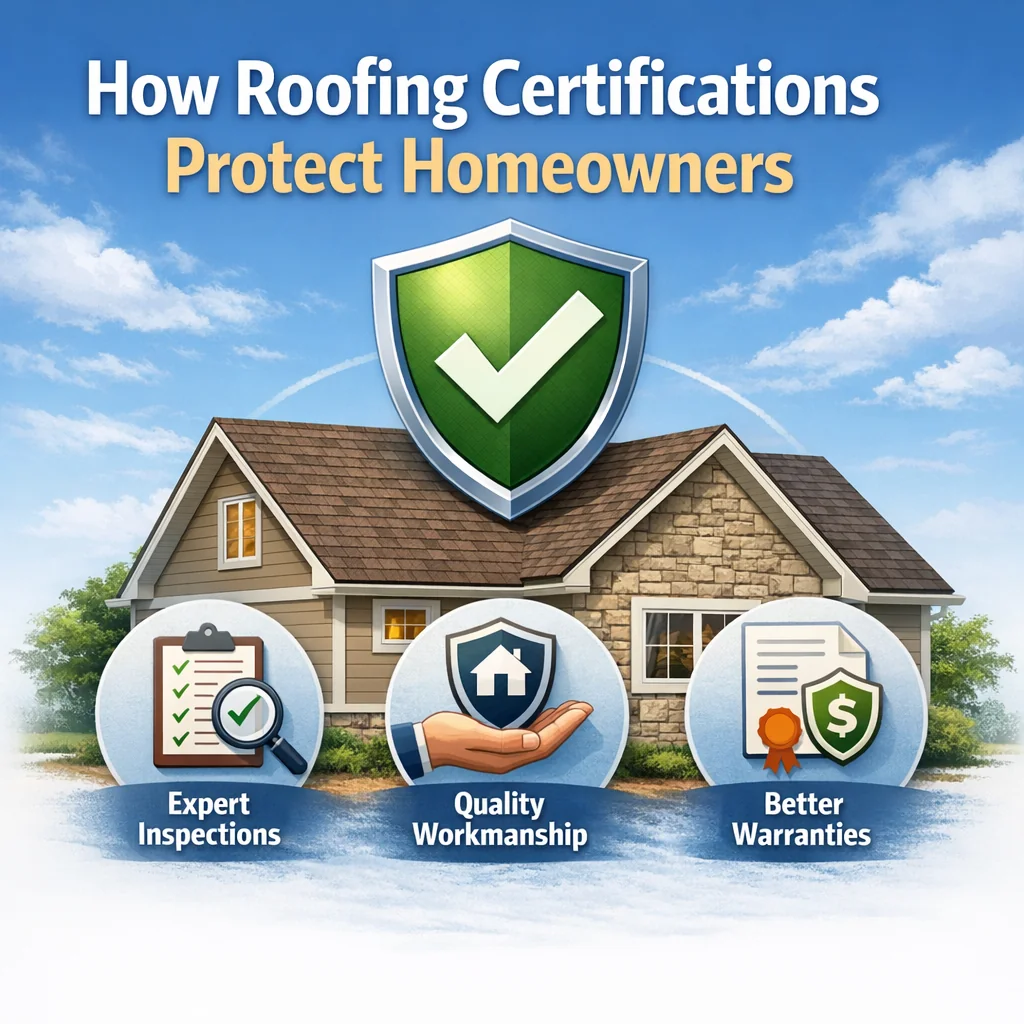
Many shingle and building product manufacturers structure their warranties so that the full coverage only activates when the product is installed by a certified applicator. An uncertified roofer can physically install the same CertainTeed Landmark shingles that a certified contractor uses. The shingles look identical on the roof. But if that installer is not certified, CertainTeed’s material warranty may be voided or significantly reduced. The homeowner paid for a premium product and unknowingly lost the manufacturer’s backing before the first rain hit.
At Smithrock Roofing, we are CertainTeed PREMIER ShingleMaster certified, which places us in a narrow category of contractors authorized to offer enhanced warranty options that an uncertified installer simply cannot access. When we install CertainTeed shingles on your home, the manufacturer’s limited lifetime warranty stays intact. That is not a marketing point. It is a legal and financial protection for you.
Earning and maintaining manufacturer certification involves documented installation training, ongoing education, liability insurance verification, and, in many programs, periodic audits of completed work. Contractors who let certifications lapse or who have never pursued them are not necessarily doing poor work, but their customers cannot access the manufacturer’s top-tier warranty coverage. The certification is the bridge between the product and its full protection. To understand exactly what coverage this unlocks, you can review our Warranty options in detail.
A lot of contractors advertise that they use their own employees rather than subcontractors. It sounds reassuring, and it is, but for a reason most contractors never spell out.
Here is the reasoning that gets left out.
When a subcontractor installs your roof, two separate legal entities are involved in your project: the general contractor who sold you the job and the sub who did the physical work. If something goes wrong two years later, a dispute can develop between those parties about who is responsible for the repair. You, the homeowner, may find yourself waiting while they sort it out, or worse, discovering that the sub is no longer in business or no longer contracted with the company you hired.
When the same trained, experienced crew installs your roof and honors the workmanship guarantee, the accountability is singular. There is no finger-pointing, no contractual ambiguity, no delay while someone locates the original installer. The 5-year workmanship warranty and the no-subcontractor policy are not two separate selling points sitting in different paragraphs. They are one compounding protection mechanism that only works when both pieces are in place.
Smithrock’s team carries more than 60 combined years of experience. These are not seasonal crews assembled for a busy stretch. They are the people who answer the call when a warranty issue arises, because they are the same people who did the original installation. If you would like to learn more about how we approach every project, our roofing service page walks through the full scope of what we offer.
Need a hand with this in Winston-Salem, Greensboro and the Triad? Call (336) 971-0464 or request a free estimate. Honest answers, no pressure.
One of the most documented sources of homeowner anxiety in exterior remodeling is the fear of being pushed toward a full replacement when a partial one would do the job. This concern shows up in real conversations among neighbors, and it is worth addressing directly.
Partial replacement is often the right answer. So is full replacement. The difference comes down to a few specific conditions.
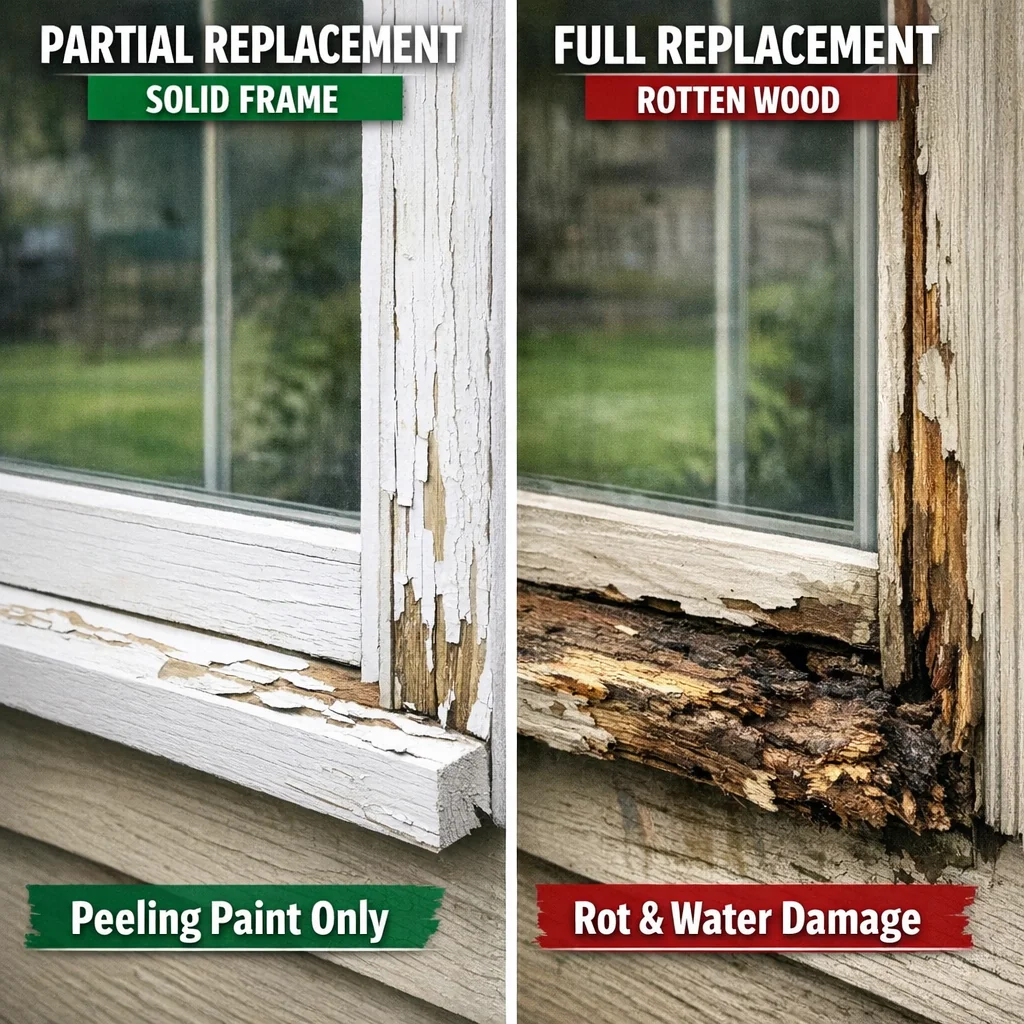
A trustworthy contractor will walk through this assessment with you before making a recommendation. If someone leads with full replacement before inspecting your existing frames, that is a signal worth paying attention to.
Most contractor websites treat material categories as endpoints. “Asphalt shingles” appears as a service description, full stop. But within that category, there are meaningful differences that affect how your home performs over the next 20 to 30 years.
| Feature | Entry-Level Shingle | Premium Architectural Shingle |
|---|---|---|
| Weight and thickness | Lighter, thinner profile | Heavier, multi-layer laminated |
| Wind resistance | Typically rated to 60-80 mph | Often rated to 110-130 mph or higher |
| Impact resistance | Standard | Class 3 or Class 4 available |
| Warranty duration | Limited, shorter coverage | Limited lifetime on qualified installs |
| Appearance | Flat, uniform look | Dimensional, shadow-line depth |
CertainTeed Landmark shingles, which Smithrock uses as our standard product, sit firmly in the premium architectural category. The difference between a qualifying shingle and a non-qualifying one is not just aesthetic. It determines the warranty tier available to the homeowner, the wind and impact performance of the roof in real conditions, and the long-term durability of the installation. For homeowners who want to understand how storm conditions specifically affect these choices, our Storm Damage Roof Repair: NC Triad Homeowner Guide covers those scenarios in depth.
Siding varies by panel thickness, profile depth, and surface texture. Thicker panels resist impact and warping more reliably. Profile depth affects how the finished exterior reads visually and how well it channels water away from the wall assembly. These are not details to skip over when comparing estimates.
The themes running through this article, certification, crew continuity, honest replacement guidance, and material specificity, are not independent selling points. They form a connected system of protection for your home and your investment.
Certified installers activate manufacturer warranties. Experienced, direct-hire crews make workmanship guarantees enforceable. Honest partial-versus-full guidance keeps you from spending more than your home actually needs. Material specificity ensures the product installed matches the performance you are paying for.
Smithrock Roofing serves homeowners across Winston-Salem, Greensboro, High Point, Kernersville, Clemmons, Rural Hall, King, and Mount Airy. With more than 350 five-star reviews and an A+ BBB rating, our reputation in this region is built on exactly this kind of straightforward, no-pressure approach. We are happy to inspect what you have, tell you honestly what it needs, and back the work we do with credentials and guarantees that actually hold up.
A triad installation refers to a coordinated approach where certification, crew quality, and material selection work together as a unified system rather than as separate choices. A standard roofing job may meet basic requirements but leave gaps in warranty coverage, workmanship accountability, or material performance. A triad installation is designed so that each element reinforces the others, giving the homeowner a more complete and verifiable outcome.
The honest answer depends on the age of the existing shingles, the extent of damage, and whether the surrounding material is still performing reliably. If the affected area is isolated and the rest of the roof is in solid condition, a partial repair can be the appropriate and more cost-effective path. If the shingles are nearing the end of their service life or damage is widespread, a full replacement is likely to serve you better long-term. A qualified inspector should be able to walk you through the reasoning, not pressure you toward the larger job.
Most manufacturer warranty programs, including the CertainTeed Sure Start Protection coverage, require that installation be completed by a credentialed contractor. If the installer does not hold the appropriate certification at the time of installation, the enhanced warranty tiers simply are not available to you, regardless of the quality of the shingles themselves. Certification is the mechanism that connects the product’s warranty potential to your actual home.
It matters considerably when something goes wrong. When a contractor uses direct-hire crews, workmanship guarantees are enforceable because there is a clear chain of responsibility. With subcontracted labor, accountability can become unclear and disputes over who is responsible for a defect can leave the homeowner without recourse. Crew continuity also affects quality consistency, since experienced teams working together regularly develop reliable habits and shared standards.
Homeowners in Winston-Salem and Kernersville deserve a roofing partner who can explain the work clearly, back it with real credentials, and stand behind the outcome. Smithrock Roofing brings certified installation, direct-hire crews, and honest guidance to every project across the Triad, because that combination is what actually protects your home. To schedule an inspection or get a no-pressure estimate, call us at (336) 971-0464 or Contact Smithrock Roofing today.

Smithrock Roofing © Copyright 2026 • All Rights Reserved • Privacy Policy • Maintained by Mongoose Digital Marketing