A flat roof does its job quietly until it doesn’t. By the time a water stain appears on your ceiling, the damage above it has usually been building for weeks or months. The good news is that flat roofs are genuinely manageable systems when you understand what to watch for and why. This guide goes beyond the standard checklist to explain the mechanical reasoning behind each maintenance step, give you a clear framework for deciding when a problem is yours to fix and when it needs a professional, and help you keep records that actually matter.
Flat roofs are not truly flat. They are designed with a slight slope, typically a quarter inch of drop per linear foot, to guide water toward drains, scuppers, or edges. The membrane covering the roof deck does all the waterproofing work, and it faces stresses that pitched-roof shingles do not. Without a slope steep enough to shed water quickly, a flat roof membrane sits in contact with standing water, UV radiation, and repeated temperature cycles. Each of those stresses has a specific effect on the material, and understanding them makes the maintenance tasks feel less arbitrary.
Flat roof membranes expand when temperatures rise and contract when they fall. Over hundreds of cycles, this movement creates stress at every seam, flashing edge, and penetration. Membranes eventually crack or separate at those stress points because the material loses its elasticity as it ages. This is the mechanical reason that blistering, splits, and flashing separations are the most common flat roof problems rather than random punctures. The roof is not failing randomly; it is failing at the points where movement stress concentrates.

You will hear often that ponding water should be addressed within 48 hours. Here is what is actually happening during that window. Standing water adds weight to the membrane and the deck beneath it. More importantly, water finds every micro-crack and seam it can reach, working into the membrane layer and then into the insulation below. Once insulation becomes saturated, it loses its thermal value and creates a consistently damp environment against the deck. Wood decking responds to sustained moisture by softening and eventually rotting. The 48-hour figure is not arbitrary; it reflects the approximate time before water penetration moves from a surface problem to a substrate problem.
Not all ponding has the same cause, and the right fix depends on identifying which type you have. These two are easy to confuse but require completely different responses.
| Ponding Type | Diagnostic Sign | Root Cause | Correct Fix |
|---|---|---|---|
| Drain-related | Clears after drains are cleaned | Debris blocking drains or scuppers | Regular drain maintenance |
| Slope-related | Returns to same spot despite clear drains | Roof deck has deflected or settled over time | Tapered insulation or re-sloping |
If you clean your drains and ponding disappears, the problem is maintenance. If water pools in the same location every time regardless of drain condition, the deck itself has shifted. Over years, roof decks deflect slightly under load and settle at connection points, changing the original drainage slope. Clearing debris cannot fix a structural change in the deck. The solution in that case is tapered insulation panels, which are thicker on one end and installed over the existing roof deck to re-establish drainage toward edges or drains. This is a professional repair, but understanding the distinction saves you from maintaining a roof that will pond indefinitely no matter how often you clean it. If you want to understand how this type of work is approached at a larger scale, the article on commercial flat roof repair covers slope correction and structural drainage fixes in detail.
Need a hand with this in Winston-Salem, Greensboro and the Triad? Call (336) 971-0464 or request a free estimate. Honest answers, no pressure.
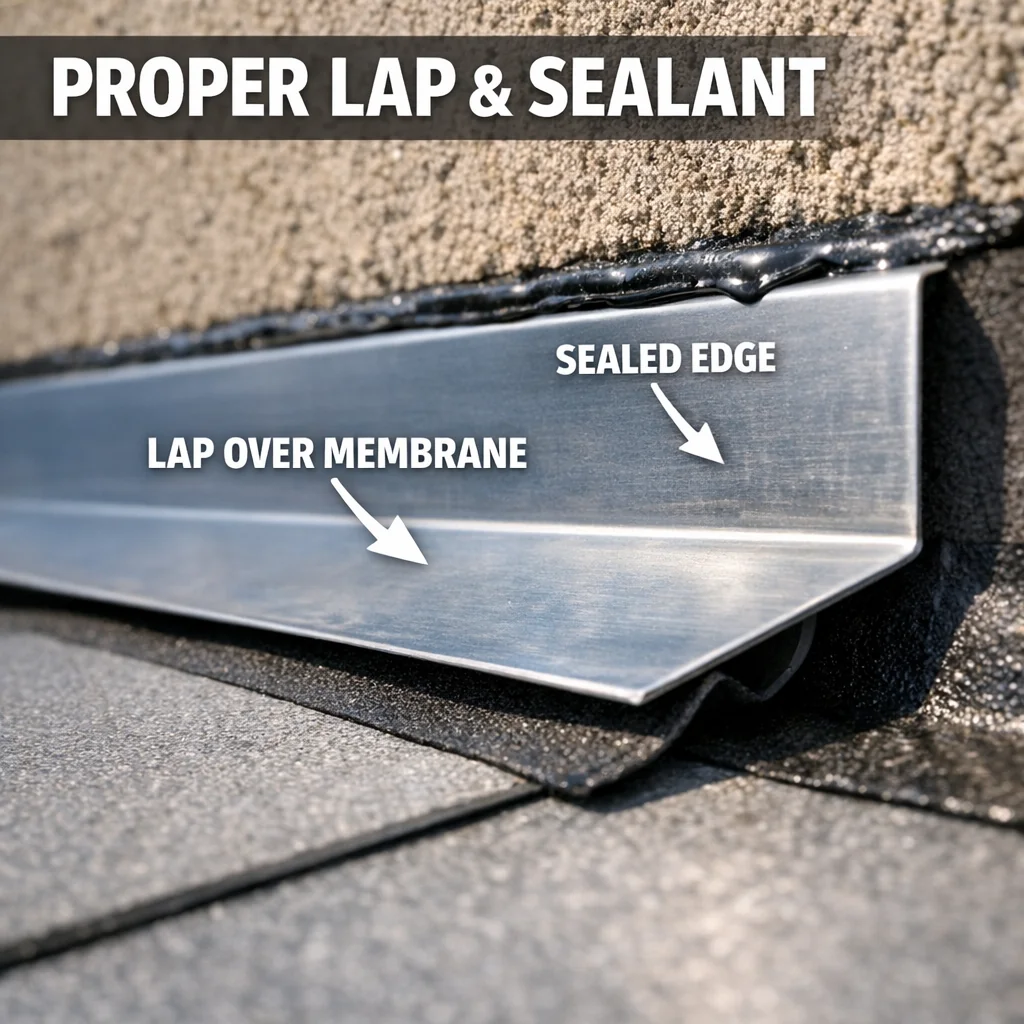
Flashings seal the joints where the roof membrane meets vertical surfaces: parapet walls, skylights, HVAC curbs, pipes, and chimneys. Every competitor will tell you that flashings are a common leak source. What they rarely explain is how to tell a flashing failure from a membrane failure when you are standing inside looking at a water stain.
A leak that appears directly below a penetration is almost always a flashing problem. A leak that appears between penetrations, in an open field of ceiling, is more likely a membrane crack or seam separation. This distinction matters because the repair approaches are different and because misdiagnosing the source leads to fixing the wrong thing.
Three specific flashing conditions cause most failures:
Roof coatings extend membrane life by protecting against UV degradation and providing an additional waterproofing layer. The mistake that leads to coating failure is treating all coatings as interchangeable. They are not.
The membrane already on your roof determines which coating will bond correctly to it:
Applying an incompatible coating does not just waste the coating. It can trap moisture beneath a partially bonded film, accelerating the membrane degradation it was meant to slow. When in doubt, the membrane manufacturer’s documentation specifies compatible coating products, and a qualified roofer can confirm the match before any product is applied. Our roofing service includes professional coating assessment to ensure the right product is matched to the right membrane before any work begins.
The disagreement in the roofing world about DIY flat roof repair is real but resolvable. The substrate condition is the deciding variable. Here is how to think through it.
If a damaged area feels spongy when you press on it, stop. Sponginess means moisture has reached the deck or the insulation layer beneath the membrane. A surface patch over a deteriorated deck is a temporary cover over a structural problem. The patch will appear to hold for a season and then fail again, often in a slightly different location as the underlying damage spreads. This is the scenario where covering existing roofing creates more problems than it solves.
If the damaged area is firm, the deck is sound, and the damage is surface-level, a DIY patch using mastic and reinforcing webbing fabric is a legitimate repair. The webbing is important. Mastic alone has no tensile strength. When the roof expands and contracts with temperature, an un-reinforced mastic patch cracks because the repair cannot accommodate the movement. Webbing gives the patch tensile capacity, the same way rebar gives concrete the ability to handle tension. Apply mastic to the clean, dry repair area, embed the webbing while the mastic is wet, and then apply a second coat. Keep the center of the patch thicker and feather the edges down gradually. A thick edge lifts and peels; a feathered edge stays bonded.
The firm-versus-spongy test does not require tools. It takes thirty seconds and tells you whether the repair is in your hands or needs a professional assessment.
Maintenance records are worth keeping because the consequences of not having them are concrete. Manufacturer warranties on flat roof systems typically require documented evidence of regular maintenance; without it, a warranty claim can be denied even if the failure would otherwise be covered. Insurance adjusters reviewing storm damage claims look for evidence of pre-existing neglect versus storm-caused damage; a clear maintenance log supports your claim. And buyers conducting due diligence on a property will ask about roof condition; documented maintenance history is a more credible answer than an estimate or a memory.
A useful maintenance record includes:
This does not need to be elaborate. A simple document or folder with dated entries and photos is enough. The discipline of maintaining it is more valuable than the format.
Homeowners across Winston-Salem, Greensboro, High Point, Kernersville, Clemmons, Rural Hall, King, and Mount Airy can reach the Smithrock Roofing team for flat roof inspections, repairs, and professional assessments. For those specifically looking for roofing in Greensboro, our local team is familiar with the climate conditions and property types in the area and brings that knowledge to every inspection and repair. With more than 350 five-star reviews and 60-plus combined years of experience, we bring the same honest, thorough approach to every flat roof we work on.
Most flat roofs benefit from at least two inspections per year, once in the spring after winter weather and once in the fall before temperatures drop. Any significant storm is also a good reason to do a quick walkthrough. Consistent inspections are what catch small problems before they become structural ones.
Soft or spongy areas underfoot, standing water that remains more than 48 hours after rain, bubbling or blistering in the membrane, and visible cracks or splits around seams or penetrations are all signs that a professional assessment is warranted. Interior water stains that appear after rain are another reliable indicator that something on the roof surface has failed.
Yes. Because flat roofs have little to no slope, they depend entirely on drains, scuppers, and properly maintained membranes to move water off the surface. Without that drainage working correctly, water sits and creates pressure on seams and flashings that pitched roofs simply don’t experience. Maintenance priorities, drain clearing, membrane inspection, flashing integrity, reflect that difference directly.
A well-executed repair on a sound membrane can last many years, but the longevity depends on the underlying condition of the roof, the quality of materials used, and whether the repair addressed the actual source of the problem. Repairs made over deteriorated or saturated substrate tend to fail sooner. That is why identifying the true cause of a leak matters as much as the repair itself.
A flat roof that gets steady attention, cleared drains, documented inspections, and prompt repairs, will consistently outlast one that only gets looked at when something goes wrong. Smithrock Roofing has served homeowners and property owners across Winston-Salem and Greensboro with the kind of honest, experienced work that keeps roofs performing for the long term. If your flat roof is due for an inspection or you have a repair that needs a professional eye, call us at (336) 971-0464 or Contact Smithrock Roofing to get started.

Smithrock Roofing © Copyright 2026 • All Rights Reserved • Privacy Policy • Maintained by Mongoose Digital Marketing