
A roof loan calculator is a planning tool, not a financing decision. It gives you a starting point: an estimated monthly payment based on a loan amount, an interest rate, and a repayment term you choose. What it cannot do is tell you which financing type fits your situation, whether the rate you entered is actually available to you, or whether a 0% promotional offer shown in the inputs would cost you nothing or potentially thousands more if you misread the fine print. Understanding the gap between the number on the screen and the real cost of borrowing is where most homeowners get into trouble, and it is entirely avoidable with a little preparation before you ever call a contractor.
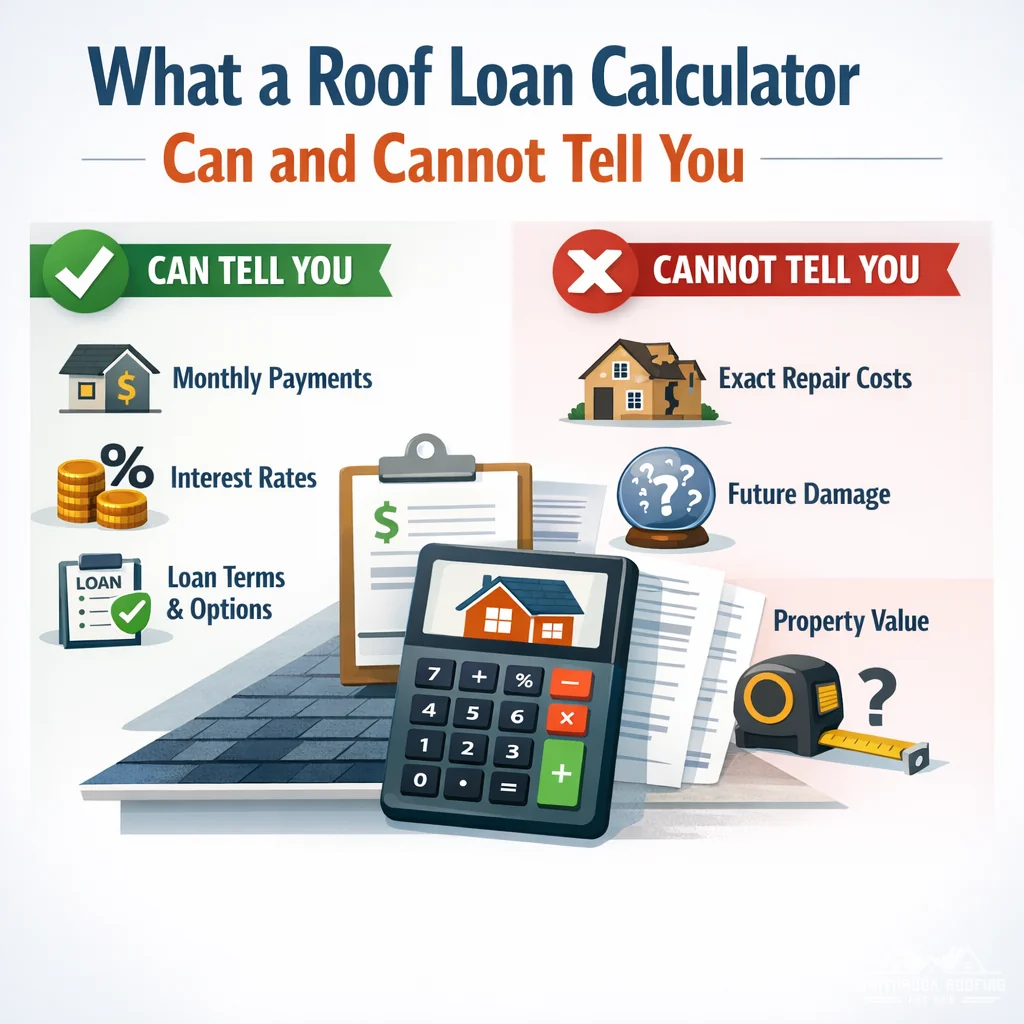
Every roof loan calculator uses the same basic math: it takes a loan amount, applies an annual percentage rate, and divides the total cost of that loan across the number of monthly payments in your chosen term. The output is a single monthly payment figure.
That number is useful for one specific purpose: confirming that a payment is within your monthly budget before you sit down with a contractor. It is not a rate quote, an approval, or an accurate reflection of what you will actually owe until a lender reviews your application and issues a written offer with confirmed terms.
Two things the calculator cannot surface are equally important. First, the total interest you pay over the life of the loan matters far more than the monthly payment when comparing financing options. A longer term lowers the monthly number but raises the total cost of borrowing significantly. Second, a 0% APR input in a calculator and a real 0% promotional loan offer look identical in the output, but they can behave very differently depending on whether the offer is a true no-interest loan or a deferred-interest program.
Illustration, not a photograph of a completed client project.
Some contractor-offered financing programs, commonly arranged through third-party lenders, advertise a promotional period with no interest. The critical distinction is whether that offer is a true 0% APR loan or a deferred-interest plan.
With a true 0% APR loan, no interest accrues during the promotional period. If you pay off the balance before the term ends, you owe nothing beyond the principal.
With a deferred-interest plan, interest accrues from day one at the full rate. If you have not cleared the entire balance before the promotional period closes, every dollar of that accumulated interest is added back to your balance immediately. The calculator shows you the same monthly payment for both options. The written loan disclosure is where the difference appears.
Before signing any contractor financing agreement, look for this language in the disclosure document: “interest accrues from the date of purchase” or “deferred interest if not paid in full.” Those phrases signal a deferred-interest structure, not a true promotional 0% offer. A phrase like “no interest if paid in full within [X] months” with no mention of retroactive accrual is more consistent with a true promotional loan, but always confirm with the lender directly before accepting terms. Many roofing contractors offer in-house financing through third-party lenders; APRs are typically 14-24%+ after any promotional period, and deferred-interest programs are common in this category. (Source: myhomecostcalc.com/roofing/roof-financing-calculator)
Have a roofing question about your home? Send a message with your town, your current roof material and the repair or material question you want to resolve. Mention this article about roof loan calculator and ask for a written explanation of possible next steps. You can also review Roofing.
Most guides rank financing options from lowest to highest APR and stop there. The more useful question is under what conditions each option makes sense, and when you should move to the next one.
| Financing Type | Typical APR Range | When It Makes Sense | Key Condition That Disqualifies It |
|---|---|---|---|
| HELOC | 5-9% | You have meaningful equity in your home and the project scope may shift | Insufficient home equity or early-stage mortgage |
| Personal Loan | 10-18% | You need fast funding, have solid credit, and want a fixed payment | Very poor credit score will push rates toward the high end |
| Contractor Financing | 15-24%+ after promotional period | You need maximum convenience and can pay off before promotional period ends | Cannot distinguish deferred interest from true 0% APR offer |
| Credit Card | 20-29% | True last resort for smaller repairs only | High balance will compound quickly; avoid for full replacements |
(APR ranges sourced from myhomecostcalc.com/roofing/roof-financing-calculator.)
The HELOC option is frequently described as the best choice because it carries the lowest rates. That is accurate when it is available. For homeowners in the earlier years of their mortgage, or in markets where home values have been flat, the equity needed to qualify for a HELOC may simply not exist. No calculator asks you that question before recommending it.
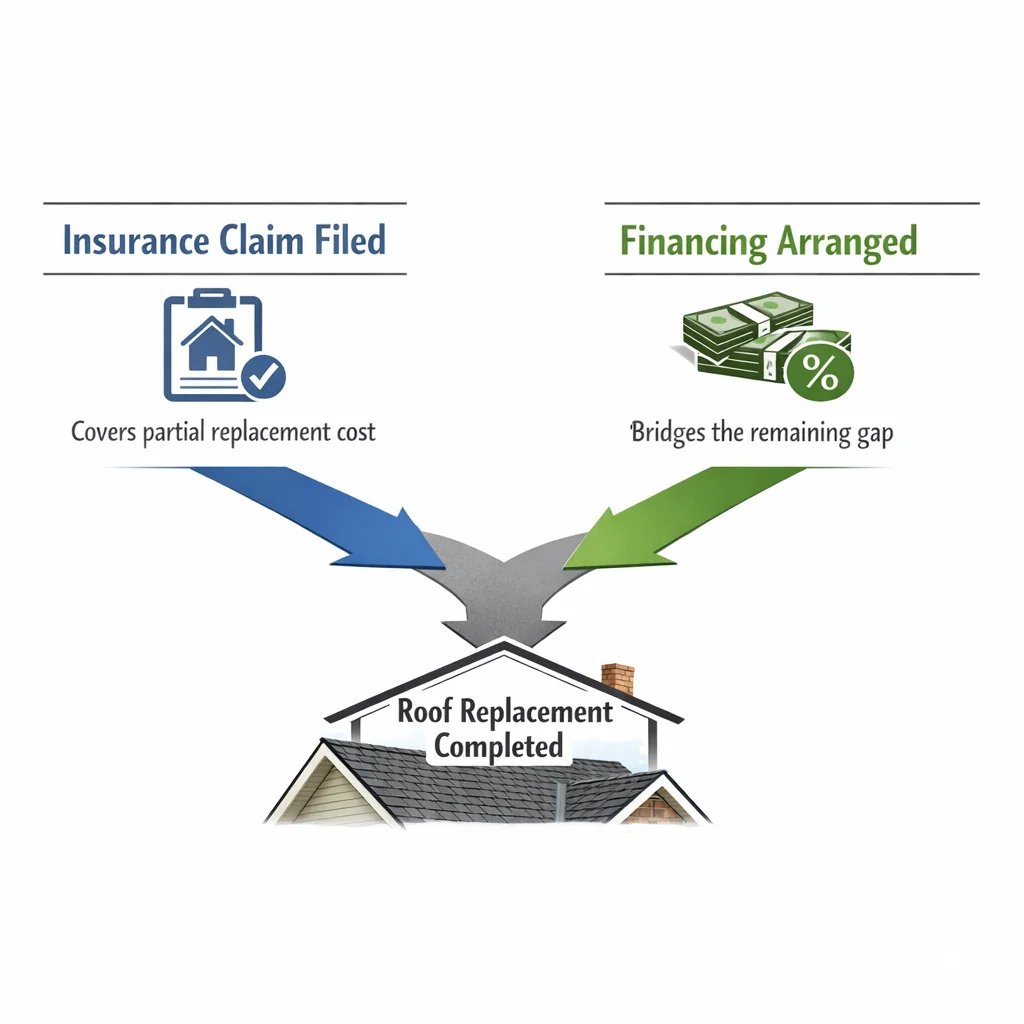
The choice between filing an insurance claim and taking out a loan is not always binary. A partially covered claim is one of the most common situations homeowners face, particularly when an aging roof receives a payout based on actual cash value rather than full replacement cost.
Under an actual cash value policy, your insurer deducts depreciation from the payout. An older roof may receive a significantly reduced settlement that covers only a portion of the replacement. In that situation, financing bridges the gap between what the insurer pays and what the project requires. The insurance claim comes first because it reduces the amount you need to borrow. Financing then covers only the remainder.
If damage was caused by a covered event such as hail or wind, file the claim before arranging any financing. Our storm damage roof repair guide walks through how to document damage and navigate the insurance process before costs escalate. Document the damage with dated photographs before any repairs begin, and understand whether your policy pays replacement cost value or actual cash value, since that determines the size of the gap financing may need to fill.
Illustration, not a photograph of a completed client project.
When you use a roof loan calculator and consider applying for financing, you are dealing with three distinct numbers that serve three different purposes.
The calculator estimate tells you whether a monthly payment is in a range you can budget for. Use it before any contractor conversation to set a realistic ceiling on what you want to finance.
The pre-qualification result from a soft credit pull gives you a lender’s early indication of the rate and terms you may qualify for. This does not affect your credit score, but it is not a final offer. The rate and amount can change when your application is formally reviewed.
The formally approved loan amount is the only number to use when finalizing your project scope with a contractor. It requires a hard credit pull and is subject to full underwriting. Until you have this number in writing, any contractor conversation about financing should remain preliminary.
If you want to compare offers from multiple lenders, which is strongly advisable, submit all formal applications within a 14-day window. Credit scoring models typically treat multiple hard inquiries for the same loan type within that period as a single inquiry, limiting the impact on your score. (Source: myhomecostcalc.com/roofing/roof-financing-calculator)
The practical implication is that the calculator phase and the application phase should be separated deliberately. Use the calculator across different scenarios to understand how term length and APR affect total cost. Then collect soft-pull pre-qualification estimates from several lenders. Only after reviewing those estimates should you select your lender and submit a formal application that triggers a hard pull.
Smithrock Roofing serves homeowners across the NC Triad, including roofing in Winston-Salem, Greensboro, High Point, Kernersville, Clemmons, Rural Hall, King, and Mount Airy. Before any financing conversation begins, we recommend starting with a clear understanding of what your roof actually needs, whether that is a repair or a full replacement. You can learn more about what goes into a roofing project through our roofing service page.
A roof loan calculator is a reasonable starting point. Knowing how to read its output, and what it is not telling you, is what turns that estimate into a smart financial decision.
No. Calculator inputs are mathematical illustrations. A 0% entry shows you what a payment would look like if no interest applied. It does not mean any lender is offering you that rate. Always use the APR from a confirmed written lender disclosure, not a calculator preset, when planning your actual budget.
If a covered event such as hail or wind caused the damage, file the claim first. Your insurer’s settlement reduces the amount you need to borrow. If the damage is from normal aging, insurance typically will not cover it, and financing is the appropriate path.
A soft pull lets a lender give you a preliminary rate estimate without affecting your credit score. A hard pull is a formal inquiry that appears on your credit report and is required for final loan approval. Pre-qualification uses a soft pull; a full application uses a hard pull.
Read the written disclosure before signing. Language such as “interest accrues from the date of purchase” or “interest charged if not paid in full” indicates a deferred-interest structure. If the disclosure is unclear, ask the lender to confirm in writing whether interest accrues during the promotional period. (Source: myhomecostcalc.com/roofing/roof-financing-calculator)
Yes. If an insurance claim covers a portion of the cost, you can finance only the remaining balance. This is a common approach and typically reduces your monthly payment and total interest compared to financing the full project amount.
No. A calculator output that fits your budget is a useful starting point, but it is not a reliable number for committing to a project. The rate you entered may not reflect what any lender will actually offer you, and the loan amount shown has not been reviewed by an underwriter. Only a formally approved loan offer, with a confirmed APR and term in writing, gives you a number that is safe to use when finalizing project scope with a contractor.
When you submit formal applications to multiple lenders within a 14-day window, credit scoring models typically treat those inquiries as a single inquiry for the same loan type. This means rate-shopping across lenders during that window generally has far less impact on your score than submitting applications at different times spread across several weeks. Using soft-pull pre-qualification tools before submitting any formal application adds another layer of protection, since soft inquiries do not affect your score at all.
Read the written loan disclosure before signing anything. Language such as “interest accrues from the date of purchase” or “interest charged if balance is not paid in full” indicates a deferred-interest structure, meaning interest has been accumulating from day one and will be added back to your balance if you have not cleared it before the promotional period ends. If you are uncertain after reading the disclosure, ask the lender directly to confirm in writing whether interest accrues during the promotional period. Never rely on a verbal description of the offer or on what a calculator input shows you. (Source: myhomecostcalc.com/roofing/roof-financing-calculator)
Not always. A HELOC typically offers the lowest APR of the common roof financing options, which makes it attractive when it is available. However, it requires meaningful home equity to qualify, which means homeowners in the earlier years of their mortgage or in markets where home values have been flat may not have sufficient equity to access this option. The right financing type depends on your specific equity position, credit profile, and how quickly you need funding, not on a general ranking of options by rate alone.
A roof loan calculator is most valuable when you understand exactly what it is and what it is not. It is a budgeting tool that lets you test scenarios before a contractor conversation, not a rate quote, an approval, or a guarantee that any promotional offer works the way you expect. The decisions that matter most, distinguishing deferred interest from true 0% APR, choosing the financing type that fits your equity and credit situation, and knowing whether an insurance claim should come before any borrowing, require reading written disclosures, comparing formal offers, and understanding how each financing structure behaves over its full term.
Getting those details right before committing to a project is what separates a manageable monthly obligation from a financial outcome that surprises you long after the roof is installed. The calculator gives you a place to start. The work of becoming an informed borrower happens in the steps that follow it.

Smithrock Roofing © Copyright 2026 • All Rights Reserved • Privacy Policy • Maintained by Mongoose Digital Marketing