
When a fascia board goes bad, the repair decision comes down to three things: how far the damage has traveled, what caused it in the first place, and whether the contractor you hire will inspect the full system or just the board they can see from the driveway. Get all three right and the fix holds. Miss any one of them and you will be paying for the same repair again in a few years.
At Smithrock Roofing, we handle exterior work across Winston-Salem, Greensboro, High Point, Kernersville, Clemmons, Rural Hall, King, and Mount Airy. This guide walks you through the system, the failure patterns, and the questions that separate a thorough contractor from one who is just patching what is visible.
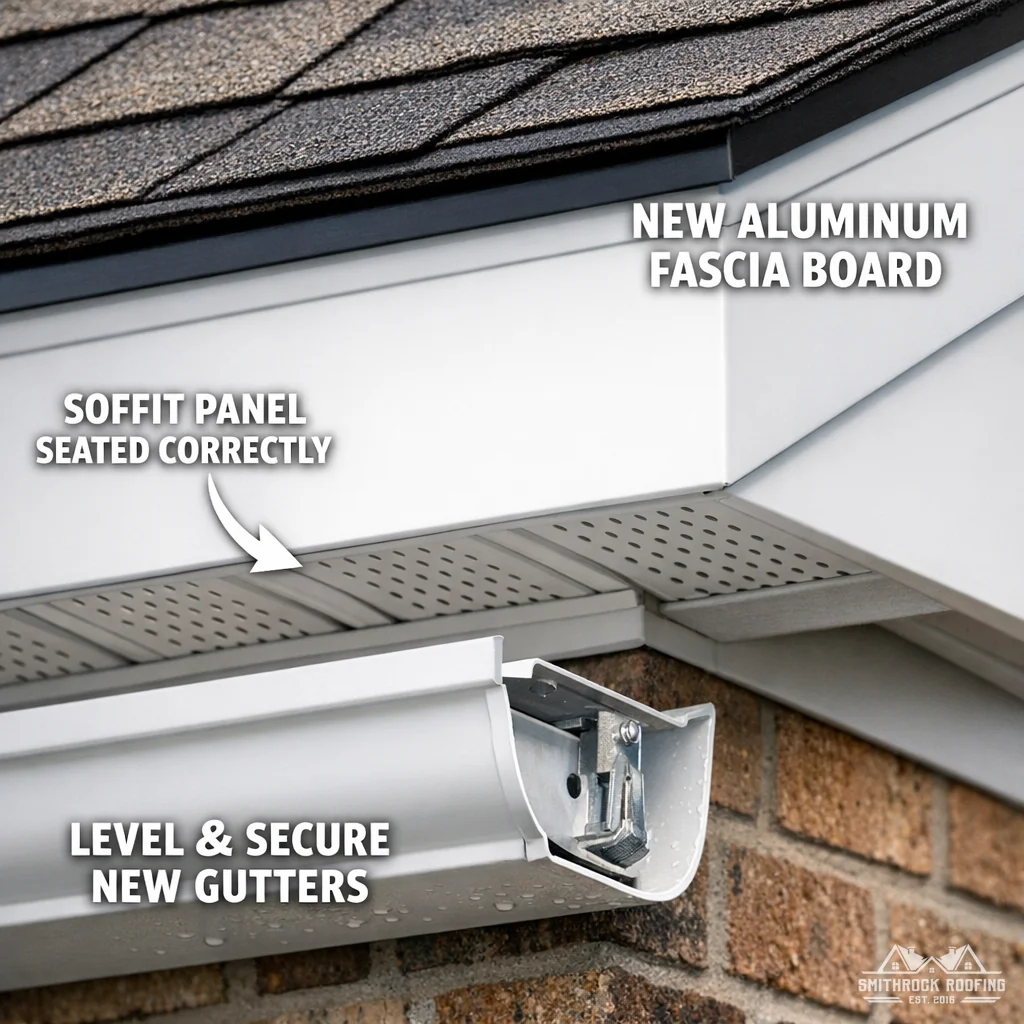
The fascia is the vertical board that runs along the lower edge of your roofline. Your gutters are screwed directly into it. Behind the fascia, rafter tails extend out from the roof structure, and below the fascia, the soffit panel closes off the underside of the overhang. That sequence, rafters to sub-fascia to finish fascia to soffit to gutter, is a system. When one part fails, the parts adjacent to it are almost always involved.
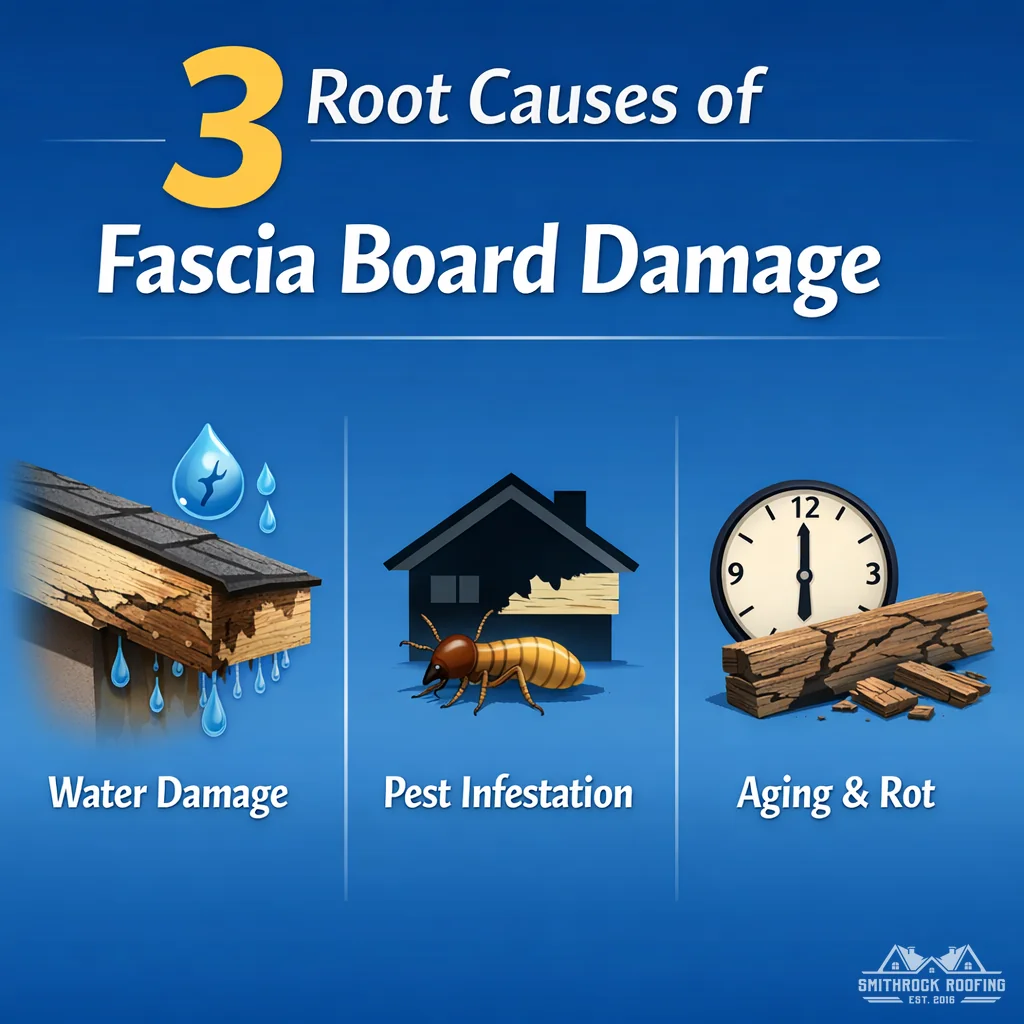
Fascia boards fail for three distinct root causes, and each one changes what the repair needs to look like.
This is the most common cause. When gutters clog or pull away from the fascia face, water does not sheet off cleanly. It backs up behind the gutter lip and runs down the back of the gutter onto the fascia. From there it wicks into the end grain of the board, the part that absorbs moisture fastest, and rot begins from the inside out. By the time you see soft or discolored wood on the face of the fascia, the damage has already progressed inward.
The critical point: replacing the fascia board without correcting the gutter slope, rehinging loose hangers, or addressing overflow will reproduce the exact same failure. The fascia is the symptom. The gutter system is the cause. Our gutter replacement guide covers the details contractors often leave out when scoping this type of repair.
Soffit vents draw cool air into the attic, which exits through ridge or gable vents. When this airflow is blocked or insufficient, moisture builds up in the attic and works outward through the eave assembly, softening the soffit first and then the fascia behind it. Replacing fascia and soffit panels without adding ventilation capacity replicates the original failure condition. The new boards sit in the same moisture environment the old ones rotted in.
Squirrels, birds, and other wildlife target softened or aging soffit material because it is easier to chew through. Once an entry point opens, the problem compounds quickly. Animals carry nesting materials that trap moisture, degrade insulation, and can reach rafter tails. Replacing the panels without sealing the entry point, and without understanding why the material was accessible in the first place (usually because it had already softened from one of the first two causes), means repeat intrusion is likely.
Illustration, not a photograph of a completed client project.
Have a question about fascia board replacement contractors? Send a message with the situation you are working through and the decision you need help with. Ask for a written explanation of possible next steps.
Many homes have two layers at the roofline: a structural sub-fascia nailed directly to the rafter tails, and a thinner finish fascia face-nailed over it. Most contractor pages treat fascia replacement as one task. It is not.
If the sub-fascia has softened, replacing only the finish fascia is a cosmetic repair. The rot is still present behind the new board, the gutter anchor point remains compromised, and the new board will fail in the same way. A thorough fascia contractor will probe both layers and be explicit in their written scope about which one is being replaced and why.
The correct sequence for eave repair is: remove gutters, inspect fascia, assess soffit, repair or replace components in order, then reinstall or replace gutters. This is not just a quality preference. It is a visibility issue.
A contractor who leaves the gutters in place while writing your estimate cannot see the full face of the fascia board. The gutter covers the top portion of the board, which is precisely where water damage concentrates. Any warranty written on that repair is functionally incomplete because the contractor could not inspect the area they are guaranteeing.
One question that separates thorough contractors from surface-level ones: “Will you remove the gutters before you write my estimate?” If the answer is no, the scope of work is incomplete before it is written.
| Feature | Fascia | Soffit |
|---|---|---|
| Location | Vertical board at roofline edge | Horizontal panel under the overhang |
| Gutter relationship | Gutters attach directly to fascia | Soffit tucks behind fascia |
| Visibility | Visible from the street | Only visible looking up from below |
| Typical discovery | Early, often before damage spreads | Late, often when symptoms appear elsewhere |
| Common late-stage symptoms | Peeling paint, soft wood, sagging gutters | Bubbling paint on eave, animal entry, attic moisture |
| Damage radius at discovery | Usually limited to affected run | Often larger than it appears; adjacent fascia likely involved |
Because soffit damage is discovered late, the actual repair area is almost always larger than a visual inspection suggests. By the time soffit rot becomes visible or symptomatic, moisture has typically already reached the fascia behind it and, in some cases, the rafter tails themselves. A contractor who probes and tests adjacent fascia even when only soffit appears damaged is doing the job correctly. A quote that addresses only the visible soffit panels without examining the connected fascia is almost certain to underestimate the real scope.
Three materials are available for fascia and soffit replacement. The right choice depends on your home’s existing profile, your maintenance preferences, and what caused the failure in the first place.
Aluminum wrapping, covering existing wood fascia with a formed aluminum cap, is a separate option that some contractors offer. It protects the wood surface from direct moisture exposure but does not address sub-fascia rot underneath. If the wood behind it is already compromised, wrapping over it traps the existing damage.
Illustration, not a photograph of a completed client project.
A thorough fascia replacement project, handled by a contractor who understands the system, includes the following:
Smithrock Roofing serves homeowners across the NC Triad and is fully licensed and insured. Our approach is to diagnose the cause first and quote what we actually find. Homeowners looking for roofing in Greensboro can reach out for a no-pressure estimate. If you have noticed soft wood, peeling paint along the roofline, sagging gutters, or any sign of animal activity at the eave, we will remove the gutters before we write a single line of scope.
The only reliable way to tell is to probe both layers after the gutters have been removed. The finish fascia is the thinner board you see from the street; the sub-fascia sits directly behind it, nailed to the rafter tails. If the finish fascia feels soft or spongy when pressed, the sub-fascia behind it has very likely absorbed moisture as well, because water wicks inward from the end grain. A contractor who probes only the visible face without removing the gutter and checking both layers cannot give you an accurate answer. Ask specifically whether the written scope identifies which layer is being replaced and why.
Not for fascia damage caused by water infiltration. The gutter covers the upper portion of the fascia face, which is exactly where water concentrates after backing up behind the gutter lip. A contractor who writes a scope with the gutters still in place is quoting only what they can see, and the area most likely to be damaged is the area they cannot see. The question to ask before any estimate is written: “Will you remove the gutters before you scope this job?” The answer tells you whether you are getting a surface quote or a complete one.
Yes. Soffit damage is almost always discovered later than fascia damage because it is only visible when you stand beneath the overhang and look up. By the time fascia rot is confirmed, moisture has frequently already reached the adjacent soffit panels and, in more advanced cases, the rafter tails behind them. A contractor doing fascia work correctly will probe the connected soffit even when the visible complaint is fascia-only. A quote that addresses only the boards a homeowner flagged, without examining what is adjacent, is likely to underestimate the actual repair area.
Replacing wood with a more moisture-resistant material reduces the board’s susceptibility to rot, but it does not eliminate the possibility of repeat damage if the root cause has not been corrected. If the original failure came from a gutter drainage problem, inadequate attic ventilation, or an animal entry point, those conditions need to be addressed as part of the repair, not just the boards themselves. New aluminum or vinyl fascia installed in the same moisture environment that destroyed the original boards will eventually show the same failure patterns. Material selection matters; root-cause correction matters more. Our roofing service includes a full eave assessment so that material upgrades are paired with the underlying fixes that make them last.
Fascia board replacement sits at an intersection that most homeowners do not expect: it touches the gutter system, the soffit, the rafter structure, and the ventilation path all at once. The board itself is replaceable in an afternoon. Understanding what damaged it, how far that damage has traveled, and whether the contractor you hire will look at the full system before writing a single line of scope is what separates a repair that holds from one that repeats.
The article’s core question remains the most useful filter you have before anyone gets on a ladder: will the gutters come down before the estimate is written? If the answer is yes, the conversation that follows is worth having.

Smithrock Roofing © Copyright 2026 • All Rights Reserved • Privacy Policy • Maintained by Mongoose Digital Marketing