
A water stain appears on your ceiling after a heavy rain. You dry it, paint over it, and it comes back. That pattern is one of the most common calls a roof waterproofing contractor receives, and the answer almost always involves more than patching the visible spot. Understanding what roof waterproofing actually means, how the right system gets selected, and what separates a durable installation from one that fails in two seasons will help you make a genuinely informed decision before you hire anyone.
Smithrock Roofing serves homeowners across Winston-Salem, Greensboro, High Point, Kernersville, Clemmons, Rural Hall, King, and Mount Airy, and this guide reflects the kind of honest, practical advice we believe every homeowner deserves before the conversation even starts.
These two terms get used interchangeably, and that is a problem. They are not the same thing, and specifying the wrong one means your roof or structure is under-protected from the start.
Dampproofing slows vapor transmission and surface moisture. It is appropriate for conditions where the goal is managing humidity or minor condensation, not resisting water under pressure.
Waterproofing creates a continuous barrier that resists hydrostatic pressure, meaning it holds back active water intrusion even when water is sitting against the surface. For roof applications, this is the standard that matters.
If a contractor proposes a dampproofing product for a surface that experiences standing water or active leaks, that is a specification mismatch. The fix will be temporary at best.
Have a roofing question about your home? Send a message with your town, your current roof material and the repair or material question you want to resolve. Mention this article about roof waterproofing contractor and ask for a written explanation of possible next steps. You can also review Roofing.
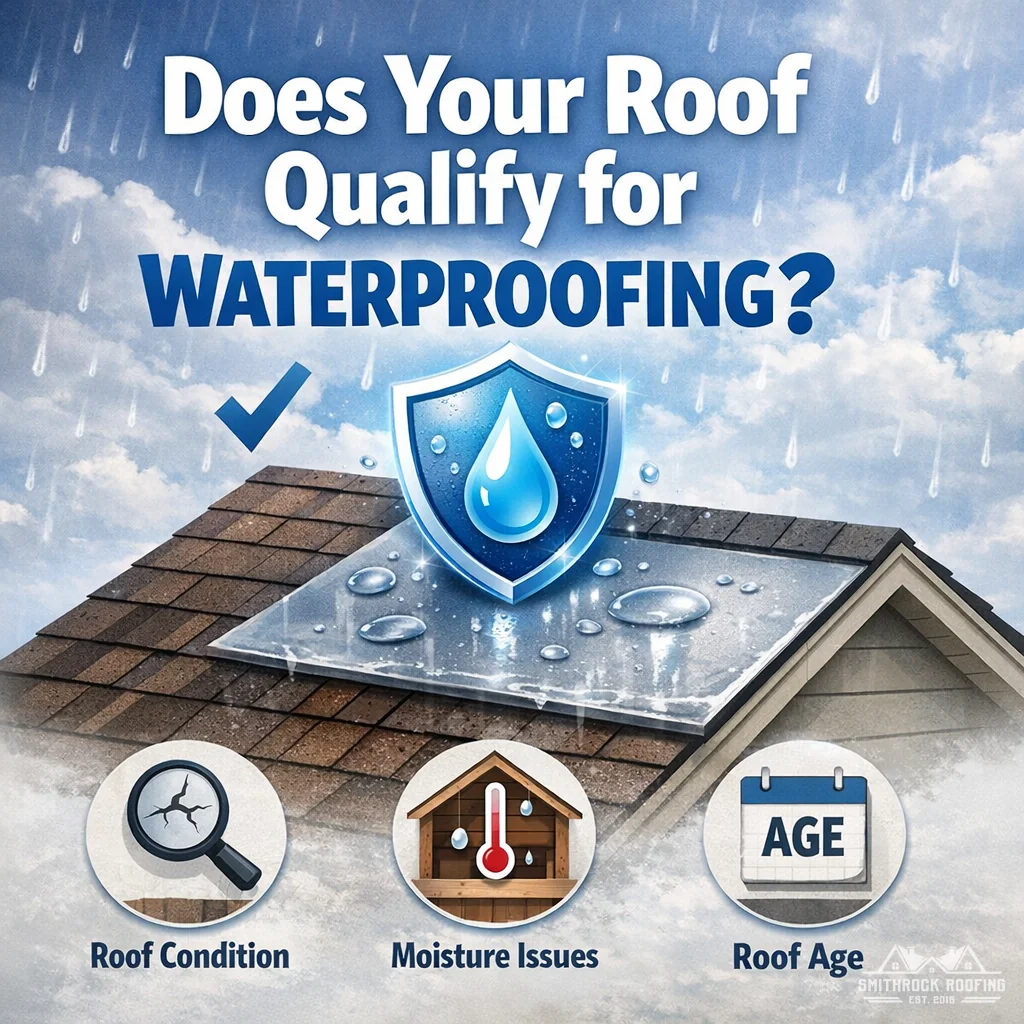
One of the most important things an experienced roof waterproofing contractor does happens before any product is selected: they determine whether a coating or overlay system is even appropriate for your roof.
This is not a minor detail. Applying a liquid-applied membrane or coating system to a roof that does not qualify creates the appearance of a repair while locking moisture problems underneath a new surface layer.
A qualified contractor evaluates several conditions before recommending a coating or membrane overlay:
When a roof does not qualify, an honest contractor says so and explains the alternative path, whether that is targeted repair, partial replacement, or full system replacement. That redirection is not a sales tactic; it is the professional assessment the situation requires. If you are weighing those options, our roofing service covers the full range of residential solutions, from assessment through installation.
Illustration, not a photograph of a completed client project.
Surface preparation is the step most homeowners never see and most contractors describe in one sentence. It is also the single biggest factor in whether a waterproofing system performs as intended or begins failing within a few seasons.
Here is the core principle: a waterproofing membrane or coating cannot perform better than the surface it bonds to. If contamination, moisture, loose material, or incompatible residue exists beneath the new system, that system will eventually separate, blister, or allow water migration regardless of product quality.
| Preparation Step | What It Addresses | What Skipping It Causes |
|---|---|---|
| Mechanical cleaning or pressure washing | Dirt, algae, chalking, loose coating residue | Poor adhesion, early delamination |
| Moisture testing of the substrate | Trapped water in deck or insulation layers | Blistering, substrate rot under new membrane |
| Crack and spall repair | Voids or damaged areas in the substrate | Water migration beneath the membrane at weak points |
| Priming compatible with the system | Adhesion preparation specific to substrate type | Bond failure, particularly at seams and edges |
| Removal of incompatible existing coatings | Layers that will not bond to the new system | Layer separation, often invisible until it leaks |
A contractor who moves directly from inspection to product application without documented preparation steps is cutting the most consequential part of the job. If you are evaluating proposals, ask specifically what the preparation sequence will be and what materials will be used at each step. That answer reveals more about expected performance than the brand of membrane selected.
Water rarely penetrates through the middle of a correctly installed, well-prepared membrane. This is worth understanding clearly, because it changes what you should be evaluating when you look at a contractor’s proposal.
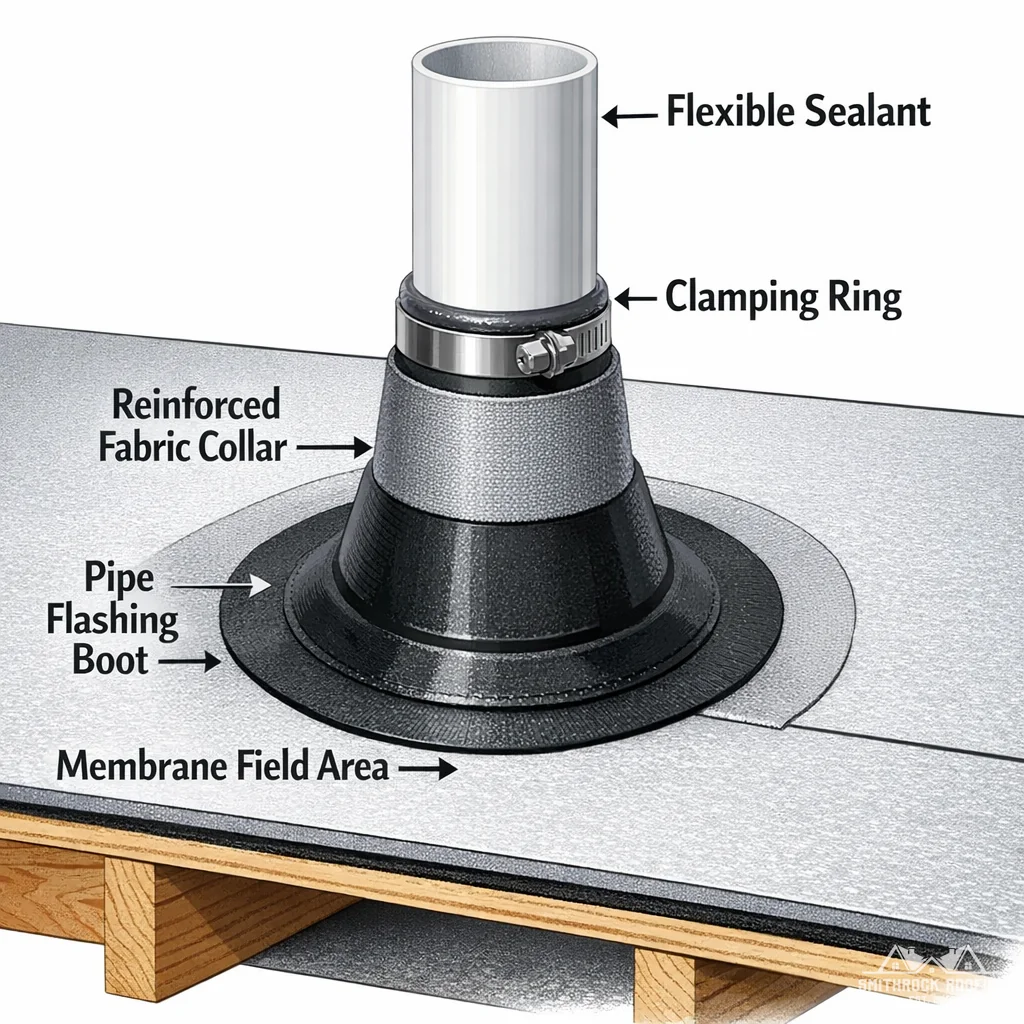
Failures concentrate at transitions. Specifically:
The mechanical reason these locations fail is differential movement. Dissimilar materials respond differently to heat and cold, and the dimensional change accumulates at every joint over years of thermal cycling. A contractor who details transitions with reinforced fabric, flexible sealants, and appropriate termination methods is addressing that movement. One who runs membrane to the edge and calls it done is not.
The right evaluation question is not “what brand of membrane do you use?” It is “show me how you handle your penetration details and transitions.”
If recurring leaks have already pushed you past the waterproofing question and into active repair territory, the article on finding a roof leak contractor walks through how to diagnose entry points and what to expect from a professional assessment.
Illustration, not a photograph of a completed client project.
Every waterproofing system requires periodic attention to perform across its intended service life. Generic advice to “schedule routine inspections” does not give homeowners enough to act on.
Here is what maintenance actually involves and what early warning signs to watch for:
Inspection frequency: Most coating and membrane systems benefit from a visual inspection at least once a year, with an additional check following any significant weather event. Early identification of minor issues prevents small problems from becoming system failures.
What to look for:
What maintenance is not: Applying a fresh coat of sealant over a surface without inspection is not maintenance. It is concealment. Effective maintenance means evaluating the system’s condition first, identifying any areas that have opened or failed, and addressing them before the next layer of protection is applied.
Smithrock Roofing approaches every exterior project, including waterproofing assessments, with that same straightforward honesty. We serve homeowners throughout Winston-Salem, roofing in Greensboro, High Point, Kernersville, Clemmons, Rural Hall, King, Mount Airy, and the surrounding NC Triad area, bringing local knowledge and a commitment to honest assessment to every project.
The answer depends on what a substrate assessment actually finds, not on the visible surface condition alone. A roof that looks worn but has sound, dry decking and structurally intact insulation may qualify for a coating or membrane system. A roof where moisture testing reveals trapped water in the deck or insulation layers, or where the existing assembly is structurally compromised, is not a coating candidate regardless of appearance. The qualification process described in this article, specifically moisture content evaluation, substrate integrity assessment, and product compatibility review, is what produces a reliable answer to that question. A contractor who recommends a coating without performing those steps is skipping the assessment that makes the recommendation meaningful.
Recurring leaks at the same location almost always indicate that the previous repair addressed the visible symptom rather than the actual entry point. Water travels along structural surfaces before it appears as a stain, so the visible ceiling damage and the actual breach in the waterproofing system are rarely in the same place. Penetrations, flashings, seam transitions, and wall-to-roof junctions are where failures concentrate. If a repair was applied to the field area of the membrane rather than tracing the water path back to its transition point origin, the underlying failure remains open. A thorough diagnostic that follows the water path, not just the stain location, is what breaks the repair cycle.
The most revealing questions center on process rather than product. Ask what the specific preparation sequence will be before any coating or membrane is applied, and what materials will be used at each step. Ask how the contractor handles penetration details and transitions, since those locations are where failures concentrate. Ask whether a moisture test will be performed on the substrate before application begins, and what the protocol is if that test reveals moisture above the manufacturer’s acceptable threshold. A contractor who can answer those questions with specific, documented methods is demonstrating the kind of detailing knowledge that separates durable installations from ones that begin failing within a few seasons.
Most coating and membrane systems benefit from a visual inspection at least once per year, with an additional check following any significant weather event. The inspection should focus on the locations most vulnerable to failure: seams and laps, sealant at penetrations and transitions, flashing terminations, and any areas where standing water accumulates after rain. Soft or spongy areas when walking a low-slope surface are a signal that moisture may have entered the substrate beneath the membrane and warrant immediate professional evaluation. Early identification of minor separation or sealant deterioration at those specific locations allows for targeted repair before a localized issue becomes a system-wide failure.
A roof waterproofing decision involves more moving parts than most homeowners expect before they start the process. The right outcome depends on an honest substrate assessment before any product is selected, preparation work that matches what the system actually requires, detailing skill at the locations where failures concentrate, and a maintenance approach that evaluates the system rather than simply covering it. Each of those factors compounds on the others: the best membrane applied over inadequately prepared or moisture-laden substrate will underperform, and a sound installation left without periodic attention will eventually develop small failures at transitions that grow into larger ones.
The goal of this guide has been to give you enough working knowledge to evaluate what a contractor is actually proposing, not just the brand name on the product label. That knowledge is most useful before the conversation starts.
Smithrock Roofing serves homeowners throughout Winston-Salem, Greensboro, High Point, Kernersville, Clemmons, Rural Hall, King, Mount Airy, and the surrounding NC Triad area. If you have questions about your roof’s current condition or what an assessment would involve, reaching out in writing is a good first step.

Smithrock Roofing © Copyright 2026 • All Rights Reserved • Privacy Policy • Maintained by Mongoose Digital Marketing