
Fascia repair is straightforward when you catch it early. The board is rotted, the gutter is pulling away, and a qualified contractor replaces both in a single visit. What this article covers is everything that happens before and around that moment: how to read what you are seeing from the ground, why the gutter and fascia fail together rather than independently, what soffit damage means for your attic, and what a thorough contractor should be checking beyond the visible board.
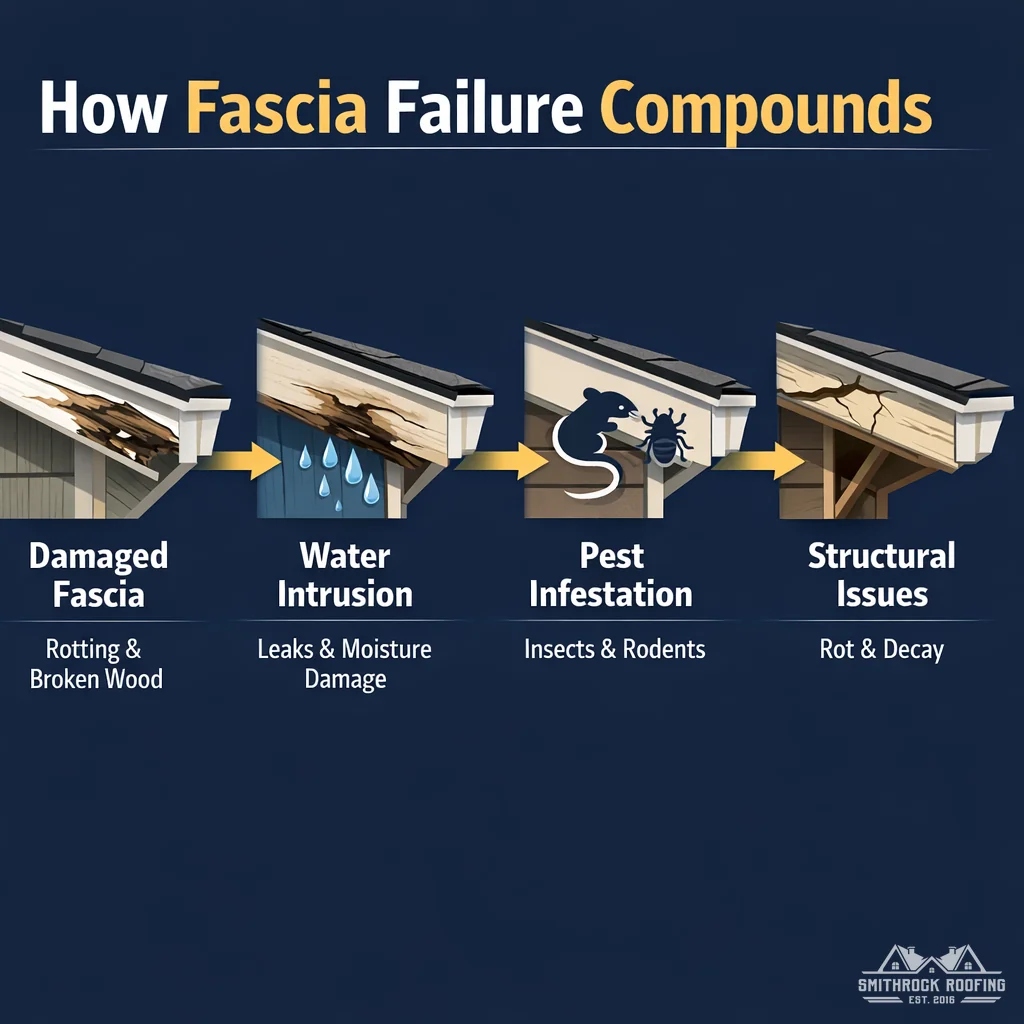
Illustration, not a photograph of a completed client project.
The fascia board is the vertical trim piece that caps the lower edge of your roof rafters. It faces outward, gives your roofline a finished look, and is the board your gutter is fastened to. Because it sits directly behind the gutter, it is the first piece of wood that gets wet when a gutter overflows, leaks at a seam, or pulls away from the wall.
The soffit is the horizontal panel that closes the underside of the roof overhang, running from the fascia back to the exterior wall of the house. Many soffits are vented, meaning they contain small perforated panels or strips that allow outside air to enter the attic. That airflow is not incidental. It is the intake half of the attic ventilation system, and it matters for the long-term health of your roof deck.
Understanding both pieces as parts of a connected system, rather than decorative trim, is what separates a surface repair from a complete one.
Have a fascia or soffit question about your home? Send a message with your town, where the fascia or soffit looks damaged from the ground, whether nearby gutters sag or overflow, and whether you are considering repair or replacement. Mention this article about fascia repair contractors and ask for a written explanation of possible next steps.
Most homeowners notice fascia problems in one of three ways: peeling or bubbled paint along the roofline, a gutter that is visibly sagging or pulling away from the house, or soffit panels that are drooping or flapping in wind. Each observation points to a different level of urgency.
The screwdriver test is the most direct way to assess what you are dealing with before scheduling an estimate. From a steady ladder, press a standard screwdriver firmly into the fascia board directly behind the gutter in several locations along the run. Here is what each result means:
| What You Find | What It Means | Likely Next Step |
|---|---|---|
| Screwdriver will not penetrate; wood feels hard | Board is structurally sound; problem is cosmetic | Paint or caulk repair only |
| Soft spot in one short section; gutters are intact and well-fastened | Localized moisture entry; isolated rot | Small patch repair; evaluate gutter seal at that point |
| Soft or crumbling wood along a full run; gutters sagging or leaking | Board has absorbed chronic water from the gutter system | Fascia replacement and gutter replacement in one visit |
| Soffit panels loose or hanging near the fascia edge | Fascia rot has removed the structural support the soffit rests on | Fascia comes first; soffit cannot be re-secured until the edge it sits on is solid |
The important point about the fourth scenario is that it is easy to mistake for a soffit problem. When soffit panels begin to sag or separate, the instinct is to focus on the soffit. But soffit panels typically rest on or against the fascia edge. If that edge has rotted away, the soffit has nothing to sit on and no amount of soffit repair holds it in place. Identifying which board needs to come first prevents repeated trips and rework.
This is the reasoning most contractor pages skip over. They acknowledge that gutters and fascia are often replaced at the same time, but they frame it as a convenience rather than a consequence of how water moves.
The sequence works like this. Roof water is channeled into the gutter. When the gutter overflows due to a clog, or leaks at a seam, or begins to pull away from the wall, that water does not simply fall to the ground. It runs down the back face of the gutter and contacts the fascia board continuously. Because the board is sheltered from direct sun on that face, it stays wet between rain events and begins to soften. As the wood softens, the screws or spikes holding the gutter lose their grip. The gutter sags outward, the gap behind it grows, and each subsequent rain introduces more water to an increasingly compromised board. The cycle accelerates.
A contractor who replaces the fascia board without first correcting the gutter problem that saturated it is completing half the repair. The new board will be exposed to the same water source and will follow the same failure path. This is why a thorough fascia repair assessment always includes a check of gutter condition, slope, and drainage continuity, not just the board itself. For a deeper look at how fascia and soffit repair should be approached as a complete system, that resource walks through what a properly scoped job looks like from start to finish.
Damaged or blocked soffit panels are almost always discussed as an exterior cosmetic issue or a pest entry point. Both are real concerns. But there is a third consequence that rarely gets mentioned.
Vented soffit panels are the intake side of your attic’s ventilation system. Air enters through the soffit, moves across the underside of the roof deck, and exits through ridge or roof vents at the top. When soffit panels are loose, sagging, or have been compromised by pests nesting in the cavities, that intake is reduced or blocked. Restricted intake ventilation contributes to moisture accumulation inside the attic. That moisture affects the roof deck from above, while the fascia problem you can see is affecting the roof edge from below.
The practical implication: a fascia and soffit repair that ignores attic ventilation function is addressing the visible symptoms without evaluating the system. A contractor worth calling should, at minimum, note whether soffit venting appears clear and functional as part of the inspection.
One component that rarely comes up in fascia repair conversations is the drip edge, the metal flashing strip installed at the roof edge between the roof deck and the top of the fascia board. Its job is to direct water off the roof edge cleanly and away from the fascia face.
If the drip edge is corroded, bent, or was never installed correctly, water from the roof surface wicks back along the underside of the shingles and onto the top edge of the fascia. This means a fascia board can be saturated from above by a failed drip edge and from behind by an overflowing gutter simultaneously. Replacing the fascia without checking and correcting drip edge condition sets the new board up for early failure.
This is why fascia, gutters, and drip edge are genuinely a system. Addressing one without evaluating the others is not a complete repair.
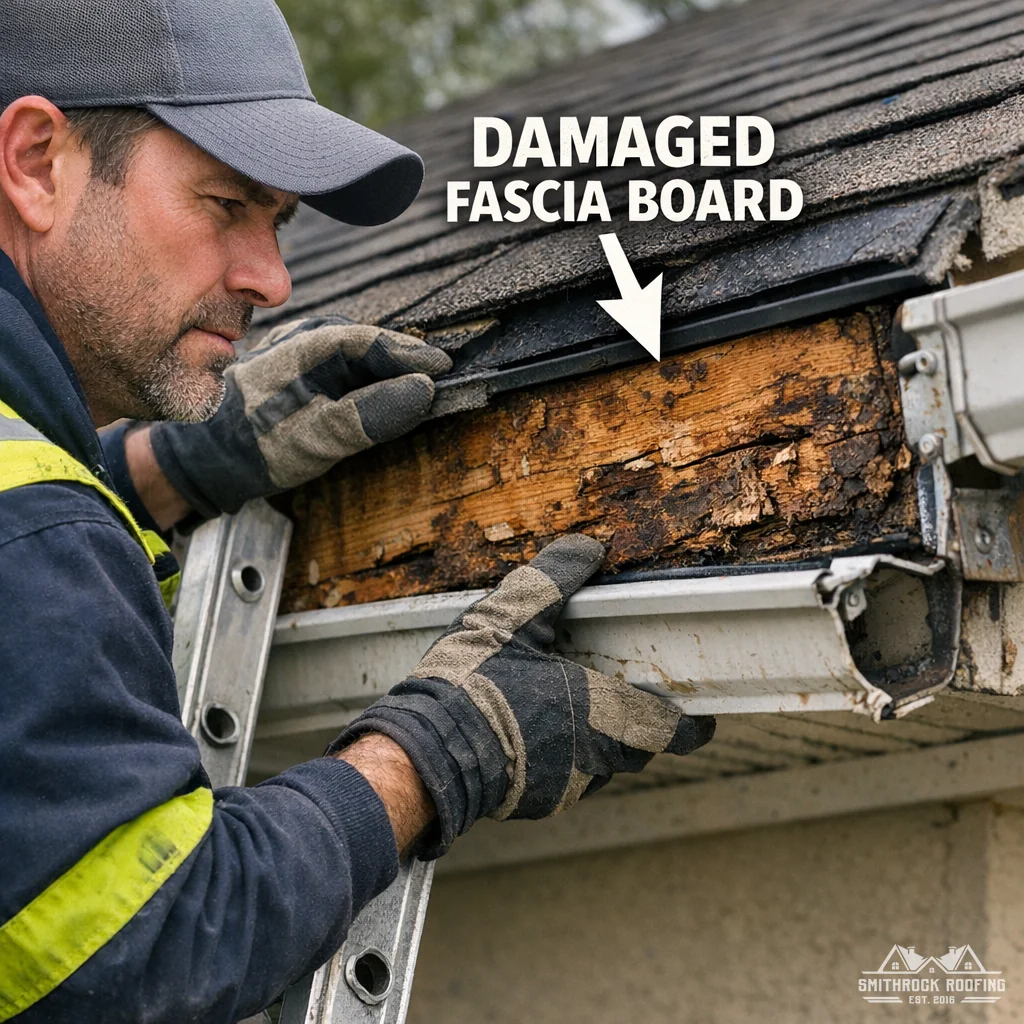
Illustration, not a photograph of a completed client project.
A capable fascia repair contractor does more than swap out a board. Here is what a thorough scope of work should include:
At Smithrock Roofing, we handle our roofing service, gutters, and exterior trim as connected systems, not separate line items. We serve homeowners across Winston-Salem, Greensboro, High Point, Kernersville, roofing in Clemmons, Rural Hall, King, Mount Airy, and the surrounding NC Triad. If your fascia, soffit, or gutters need attention, we will give you a straight answer about what needs to happen and in what order.
It depends on what the screwdriver test reveals across the full run, not just where the damage is visible. Rot that starts behind a leaking gutter seam often travels further along the board than the paint peeling on the face would suggest. If testing reveals isolated softness in one short section with gutters that are otherwise secure and draining correctly, a targeted repair may be appropriate. If softness runs along a significant portion of the board, or if the gutters are sagging or pulling away, replacing the full affected run is typically the more sound approach. A contractor should probe the board in multiple locations before limiting the scope of work to what is visible from the ground.
Not always, but often yes. The face of the gutter that is visible from the ground tells you very little about what is happening at the back edge where the gutter flange meets the fascia board. A gutter can appear level and intact from below while still leaking at a seam, overflowing at a low point, or sitting slightly away from the wall in a way that channels water directly onto the hidden face of the board. Any thorough fascia assessment should include checking gutter slope, seam integrity, and how water exits the system, not just how the gutter looks from the yard.
Because soffit panels typically rest on or against the fascia edge. If the fascia has rotted at that edge, the soffit loses its structural support regardless of the condition of the panels themselves. Re-securing or replacing soffit before the fascia is solid means the new soffit work has nothing sound to attach to, and the repair will fail on the same timeline as the original. The correct sequence is to establish a solid fascia edge first, then address the soffit panels above it. A contractor who cannot explain why that order matters is worth questioning before work begins.
The most direct indicator is the condition of the soffit panels themselves. Vented soffits contain perforated sections that allow outside air to enter the attic as the intake side of the ventilation system. If those panels are loose, sagging, crushed, or have been partially blocked by pests nesting in the cavity between the soffit and the attic floor, airflow into the attic is restricted. Inside the attic, signs of reduced ventilation include moisture staining on the underside of the roof deck, condensation on framing members, or insulation that feels damp near the eaves. A contractor evaluating your fascia and soffit should note whether the perforated panels appear clear and functional, and flag any signs of restricted intake as part of the assessment.
A fascia problem that looks simple from the ground is rarely confined to the board you can see. The rot behind the gutter, the gutter that caused the rot, the drip edge directing water onto the board from above, and the soffit panels that depend on a solid fascia edge are all part of the same system. Reading what you are seeing accurately before anyone arrives, understanding why the components fail in sequence rather than independently, and knowing what questions to ask when evaluating a contractor’s scope are what separate a repair that holds from one that restarts the same cycle in a year or two.
If you are looking at a sagging gutter, bubbled paint along the roofline, or soffit panels that are no longer sitting flush, the most useful next step is a thorough on-site assessment by someone who works across roofing, gutters, and exterior trim as a connected system rather than separate trades. At Smithrock Roofing, that is how we approach every evaluation for homeowners across Winston-Salem, Greensboro, High Point, Kernersville, Clemmons, Rural Hall, King, Mount Airy, and the surrounding NC Triad. If you have questions about what you are seeing, reach out and describe what you are dealing with. A straight answer about what needs to happen and in what order is where every good repair starts.

Smithrock Roofing © Copyright 2026 • All Rights Reserved • Privacy Policy • Maintained by Mongoose Digital Marketing