
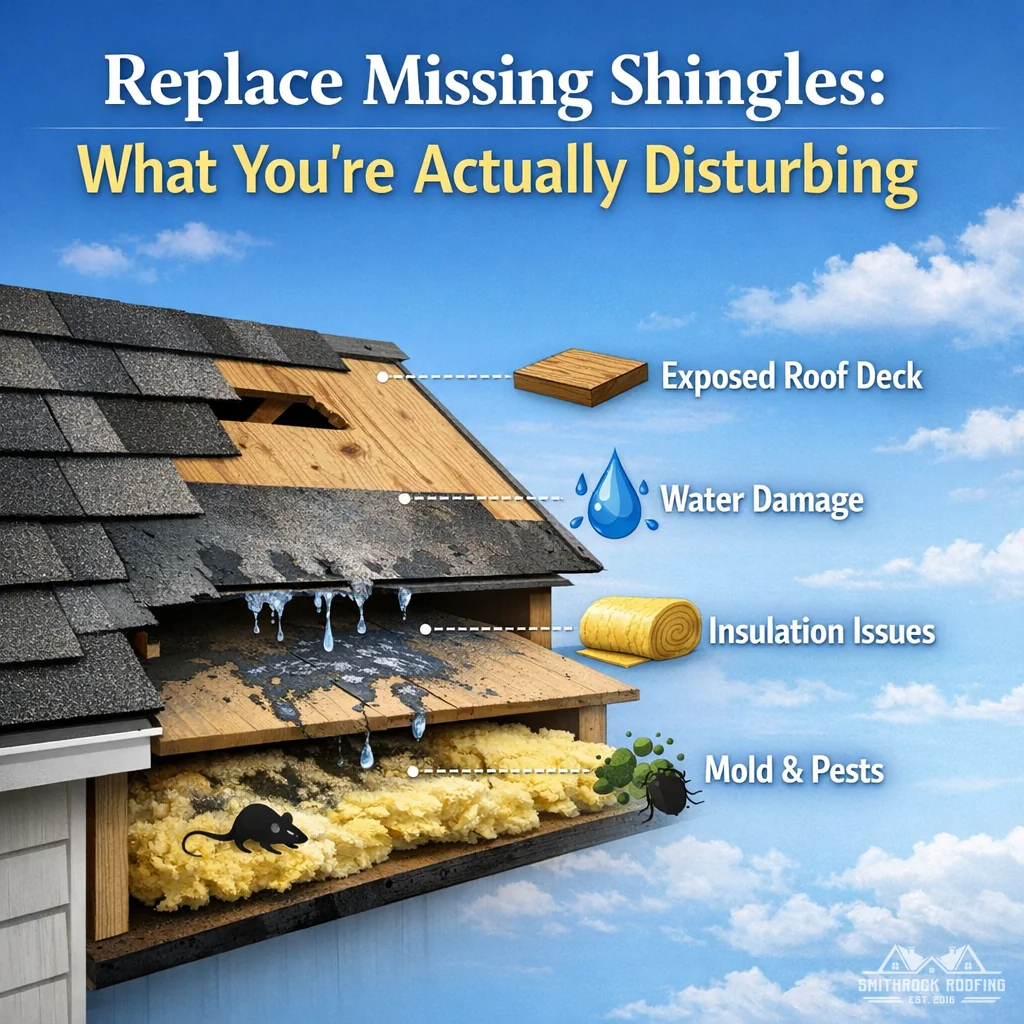
After a wind storm moves through, it is not unusual to step outside and spot a bare patch on your roof where a shingle used to be. The felt underlayment underneath is now exposed, and every rain event from that point forward is pushing water closer to your home’s structure. The good news is that replacing one or several missing shingles is a manageable repair when conditions are right and the surrounding roof is in solid shape. The harder news is that the job is a little more involved than sliding one piece out and dropping another in. Understanding exactly why that is will help you decide whether this is a project you can handle yourself, or one where calling a professional makes more sense.
Most explanations of this repair describe it as removing a single bad shingle and nailing in a fresh one. That framing undersells the actual scope.
Each asphalt shingle on your roof is held down by two rows of nails, not one. Its own nails fasten it to the deck, and the nails from the course directly above it also pass through its upper edge. This design is intentional. The overlapping fastening pattern is a core part of how the roof system resists wind uplift. (IKO explains this directly: “each shingle on a roof is actually held in place with TWO rows of nails” and calls it “a key factor in the overall roof system’s wind resistance.”, iko.com)
What this means in practice is that to remove the target shingle, you must first lift and partially free the course above it to access the nails passing through the top edge of the damaged shingle. That means you are temporarily loosening the fastening integrity of at least two additional courses beyond the one you are replacing.
When you re-nail those upper courses after the new shingle is in place, the nails should not go back into the same holes. Moving each nail roughly an inch to the side, as described in common repair demonstrations, restores proper mechanical hold. The repair is only as secure as those re-nailed upper courses, so skipping that step or being careless about it leaves the repaired zone weaker than it was before.
Before You Start: Check These Three Rows
Before pulling out a pry bar, assess the condition of the shingle above the missing one and the course above that.
If the surrounding shingles are in poor condition, disturbing them to make the repair may cause new damage that is worse than the original problem. For a deeper look at the full installation process and how courses relate to one another, the asphalt shingles installation guide walks through the layering logic in detail.
Have a roofing question about your home? Send a message with your town, your current roof material and the repair or material question you want to resolve. Mention this article about replace missing shingles and ask for a written explanation of possible next steps. You can also review Roofing.
Every guide on replacing missing shingles mentions temperature in passing. None of them fully resolves the contradiction they raise.
Here is the conflict: cooler weather makes sealant bonds easier to shear cleanly with a pry bar. But cold shingles become stiff and brittle and will crack when you flex them to get nails into position. Warm weather softens the shingles for easier handling, but it also makes sealant bonds sticky and hard to separate without tearing the surrounding shingles. (IKO notes that hot weather makes sealant “more gooey and tenacious.”, iko.com. Roof Revivers demonstrate that at 76°F “we have a little bit of grace on the flexibility of the shingle,” while cold conditions cause shingles to become “really hard to bend” and will cause cracking., youtube.com)
These are not two versions of a vague caution. They are two different failure modes that require two different adjustments.
Temperature Decision Framework
| Condition | Primary Risk | Adjustment |
|---|---|---|
| Cold morning, below 40°F | Shingles crack when flexed for nailing | Do not attempt; wait for milder temperatures |
| Cool overcast day, 45-65°F | Sealant is firm, shingles have moderate flex | Best working window; break sealant carefully |
| Warm sunny day, 70-85°F | Sealant is sticky, handling is easy | Work in the morning before the roof surface heats; plan on extra sealant work |
| Hot direct sun, 85°F+ on a south-facing slope | Shingles are very soft, sealant will not shear cleanly | Avoid; risk of damaging surrounding shingles during removal |
| Winter / approaching cold front | Shingles will not reseal by themselves afterward | Manual resealing is mandatory, not optional |
If the working temperature falls in the cold or extreme-heat ranges, the smarter move is to tack a temporary patch over the exposed area and wait for a milder day, rather than forcing a repair that creates additional problems.
Illustration, not a photograph of a completed client project.
This is the step most guides treat as a nice-to-have. It is not.
When you break the sealant bond on the shingles surrounding the repair to gain access, those bonds do not automatically restore themselves once the work is done. The factory sealant strip on a new shingle will eventually re-activate with sun warmth, but that process can take multiple days, and in cooler seasons it may take considerably longer. In the meantime, the repaired zone is more vulnerable to wind uplift than the rest of the roof.
IKO recommends applying “three small spots of asphalt plastic roof cement under the new shingle’s tabs, evenly spaced along the shingle length,” and sealing any surrounding shingles whose bonds were disturbed. (iko.com) Forum guidance from experienced DIYers reinforces this: the disturbed shingles “probably won’t seal down by themselves and the tar helps prevent wind lift.” (doityourself.com)
The standard is nickel-sized dabs, not large beads. Excess roofing cement can telegraph through the top surface of the shingle as it heats and cools over time, leaving a visible stain. Apply enough to bond, not enough to squeeze out from the edges when you press the shingle flat.
It is common knowledge that a replacement shingle will not match the weathered color of the existing roof. What is less discussed is what a large color gap actually signals about the roof’s condition.
New shingles and five-year-old shingles of the same product line can look dramatically different side by side. The granules on aged shingles shift in color as they weather, and the contrast can be significant. If the gap between new and existing shingles is extremely pronounced, that is useful information. It means the existing roof surface has seen years of UV exposure, thermal cycling, and granule loss. Spot-replacing one or two shingles on a roof that is visibly aged may be a sound short-term fix, but it is worth having a professional assess whether the surrounding field is still performing well or whether the repair is simply deferring a larger decision. If you are unsure how much life is left in your roof overall, the article on old roofs and when it’s time to replace covers the key indicators worth checking.
Illustration, not a photograph of a completed client project.
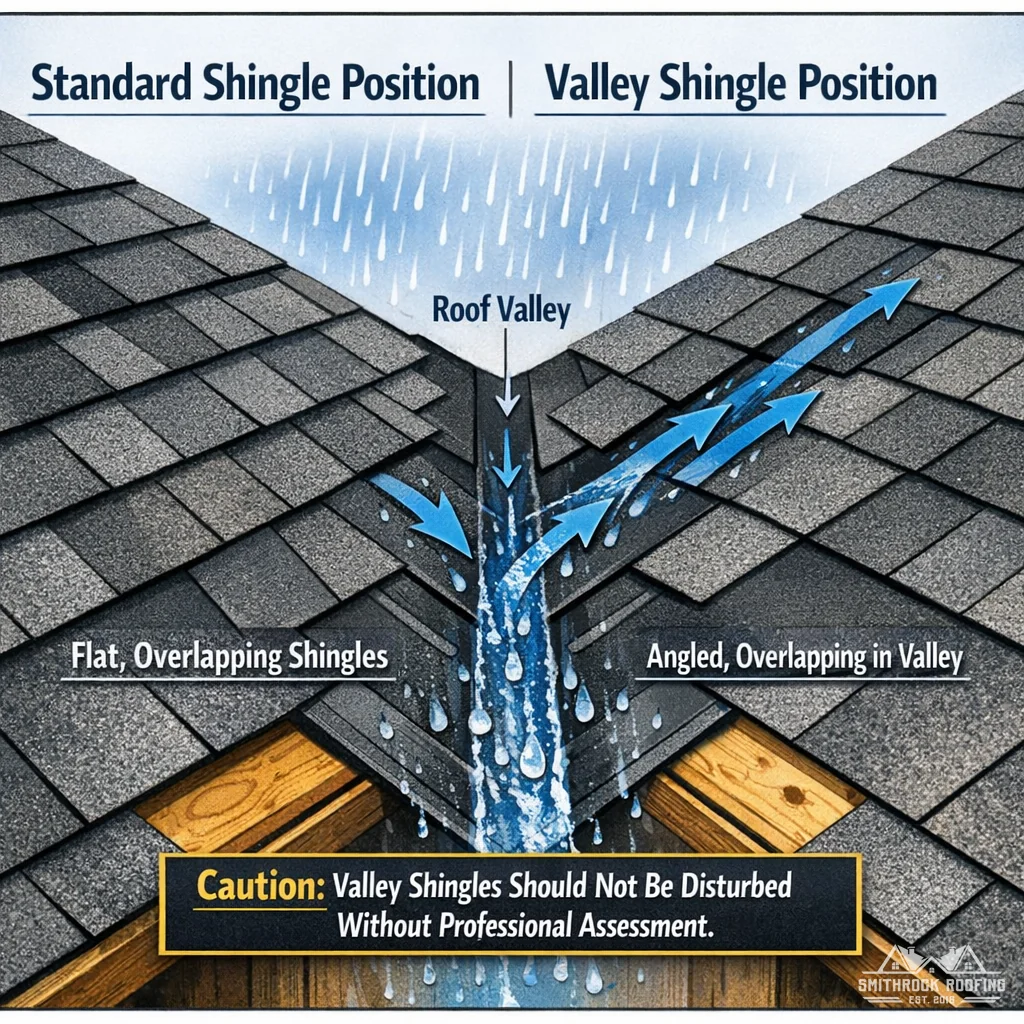
Valley shingles are a specific case where even a competent DIYer should stop. The valley is where two roof planes meet and water volume concentrates. The shingles in and around a valley are installed in a layered, overlapping pattern that manages that water flow. Disturbing one of those shingles without understanding how the full valley system is configured can break the water-shedding logic of the entire channel, creating a leak point that is harder to find and fix than the original missing shingle. (Roof Revivers explicitly avoids replacing valley shingles in their demonstration, noting that “unless you are an experienced roofer, you wouldn’t want to get into tearing into that valley.”, youtube.com)
The same principle applies to pitch. If the slope is steep enough that you need both hands on the roof to feel stable, the repair is beyond safe DIY territory regardless of how straightforward the mechanical steps are.
For homeowners across the NC Triad, including Winston-Salem, Greensboro, High Point, Kernersville, and surrounding communities, Smithrock Roofing is available to assess whether a missing shingle situation is a quick spot repair or the beginning of a broader conversation about roof health. Our roofing service covers everything from single-shingle assessments to full replacement evaluations.
You always have to disturb the surrounding courses, there is no way around it. Each shingle is held by two rows of nails: its own nails and the nails from the course directly above it, which also pass through the upper edge of the shingle you are replacing. To slide the damaged shingle out and position a new one, you must lift the overlying course to access and remove those upper nails. The courses above that must also be gently lifted to allow access. Plan for a minimum of three rows being involved in any single shingle replacement, and re-nail the disturbed upper courses in fresh locations rather than reusing the existing nail holes.
Cold weather creates a real risk of cracking the shingles you are trying to work around. When temperatures drop below roughly 40°F, asphalt shingles become stiff and brittle, and the flexing required to lift overlying courses and drive nails into position can cause them to snap. If the weather is cold and you have a bare patch on the roof, the safer short-term move is to tack a temporary cover over the exposed underlayment and wait for a milder day, an overcast day in the 45-65°F range is the most workable window. Cold conditions also mean the sealant on any disturbed shingles will not re-activate on its own, making manual resealing with roofing cement mandatory rather than optional.
Color difference between a new shingle and an aged roof is expected and unavoidable. Granules on existing shingles shift in color over years of UV exposure, rain, and thermal cycling, so even a shingle from the same product line will look noticeably lighter or brighter than the surrounding field. The more important question is what a dramatic color gap tells you about the roof’s condition overall. If the contrast is extreme, it is a signal that the existing field has aged significantly. The spot repair is still better than leaving an opening, but it may be worth having a professional assess whether the surrounding shingles are still performing adequately or whether the repair is simply deferring a broader replacement conversation.
Two situations fall clearly outside safe DIY territory. The first is valley shingles, the area where two roof planes meet and water volume concentrates. Valley shingles are installed in a layered, overlapping pattern designed to manage that concentrated flow, and disturbing even one of them without understanding the full valley configuration can break the water-shedding logic of the entire channel, creating a leak point that is harder to locate and correct than the original missing shingle. The second situation is any slope steep enough that you cannot work with both hands without feeling unstable. If the pitch requires you to grip the roof surface to stay in position, the mechanical steps of the repair are secondary to the fall risk, and a professional should handle it regardless of how straightforward the job appears from the ground.
Replacing a missing shingle is a repair that rewards careful preparation more than speed. The scope is wider than it looks from the ground, three courses involved instead of one, manual resealing required, temperature vetted before you climb, and the surrounding deck and shingles assessed before anything is disturbed. When those conditions are right and the rest of the roof is in solid shape, the repair is well within reach for a prepared homeowner.
When they are not, when the surrounding shingles are brittle, when the missing piece sits in a valley, when the pitch is too steep to work safely, or when the color contrast between old and new is sharp enough to raise questions about what else may be wearing out, the right call is to get a professional opinion before the repair turns into a larger problem.
Homeowners in Winston-Salem, Greensboro, High Point, Kernersville, Clemmons, Rural Hall, King, roofing in Mount Airy, and throughout the NC Triad can reach out to Smithrock Roofing for a straight assessment of whether a missing shingle situation is a quick spot fix or the start of a bigger conversation about the roof’s overall health.

Smithrock Roofing © Copyright 2026 • All Rights Reserved • Privacy Policy • Maintained by Mongoose Digital Marketing