Why Finding Quality Insulated Windows Near Me Matters for Your Home
If you’ve ever felt a persistent chill near your windows in winter or noticed your air conditioning running nonstop during a summer heatwave, your windows are likely the culprit. Outdated, inefficient windows are more than a minor inconvenience; they are gateways for energy loss, discomfort, and high utility bills. Finding high-quality insulated windows near me is the single most effective step you can take toward creating a more comfortable, energy-efficient, and valuable home. The search for qualified professionals can begin with local contractors and specialized window companies, and a structured approach will yield the best results.
Here’s a more detailed way to begin your search for the right installation partner:
- Search for Local, Specialized Contractors: Focus on companies that specialize in window replacement rather than general handymen. Look for established businesses with a physical office in your area, as this often indicates stability and accountability. Ensure they are fully licensed and insured to protect your property and their workers.
- Scrutinize Online Reviews and Testimonials: Use trusted platforms like Google, Yelp, and the Better Business Bureau (BBB) to read unfiltered customer feedback. Look for patterns in the comments regarding communication, craftsmanship, cleanup, and how the company handles issues when they arise.
- Consult Manufacturer Directories: Top window manufacturers want their products installed correctly. They maintain lists of certified or authorized dealers and installers on their websites. This can be a great way to find contractors who are factory-trained on the specific products you’re considering.
- Get Multiple, Detailed Quotes: Never settle for the first estimate. Contact at least three reputable companies and request a detailed, itemized quote. This document should clearly outline the cost of the windows, labor, materials (like caulk, foam, and trim), and any potential charges for unforeseen repairs. This allows for a true apples-to-apples comparison.
If you’ve noticed your energy bills steadily climbing, felt persistent cold drafts, seen condensation or fog forming between the glass panes, or struggled to open and close your windows, you’re not alone. These are classic signs of window failure. Modern insulated windows are engineered to solve these problems, dramatically improving your home’s comfort, curb appeal, and long-term value.
This comprehensive guide will serve as your roadmap. We will delve into the science behind how insulated windows work, explore the vast array of materials and styles available, teach you how to decipher complex energy performance ratings, and provide a step-by-step plan for finding and hiring reliable local installers. A thorough understanding of your options is the key to making a smart, confident investment that will pay dividends for decades to come.

The Science of Comfort: Understanding Insulated Windows and Their Benefits
If your home suffers from chilly drafts, soaring energy bills, or perpetually foggy windows, you understand the daily frustration of living with inefficient windows. These problems compromise your comfort, strain your budget, and can even lead to moisture-related issues like mold and mildew. The search for insulated windows near me is a search for a proven solution, one that is meticulously engineered to create a more comfortable, energy-efficient, and peaceful living environment.

At Smithrock Roofing, we have seen firsthand how upgrading to modern insulated windows consistently transforms a home’s comfort and efficiency, turning problematic spaces into favorite rooms.
What Are Insulated Windows and How Do They Work?
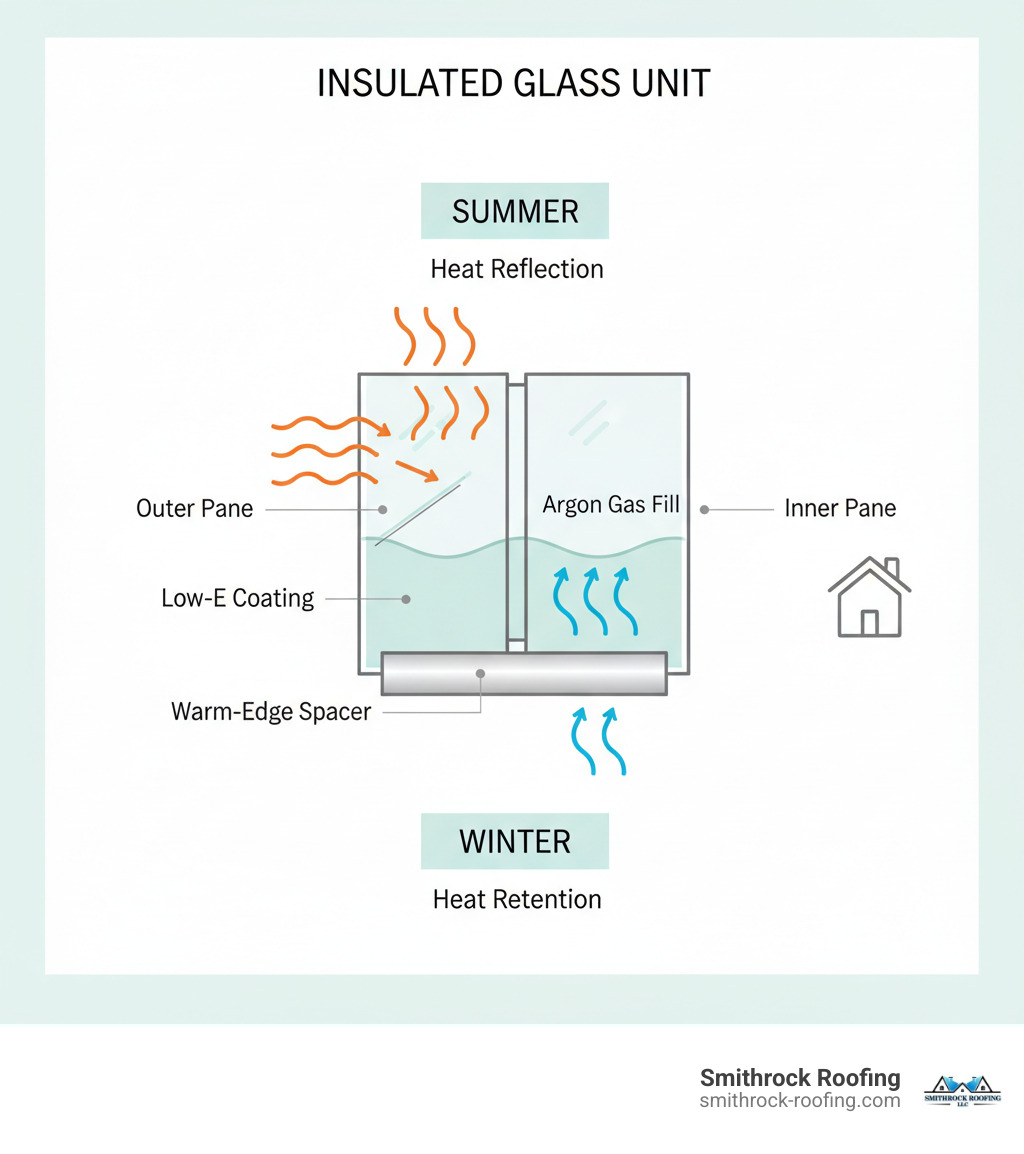
Insulated windows, also known as Insulated Glass Units (IGUs), are advanced window systems designed to minimize heat transfer. Heat moves in three ways: conduction (through solid materials), convection (through the movement of air or gas), and radiation (as electromagnetic waves). An IGU is engineered to combat all three.
- Double-Pane and Triple-Pane Construction: A single pane of glass does little to stop heat transfer. By using two panes of glass (double-pane) or three panes (triple-pane), an IGU creates one or two sealed airspaces. This dramatically slows the process of conduction, as heat struggles to move through the entire unit.
- Inert Gas Fills: The space between the panes is filled with a dense, inert gas, most commonly Argon or Krypton. These gases are far denser and less thermally conductive than regular air. They effectively disrupt the convection currents that would otherwise transfer heat from the warmer pane to the cooler pane, providing a significant boost in insulation.
- Low-E Coatings: A Low-E (low-emissivity) coating is an ultra-thin, transparent layer of metallic oxide applied to one or more glass surfaces. This coating is designed to reflect radiant heat. In the winter, it reflects your home’s furnace heat back into the room. In the summer, it reflects the sun’s infrared heat back outside, keeping your home cooler.
- Warm-Edge Spacers: The spacer is the component that separates the glass panes and seals the gas-filled unit. Older windows used highly conductive aluminum spacers, which created a thermal bridge that allowed heat to escape and condensation to form. Modern warm-edge spacers are made from foam, silicone, or other composites that are far less conductive, improving the window’s overall efficiency and keeping the edges of the glass warmer.
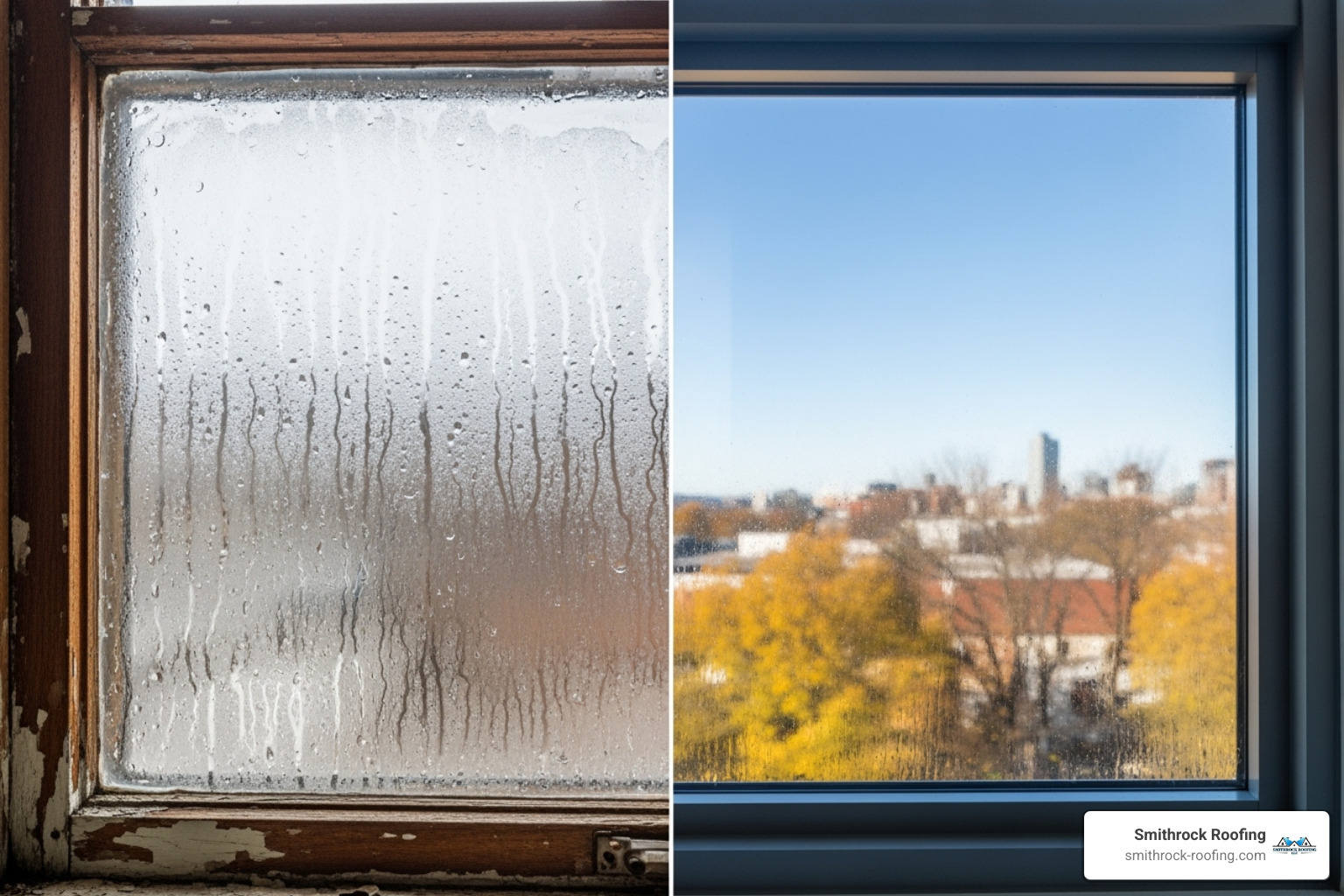
- Hermetic Seal: The entire unit is hermetically sealed to be airtight and watertight. This seal is critical for keeping the inert gas in and moisture out. If you see fog, condensation, or mineral deposits between the panes of your window, it’s a definitive sign that this seal has failed and the window has lost its insulating properties.
To compare specific high-performance options, see our guide on the best windows for insulation.
Top Benefits of Upgrading Your Home
- Lower Energy Bills: This is the most celebrated benefit. By reducing heat loss in winter and heat gain in summer, insulated windows significantly ease the workload on your HVAC system. According to the U.S. Department of Energy, replacing old single-pane windows with ENERGY STAR certified windows can save homeowners between $126 and $465 per year.
- Consistent Indoor Temperatures: Insulated windows create a powerful thermal barrier, eliminating the hot and cold spots commonly found near old, drafty windows. This results in a more stable and comfortable temperature throughout your home, year-round.
- Significant Sound Dampening: The multiple layers of glass, combined with the insulating gas, create an effective acoustic barrier. This can dramatically reduce the intrusion of outside noise from traffic, neighbors, or construction, creating a more serene indoor environment. A window’s ability to block sound is measured by its Sound Transmission Class (STC) rating; a higher number means better sound insulation.
- UV Protection for Your Interior: The same Low-E coatings that block heat also block a significant portion of the sun’s harmful ultraviolet (UV) rays. This helps prevent the fading of your valuable furniture, flooring, curtains, and artwork, preserving their color and condition for years to come.
- Reduced Condensation and Mold Risk: In winter, the interior pane of an insulated window stays warmer than that of a single-pane window. This warmer surface makes it much more difficult for condensation to form, reducing the risk of moisture damage, peeling paint, and the growth of unhealthy mold and mildew around your window frames.
- Enhanced Curb Appeal and Home Value: New windows provide one of the most dramatic facelifts you can give your home’s exterior. This improved appearance, combined with the documented energy savings, is a highly attractive feature for potential buyers, increasing your home’s resale value. Many real estate reports show that homeowners can recoup a significant portion of their investment upon resale.
Many homeowners find that upgrading in the cooler months yields great results. Learn more about why fall and winter are the perfect time for window replacements.
A Guide to Insulated Window Types, Frames, and Styles
When you upgrade to insulated windows, you gain efficiency and design flexibility. The right glass, frame, and style can dramatically improve comfort and curb appeal.
At Smithrock Roofing, we help you align performance goals with your home’s architecture and personal style.
Decoding the Glass: Double-Pane, Triple-Pane, and Low-E Coatings
- Double-pane windows: The residential standard that outperforms single-pane by adding a sealed insulating space.
- Triple-pane windows: Add a third pane and second insulating space for maximum thermal and noise performance.
- Low-E (low-emissivity) glass: A transparent coating that reflects heat while letting in visible light, improving comfort year-round and reducing UV-related fading.
Choosing Your Frame: A Comparison of Materials
- Vinyl: Affordable, low-maintenance, and naturally insulating.
- Wood: Classic look and good insulation; requires periodic finishing.
- Fiberglass: Stable, durable, and energy efficient with minimal upkeep.
- Aluminum: Strong and modern; thermally broken frames improve efficiency.
- Composite: Blends materials for wood-like looks with lower maintenance.
A Guide to Insulated Window Types, Frames, and Styles
When you’re ready to upgrade to insulated windows, you’re not just choosing a functional product; you’re making a key design decision. The right combination of glass technology, frame material, and operational style can transform your home’s energy efficiency, daily comfort, and overall curb appeal. Performance and aesthetics go hand-in-hand.
At Smithrock Roofing, we guide homeowners in Winston-Salem NC, King NC, Clemmons NC, and surrounding areas through the selection process, ensuring the final choice performs exceptionally and perfectly complements each home’s unique architectural character.
Decoding the Glass: Double-Pane, Triple-Pane, and Low-E Coatings
The heart of any modern window is its insulated glass unit (IGU). The glass package you choose is the primary driver of thermal performance.
- Double-Pane Windows: This is the current industry standard for residential homes. Featuring two panes of glass separated by a sealed, gas-filled space, they far outperform outdated single-pane windows in both insulation and noise reduction.
- Triple-Pane Windows: For homeowners seeking the highest level of performance, triple-pane windows add a third pane of glass and a second sealed insulating chamber. This provides top-tier thermal control, making them ideal for extreme climates or for homes aiming for maximum energy efficiency and soundproofing.
- Low-E (Low-Emissivity) Glass: This technology is a game-changer. Low-E is a microscopically thin, transparent metallic coating that acts as a heat filter. There are two main types: Soft-Coat Low-E, applied in a vacuum chamber after the glass is made, offers the highest performance by reflecting furnace heat in winter and solar heat in summer. Hard-Coat Low-E is fused to the glass surface during manufacturing, making it more durable but slightly less efficient. For most residential applications, especially in mixed climates like North Carolina, a high-performance Soft-Coat Low-E is the superior choice for reducing HVAC load and blocking up to 99% of harmful UV rays.
Choosing Your Frame: A Detailed Comparison of Materials
The window frame holds the glass package and is responsible for the window’s structural integrity, durability, and a significant portion of its insulating capability.
- Vinyl Frames: The most popular choice in the U.S., vinyl is affordable, highly energy-efficient, and virtually maintenance-free. Modern vinyl frames feature multi-chambered construction that creates insulating air pockets, and many are foam-filled for even better performance. They don’t require painting or staining and won’t rot or peel. Pros: Cost-effective, excellent insulation, low maintenance. Cons: Limited color options (though improving), can be perceived as less premium than other materials. Explore options through our vinyl windows in Winston Salem services.
- Wood Frames: For centuries, wood has been the traditional choice, offering timeless beauty and natural insulating properties. It can be painted or stained to match any decor, providing unmatched aesthetic warmth. Pros: Classic, high-end look; excellent natural insulator. Cons: Requires regular maintenance (painting/staining) to prevent rot and warping; typically the most expensive option.
- Fiberglass Frames: A premium modern material, fiberglass is made from glass fibers and resin. It is incredibly strong and dimensionally stable, meaning it expands and contracts very little with temperature changes. This reduces stress on the window seals, leading to a longer lifespan. Pros: Supreme durability and strength, highly energy-efficient, low maintenance, can be painted. Cons: Higher initial cost than vinyl.
- Aluminum Frames: Known for their strength, light weight, and slim profiles, aluminum frames are popular in modern and commercial architecture. However, standard aluminum is a poor insulator. It’s crucial to choose thermally broken aluminum frames, which have a plastic or composite material separating the interior and exterior frame components to reduce heat transfer. Pros: Strong, slim sightlines, durable finish. Cons: Less energy-efficient than other materials, even when thermally broken.
- Composite Frames: These frames aim to provide the best of both worlds. They are typically made from a blend of materials, such as wood fibers and polymers. The goal is to replicate the look of wood without the high maintenance requirements. Pros: Wood-like appearance, durable, low maintenance. Cons: Can be expensive, quality varies significantly between manufacturers.
Our team covers the full spectrum of window installation and replacement, including specialized options like casement windows replacement in Winston Salem.
Finding the Perfect Fit: Common Window Shapes and Styles
Your window’s style dictates its function, affecting airflow, natural light, and your home’s architectural voice.
- Single-Hung & Double-Hung Windows: The classic American window. On a single-hung, the bottom sash moves up and down. On a double-hung, both sashes operate, and they often tilt inward for easy cleaning of the exterior glass from inside your home.
- Casement Windows: Hinged on the side like a door, these windows crank open outward. They provide excellent, unobstructed views and, when closed, their sash presses tightly against the frame to create a highly effective compression seal, making them one of the most energy-efficient operable window styles.
- Picture Windows: These are large, fixed panes of glass that do not open. Their purpose is to maximize natural light and provide expansive, uninterrupted views of the outdoors. They are often combined with operable windows to provide ventilation.
- Sliding Windows: Operating horizontally on a track, sliders are easy to open and are a great choice for wide openings where a projecting casement or awning window would be an obstruction, such as over a deck or walkway.
- Bay and Bow Windows: These are three-dimensional window combinations that project outward from the home’s exterior wall. A bay window typically consists of three windows (a central picture window flanked by two smaller, operable windows), while a bow window is a more gentle curve of four or more windows. Both add interior space, light, and significant architectural interest.
- Awning Windows: Hinged at the top and opening outward from the bottom, awning windows can be left open even during a light rain, providing ventilation while keeping water out.
- Custom Shapes: From circles and half-circles to octagons, triangles, and trapezoids, custom windows can be made to fit unique architectural designs and add a distinctive flair to your home.
With these choices, you never have to compromise between efficiency and design, whether replacing existing units or adding windows to a house. Our goal is to help you find insulated windows near me that perfectly meet your performance, style, and value needs.
Making the Smart Choice: Ratings, Measurements, and Lifespan
Investing in new windows is a significant decision, and feeling confident in your choice requires understanding the technical details. From deciphering energy performance labels to appreciating the importance of precise measurements and long-term value, knowledge is power. We help customers in Kernersville NC, High Point NC, Greensboro NC, and beyond navigate these details to make a truly smart investment.

How to Read the Label: Energy Efficiency Ratings and Certifications
When comparing windows, look for two key labels. The ENERGY STAR label indicates that the product meets or exceeds energy efficiency guidelines set by the U.S. Environmental Protection Agency for your specific climate zone. The National Fenestration Rating Council (NFRC) label provides independently verified ratings for specific performance metrics. Here’s what they mean:
- U-Factor: This measures how well a window prevents heat from escaping a home. It’s a measure of insulation, and the lower the number, the better. U-Factor ratings generally range from 0.20 for high-performance triple-pane windows to 1.25 for old, single-pane windows. For a mixed climate like North Carolina, a U-Factor of 0.30 or lower is a good target.
- Solar Heat Gain Coefficient (SHGC): This measures how well a window resists unwanted heat gain from the sun. The lower the SHGC, the less solar heat it transmits, which helps keep your home cooler in the summer and reduces air conditioning costs. In a cooling-dominated climate like North Carolina, a low SHGC (ideally 0.27 or lower) is crucial.
- Visible Transmittance (VT): This measures how much visible light comes through the window. A higher VT number (closer to 1.0) means more daylight, potentially reducing the need for artificial lighting. There is often a trade-off between a low SHGC and a high VT, but modern Low-E coatings are designed to block heat while allowing plenty of visible light through.
- Air Leakage (AL): This measures how much air will pass through a window assembly. A lower AL rating means a tighter window and fewer drafts. Look for an AL of 0.30 cfm/ft² or less.
- Condensation Resistance (CR): This optional rating measures a window’s ability to resist the formation of condensation on its interior surface. The higher the number (on a scale of 1 to 100), the better. This is particularly important in humid climates or homes with potential moisture issues.
Always ensure the product you choose is certified for your climate zone. You can compare certified products using the ENERGY STAR Product Finder.
Getting It Right: How to Measure for Replacement Windows
While professional measurement is non-negotiable for ordering custom-fit windows, you can take basic measurements to get a rough idea for budgeting. The key is to measure the window opening from jamb to jamb (width) and from the head to the sill (height).
- Width: Measure the inside width at the top, middle, and bottom of the opening. Record the smallest of the three measurements.
- Height: Measure the inside height at the left, center, and right. Record the smallest of the three measurements.
- Depth: The depth of the frame helps determine if you need an insert replacement or a full-frame replacement.
Precision is everything. An error of even a quarter-inch can lead to drafts, water leaks, or installation failure. This is especially critical when adding windows to a house, where a new rough opening must be created perfectly. Our team measures every opening with expert accuracy to guarantee a perfect fit.
Understanding the Investment in Insulated Windows Near Me
The cost of a window replacement project is influenced by several key factors:
- Size and Style: Larger windows and complex styles like bay, bow, or custom shapes naturally cost more due to increased materials and labor.
- Frame Material: Vinyl is typically the most budget-friendly option, while fiberglass and high-end wood frames represent a premium investment with long-term performance benefits.
- Glass Package: Upgrading from a standard double-pane, low-E package to a triple-pane unit or one with specialized coatings for sound reduction will increase the cost but also the performance.
- Installation Complexity: An insert (or pocket) replacement, where the new window fits into the existing frame, is less labor-intensive and more affordable. A full-frame replacement, which involves removing the entire window down to the rough opening to address potential rot or structural issues, is more complex and costly but provides a more complete solution.
- Professional Labor: The cost of skilled, insured, and warrantied labor is a crucial part of your investment. Cutting corners on installation will compromise the performance of even the best windows.
For a deeper overview of factors that influence project costs, see our guide on the cost to replace windows.
How Long Do Insulated Windows Last?
The lifespan of your new windows depends heavily on the frame material, local climate conditions, and, most importantly, the quality of the installation.
- Vinyl: 20–40 years
- Wood (well-maintained): 30–50+ years
- Fiberglass: 40–50+ years
- Aluminum: 20–40 years
The most common point of failure in an insulated window is the hermetic seal of the IGU. When this seal breaks, the insulating gas escapes, and moist air enters, causing the telltale fogging between the panes. This signifies a complete loss of insulating value. Choosing windows with a strong manufacturer warranty (often 10–20 years or even lifetime coverage for the IGU seal) and ensuring expert installation are the two most critical factors for achieving long-term performance and durability.
The Replacement Journey: How to Find and Install Insulated Windows Near Me
Deciding to replace your windows is a major home improvement project and a significant investment in your property’s comfort, efficiency, and value. To ensure a successful outcome, it’s essential to know when it’s time to act, understand the professional installation process, and know how to select a trustworthy local contractor.
At Smithrock Roofing, we guide homeowners in Winston-Salem NC, Pilot Mountain NC, East Bend NC, Mt. Airy NC, and nearby communities through every step of this journey, ensuring clarity and confidence from start to finish.
Telltale Signs You Need New Windows
Your home often sends clear signals when your windows are failing. Look for these common indicators:
- Persistent Drafts: Feeling cold air near a closed window is a sure sign that seals, weatherstripping, or the frame itself has failed.
- Noticeably Rising Energy Bills: If your heating and cooling costs are climbing without any other explanation, your windows are likely leaking energy.
- Condensation Between the Panes: Any fog, moisture, or mineral buildup between the layers of glass means the hermetic seal has broken and the window’s insulating value is gone.
- Difficult Operation: Windows that stick, jam, or won’t stay open are not just an annoyance; they can be a safety hazard, especially in an emergency.
- Visible Damage or Decay: Obvious signs like cracked glass, rotting wood frames, peeling paint, warped vinyl, or crumbling caulk all indicate that the window is past its prime.
- Excessive Outside Noise: If you can hear conversations or traffic from the street as if you were standing outside, your windows are providing poor acoustic insulation.
For more tips on project timing, see our guide on the best time to replace windows.
The Professional Window Installation Process: A Step-by-Step Guide
A quality window is only as good as its installation. A professional process ensures your windows perform as designed for their entire lifespan.
- Initial Consultation & Selection: The process begins with a thorough discussion of your needs, aesthetic goals, and budget. A professional will help you select the right window type, material, and glass package for your home and climate.
- Precise, Final Measurements: An expert installer will visit your home to take exact measurements of each window opening. This ensures your custom-ordered windows will fit perfectly.
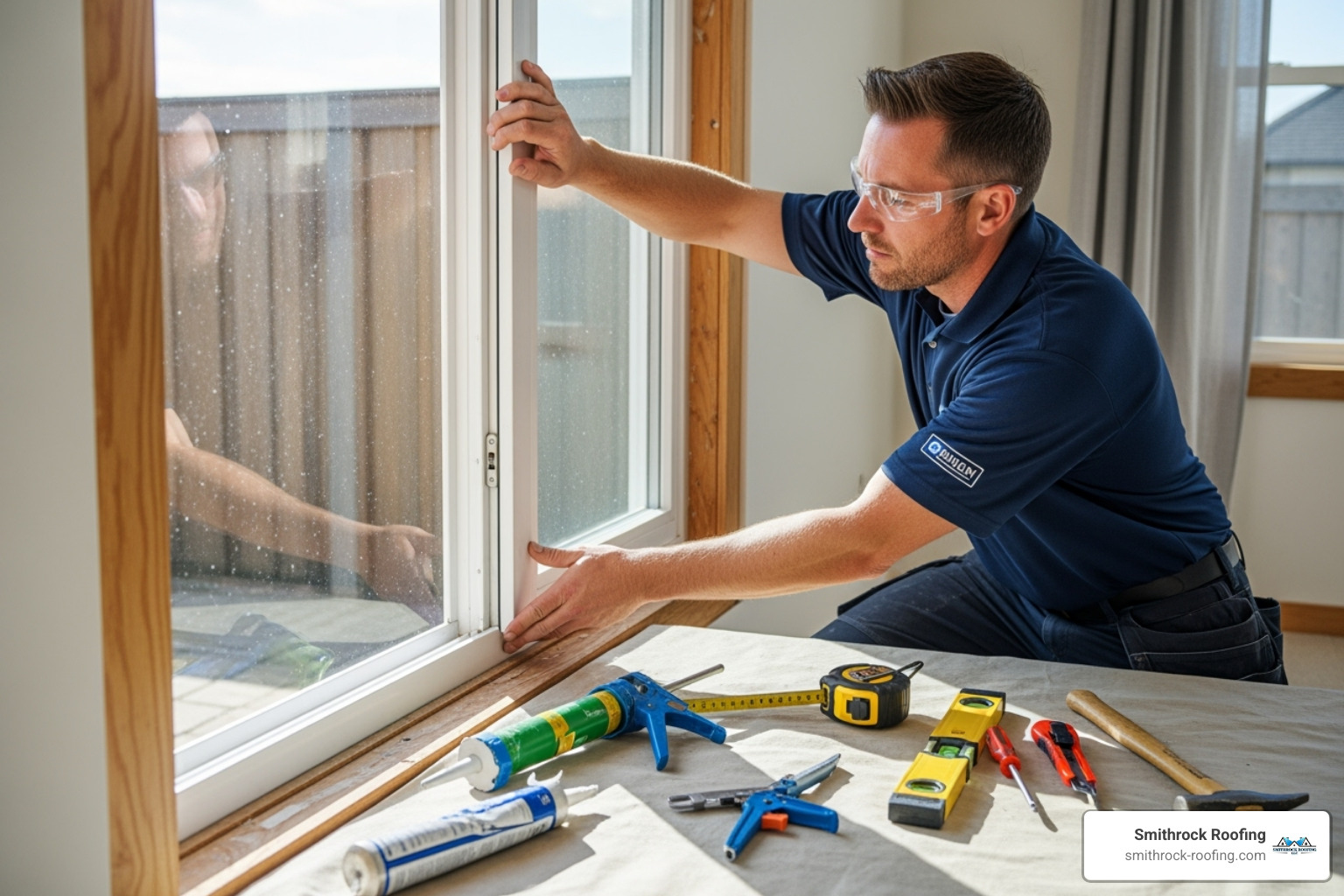
- Site Preparation & Old Window Removal: On installation day, the crew will protect your home by laying down drop cloths on floors and covering nearby furniture. They will then carefully remove the old window sashes and, if necessary, the entire frame.
- Opening Preparation & Repair: This is a critical step. The installer will inspect the rough opening for any signs of wood rot or damage, making repairs as needed. They will ensure the opening is clean, level, and square, and will apply new flashing and a sill pan to create a waterproof barrier.
- New Window Installation: The new window unit is carefully placed into the prepared opening. It is set, shimmed to be perfectly plumb and level, and then securely fastened into the frame.
- Sealing and Insulating: The gap between the new window frame and the house’s rough opening is filled with low-expansion insulating foam. This creates an airtight seal without putting pressure on the frame that could cause it to warp. High-quality exterior caulk is then applied to create a durable, watertight seal against the elements.
- Finishing Touches: New interior and exterior trim is installed to provide a clean, professional, and finished look.
- Final Inspection and Cleanup: The installer will test the operation of each new window, demonstrate its features to you, and answer any questions. The crew will then thoroughly clean the work area, removing all debris and leaving your home tidy.
This meticulous approach is fundamental to our window installation and replacement services.
Finding Local Installers and Suppliers for Insulated Windows Near Me
Choosing the right contractor is the most important decision you’ll make.
- Choose Local and Established: Select a contractor with deep roots in your community. Smithrock Roofing proudly serves Winston-Salem NC, King NC, Clemmons NC, Lewisville NC, and the surrounding areas listed below.
- Verify Credentials: Always confirm that the company has valid liability insurance and workers’ compensation coverage. Ask for their license number.
- Ask Detailed Questions: Don’t be shy. Ask who will be performing the installation (employees or subcontractors?), what their workmanship warranty covers, and for a list of recent references.
- Demand Detailed Written Quotes: A professional quote is itemized and transparent. Compare at least three quotes, looking not just at the price but at the specific products, materials, and installation methods proposed.
- Review Warranties: Understand the warranties. There is typically a manufacturer’s warranty on the product itself and a separate workmanship warranty from the installer covering any labor-related issues.
We provide the window replacement service Winston Salem NC homeowners trust, installing high-quality Norandex eXtreme 3000S windows with expert care.
Saving Money: Rebates and Tax Credits
- Federal Energy Tax Credits: The Inflation Reduction Act of 2022 renewed and enhanced tax credits for energy-efficient home improvements. Homeowners can claim a credit of 30% of the cost of new, ENERGY STAR certified windows, up to a maximum of $600 per year.
- State and Local Incentives: Check with your state’s energy office for any available rebates or credits.
- Utility Company Programs: Many electric and gas utilities offer their own rebates for customers who upgrade to energy-efficient windows and doors.
Use the ENERGY STAR Rebate Finder by entering your zip code to see a list of available programs in your area. Combining these incentives with your long-term energy savings makes upgrading a financially savvy decision.
Frequently Asked Questions about Insulated Windows
We understand that investing in new windows for your home brings up many questions. To help you feel confident in your decision, we’ve compiled clear, detailed answers to some of the most common inquiries we receive.
What maintenance is required for insulated windows?
Modern insulated windows are designed for durability and ease of care, but some simple, periodic maintenance will ensure they look and perform their best for decades.
- Cleaning: Clean the glass with a non-abrasive, ammonia-free glass cleaner and a soft cloth. For the frames, a simple solution of mild soap and water is usually sufficient. Avoid harsh chemicals, solvents, or power washers, which can damage frame surfaces and seals.
- Annual Inspection: Once a year, walk around your home and inspect the exterior caulk seals around each window. If you see any cracks or gaps, these should be resealed with a high-quality exterior-grade caulk to prevent water intrusion. Also, keep an eye out for any fogging between the panes, which indicates a seal failure.
- Lubrication: For operable windows like sliders, casements, and double-hungs, applying a small amount of pure silicone-based lubricant to the tracks, hinges, and locking mechanisms once a year will keep them operating smoothly.
- Material-Specific Care: Vinyl and fiberglass frames are virtually maintenance-free, requiring only occasional cleaning. Wood frames, however, will need to be periodically repainted or re-stained every few years to protect them from moisture and sun damage.
Can insulated windows really reduce noise?
Absolutely. The ability of a window to block sound is measured by its Sound Transmission Class (STC) rating. A typical old, single-pane window might have an STC rating of 26-28. A standard double-pane insulated window can increase that rating to 30-33. While this may not seem like a large jump, a 10-point increase in STC rating can block about 50% of perceived noise. For homeowners living near busy roads, airports, or other noisy environments, you can opt for specialized laminated glass or windows with different glass thicknesses, which can achieve STC ratings in the high 30s or even low 40s, creating a remarkably quiet indoor space.
Is it better to repair or replace a foggy insulated window?
Fogging between the glass panes is a definitive sign that the hermetic seal of the Insulated Glass Unit (IGU) has failed. When this happens, the insulating gas has escaped, and moist air has entered, completely negating the window’s energy efficiency. While some companies offer “de-fogging” services—which involve drilling a hole, cleaning the interior, and inserting a valve—this is a purely cosmetic, temporary fix. It does not restore the insulating gas or the window’s thermal performance. For a lasting solution that restores both clarity and energy efficiency, the only proper course of action is to replace the IGU (the glass unit itself) or, if the frame is also in poor condition, the entire window.
What is the difference between a full-frame and a pocket/insert window replacement?
A pocket or insert replacement is the most common type. In this method, the old window sashes are removed, but the original window frame and trim are left in place. The new window is then inserted into this existing “pocket.” It’s faster, less disruptive, and more affordable. It’s a great option when the existing frame is still square, in good condition, and free of rot. A full-frame replacement is a more extensive process where the entire window—sash, frame, and trim—is completely removed down to the rough opening in the wall. This method is necessary when the old frame is rotted, out of square, or severely damaged. It allows the installer to address any hidden structural issues and properly insulate and seal the entire opening before installing the new window. While more expensive, it is the most complete and energy-efficient solution.
Are insulated windows a good return on investment (ROI)?
Yes, for several reasons. First, there is the immediate return of lower monthly energy bills, which can add up to thousands of dollars over the window’s lifespan. Second, according to the National Association of Realtors’ annual “Cost vs. Value Report,” replacing old windows with new, energy-efficient vinyl or wood windows is consistently one of the top home improvement projects for recouping your investment upon resale. Buyers value the comfort, savings, and curb appeal that new windows provide. Finally, there’s the intangible but significant ROI of improved daily comfort, a quieter home, and pride in your property’s appearance.
Do I really need triple-pane windows in a moderate climate like North Carolina?
This is an excellent question of cost versus benefit. For most homes in North Carolina’s mixed-humid climate, a high-quality, double-pane window with an advanced Low-E coating and argon gas fill provides outstanding performance and is the most cost-effective choice. It will deliver significant energy savings and comfort improvements. Triple-pane windows offer a marginal increase in insulating performance (U-Factor) but at a significantly higher cost. They are typically best suited for extremely cold northern climates, homes located in very noisy areas where sound reduction is a top priority, or for homeowners pursuing the highest possible standard of energy efficiency (such as in a Passive House). We can help you analyze the cost-benefit for your specific situation.
Conclusion: Upgrade Your Home’s Comfort and Efficiency Today
Navigating the world of insulated windows—from U-Factors and SHGC ratings to frame materials and installation methods—can seem complex. However, by understanding the fundamentals, you are empowered to make a confident decision that will profoundly benefit your home and family for years to come. We’ve explored the science of how these advanced windows work, detailing how multi-pane construction, inert gas fills, Low-E coatings, and warm-edge spacers team up to create a powerful thermal barrier. We’ve also highlighted the extensive advantages they deliver: significant energy savings, consistent year-round comfort, a quieter indoor environment, crucial UV protection for your furnishings, and a tangible boost to your home’s curb appeal and resale value.
Remember, the remarkable performance of a high-quality window can be completely undermined by improper installation. That’s why choosing a reputable, experienced, and meticulous local installer is the most critical step in the entire process. A professional ensures precise measurements, expert preparation of the window opening, and a flawless sealing and insulation job that maximizes the performance and lifespan of your investment. As you plan your project, don’t forget to investigate the available federal energy tax credits, as well as state and local utility rebates, which can make your energy-efficient upgrade even more affordable.
If you’re a homeowner in our service area—including Winston-Salem NC, King NC, Clemmons NC, Lewisville NC, Pilot Mountain NC, East Bend NC, Mt. Airy NC, Kernersville NC, Siloam NC, Danbury NC, High Point NC, Trinity NC, Pfafftown NC, Tobaccoville NC, Greensboro NC, Walnut Cove NC, Belews Creek NC, Rural Hall NC, Pinnacle NC, Bethania NC, Advance NC, Wallburg NC, Horneytown NC, Union Cross NC, and Midway NC—Smithrock Roofing is your trusted local partner. We are committed to providing expert guidance and superior installation of high-performance windows designed to protect, beautify, and enhance your home. With our help, you’ll never get left in the cold (or the heat) again.
Ready to transform your home with the lasting benefits of quality insulated windows? Contact us to explore your window options today and take the first step towards a more comfortable, efficient, and beautiful living space.