
A note on the numbers: the figures in this guide are national industry averages compiled for research — they are not Smithrock Roofing quotes. Every home and project is different, which is why our in-home assessments and written quotes are always free.
See also: choosing the right downspout drain pipe for the system you install.
Need a local pro? Learn more about our gutter installation and repair in High Point.
The cost to install gutter drainage systems varies significantly based on your specific needs, but most homeowners can expect to pay between $800 and $5,700 for professional installation. Here’s what you need to know:
Quick Cost Breakdown:
When water starts pooling near your downspouts after heavy rains, it might seem like no big deal. But without proper drainage, you’re looking at potential foundation cracks, basement flooding, and thousands in water damage repairs down the road.
The reality is that proper gutter drainage installation is one of the most cost-effective investments you can make in your home’s protection. While the upfront cost might seem significant, it’s far less expensive than dealing with foundation repairs that can cost $2,300 to $6,800 or basement waterproofing that runs $4,500 to $15,500.
At Smithrock Roofing, our team has seen firsthand how proper drainage systems save homeowners thousands in repair costs across Winston-Salem, Greensboro, High Point, and the surrounding NC Triad. Our experience with the cost to install gutter drainage has taught us that investing in quality installation upfront prevents much larger expenses later.
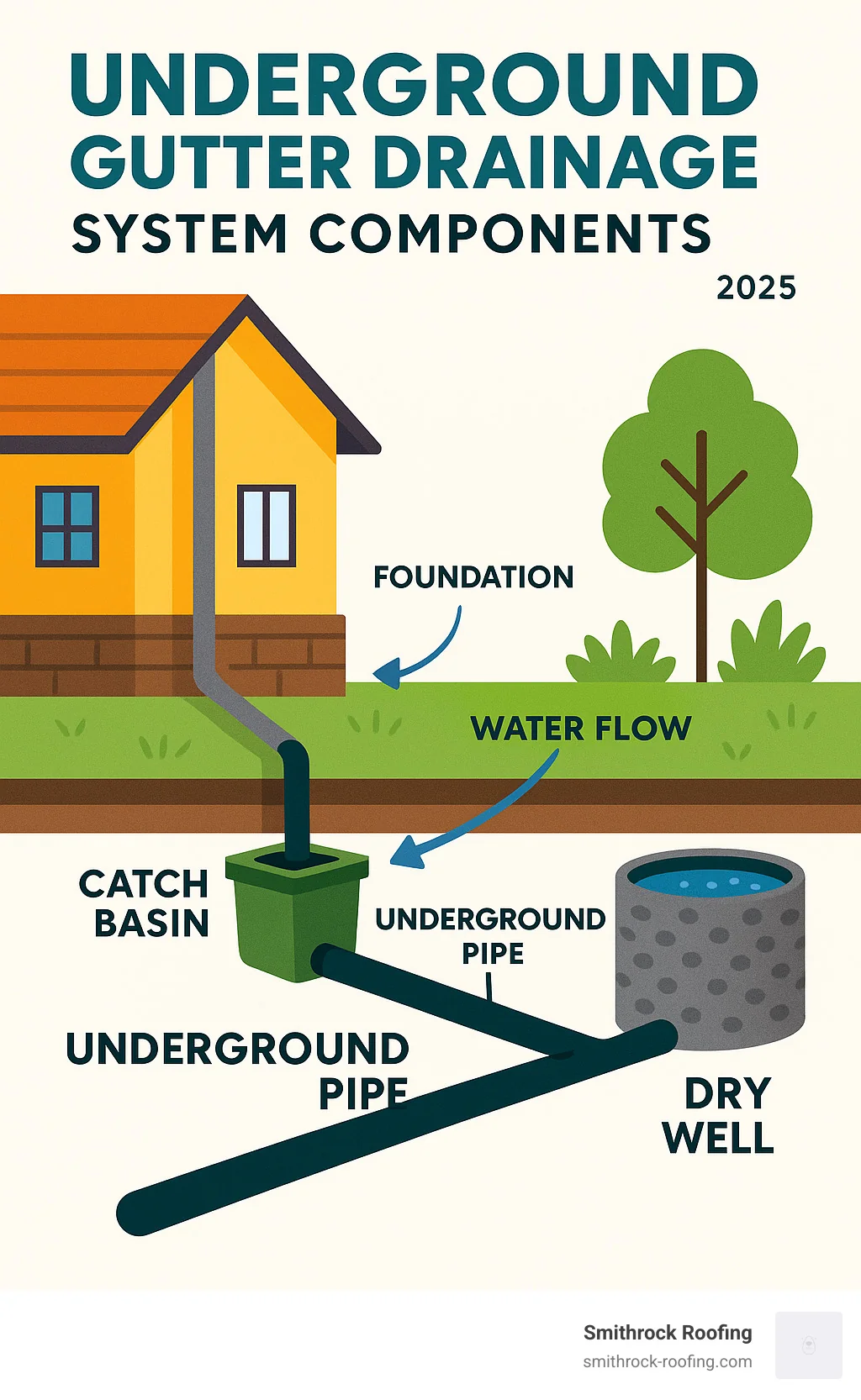
It’s easy to think of gutters and drainage as two separate things, but they’re really one interconnected system. A well-functioning gutter and drainage setup has to work seamlessly from the roofline all the way to the final discharge point — and a weak link anywhere in that chain undermines the whole thing.
Here’s how the pieces connect:
Gutters collect rainwater as it runs off your roof and channel it toward the downspouts. If gutters are undersized, improperly sloped, or clogged, water overflows before it ever reaches the drainage system — dumping it right against your foundation walls.
Downspouts carry water from the gutters down to ground level. The number, size, and placement of downspouts determine how much water the system can handle at once. Too few downspouts and gutters back up; too small and they can’t keep pace with a hard rain.
The drainage system — whether that’s an underground pipe, a French drain, or a dry well — takes over from there and moves water to a safe discharge point well away from your home.
When all three components are properly designed and installed together, you get a complete gutters and drainage solution that handles even the heaviest NC storms without stress. When one component is out of spec, the whole system suffers.
This is why we evaluate the full picture when homeowners call us about drainage issues. Sometimes the real problem isn’t the underground system at all — it’s undersized gutters or too few downspouts feeding too much water into a system that was never designed for it.
Need a hand with this in Winston-Salem, Greensboro and the NC Triad? Call (336) 971-0464 or request a free estimate. Honest answers, no pressure.
Here’s something most homeowners don’t realize: those simple downspouts attached to your gutters are only doing half the job. They’re moving water off your roof, but they’re dumping it right next to your foundation — exactly where you don’t want it.
Traditional downspouts typically move water just 10 to 20 feet from your home. That might sound like enough, but it’s not. Underground drainage systems can route water 100 feet or more away from your foundation, and that extra distance makes all the difference in protecting your biggest investment.
When you’re considering the cost to install gutter drainage, you’re really investing in your home’s structural integrity. An underground system prevents hydrostatic pressure from your roofline — that’s the force water creates when it builds up around your foundation walls.
Think of it this way: every time it rains, water wants to find the path of least resistance. Without proper drainage, that path often leads straight to your basement or crawl space. Underground systems give water a better route to follow, one that keeps it far away from your home’s foundation.
The benefits go beyond just foundation protection. A well-designed underground drainage system provides soil erosion control around your landscaping, prevents basement flooding during heavy rains, and protects your outdoor spaces from water damage. Many homeowners are surprised to learn that proper drainage can even help with pest control — mosquitoes and other insects love standing water, and eliminating pooling areas reduces their breeding grounds.
Perhaps most importantly, investing in professional drainage installation can significantly increase your home’s value. Potential buyers recognize the importance of proper water management, and a quality drainage system gives them confidence in the property’s long-term condition.
Water pooling around your foundation isn’t just unsightly — it’s dangerous. When water sits against your foundation walls, it creates pressure that can cause serious structural problems over time.
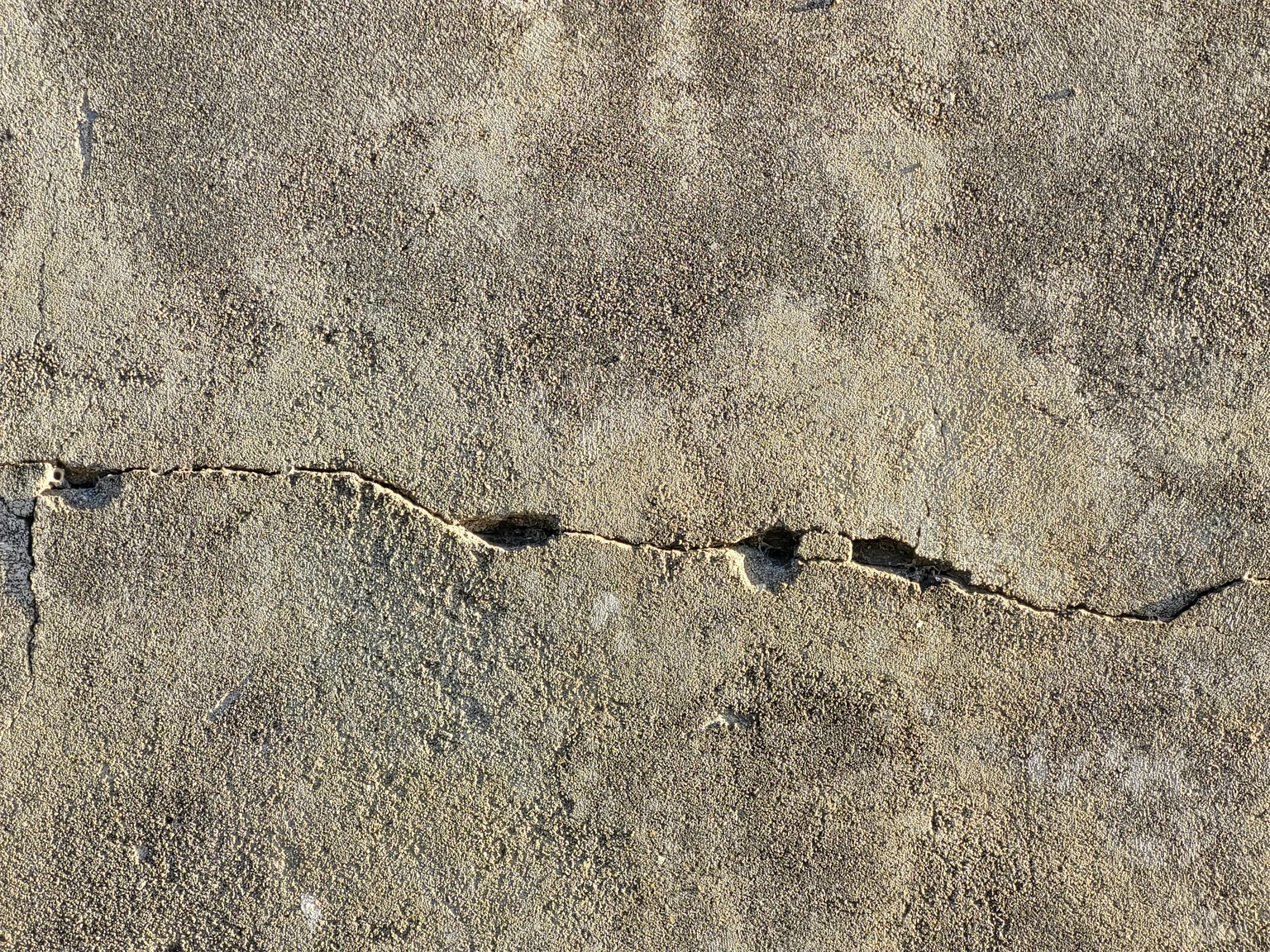
Foundation cracks are often the first sign of drainage issues. Water saturates the soil around your foundation, causing it to expand and contract with temperature changes. This constant movement puts stress on your foundation walls, leading to cracks that can compromise your home’s structural integrity.
Mold and mildew growth becomes a serious health concern when moisture finds its way into your basement or crawl space. These organisms thrive in damp conditions and can spread throughout your home’s ventilation system, affecting your family’s health and requiring expensive remediation.
Siding damage occurs when water constantly splashes against your home’s exterior. Over time, this moisture causes paint to peel, wood to rot, and even damage to vinyl or fiber cement siding materials.
Don’t forget about driveway damage either. Water pooling near your foundation often flows across driveways and walkways, washing away the supporting soil underneath. This erosion can cause concrete slabs to crack and settle, creating trip hazards and requiring costly repairs.
While you might be tempted to tackle drainage installation yourself to save money, professional installation ensures your system works correctly from day one. The difference between a DIY job and professional work often shows up years later when DIY systems fail.
Proper slope calculation is crucial for effective drainage. Water needs to flow consistently toward the discharge point, and achieving the right grade requires experience and specialized tools. Professional installers know how to calculate the exact slope needed for your specific property conditions.
Correct material selection makes a huge difference in system longevity. While you might think all drainage pipes are the same, professionals understand when to use PVC versus corrugated pipe, and which fittings and connectors will stand up to your local soil conditions.
System longevity is where professional installation really pays off. A properly installed underground drainage system can last 15 to 40 years with basic maintenance. DIY installations often require repairs or complete replacement within just a few years, making the initial savings disappear quickly.
Most importantly, professional installation gives you peace of mind. You know the system is installed correctly, meets local building codes, and comes with warranty protection. When you’re dealing with something as important as protecting your home’s foundation, that confidence is worth the investment.
When homeowners ask about the cost to install gutter drainage, we always start with the good news: it’s far less expensive than dealing with foundation repairs later. The investment typically ranges from $800 to $5,700 for most residential projects, depending on your home’s specific needs.
The national average for underground drainage installation sits between $2,000 and $6,000 for a basic system on a typical single-family home. If you have a larger property or need a more complex system, you might be looking at $10,000 to $20,000 or more.
What drives these costs? It’s mainly about labor and materials. Professional installation typically accounts for 60-70% of your total project cost, while materials make up the remaining 30-40%. This breakdown makes sense when you consider the excavation work, proper grading, and technical expertise required.
For underground downspout systems specifically, you’ll pay $150 to $350 per downspout. This includes everything: the catch basin, extension piping, trenching, and proper discharge point installation.
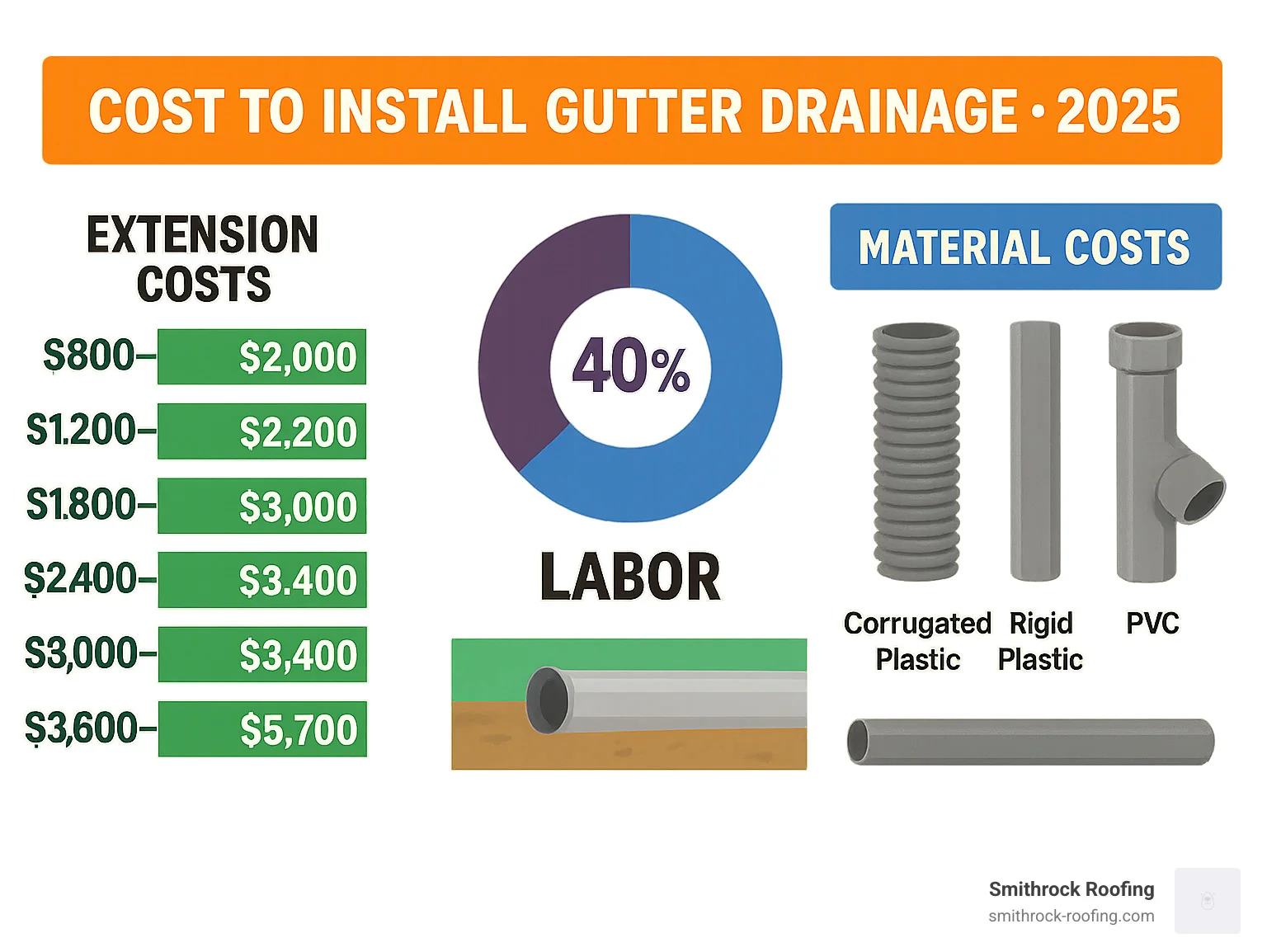
The number of drainage extensions is the biggest factor in determining your final bill. Here’s what you can expect:
Single extension projects typically cost $800 to $2,000. This works well for smaller homes or properties where water issues are isolated to one area.
Two drainage extensions will run you $1,200 to $2,200, while three extensions increase the cost to $1,800 to $3,000. Most average-sized homes fall into this range.
For larger homes, four drainage extensions cost $2,400 to $3,400, five extensions run $3,000 to $4,200, and six extensions can reach $3,600 to $5,700.
These prices include both materials and professional installation. The variation depends on factors like how deep we need to dig, the length of pipe required, and local labor rates in your area.
Each extension involves trenching, pipe installation, proper grading, and connecting to your existing gutter system. It’s detailed work that requires the right tools and experience to do correctly.
Downspouts are the workhorses of any gutter and drainage system — they carry water from the roof edge all the way down to ground level and into your drainage solution. Understanding downspout installation cost on its own helps you plan your overall drainage budget accurately.
Basic downspout installation — adding a new downspout to an existing gutter run — typically costs $75 to $250 per downspout, including labor and materials. Replacing an existing downspout that’s damaged or undersized usually falls in a similar range.
Downspout extensions and redirects — where the downspout is extended along the ground or redirected to a better discharge point — add another $20 to $100 depending on the length and the type of extension used.
Underground downspout drain installation, where the downspout connects to a buried pipe system, runs $150 to $350 per downspout as noted above. This is the most effective long-term option for keeping water well away from your foundation.
A few factors influence the final downspout installation cost for your specific home:
One thing worth noting: properly sizing and positioning your downspouts is just as important as the drainage system they feed into. An undersized or poorly placed downspout will overwhelm even the best underground drainage system during a heavy North Carolina rainstorm.
Whether you’re adding downspouts to a new gutter system or replacing ones that have seen better days, the cost to install downspouts breaks down a little differently depending on the scenario. Here’s a straightforward look at both.
If you’re having gutters installed or extended and need new downspouts as part of that project, most contractors bundle the cost into the overall gutter job. Standalone new downspout installation on an existing gutter system runs roughly $75 to $200 per downspout for standard aluminum in common sizes (2×3 inch or 3×4 inch). Larger downspouts for high-volume areas cost more.
When an existing downspout is crushed, cracked, pulling away from the wall, or simply undersized for your roof area, replacement is usually the right call. Expect to pay $100 to $250 per downspout replaced, depending on size and material. If the old downspout was connected to an underground drain line, there may be additional cost to properly reconnect the new downspout to that system.
A general rule of thumb is one downspout for every 20 to 40 linear feet of gutter. Homes with steeper roofs, larger drainage areas, or properties in areas with heavy rainfall — which certainly describes many NC Triad homes during spring storm season — often benefit from additional downspouts to prevent overflow. When we evaluate a home’s gutter and drainage system, assessing downspout quantity and placement is always part of the conversation.
When homeowners ask about the cost to install gutter drainage, the honest answer is that it’s not a one-size-fits-all number. Your final price depends on several key factors that can swing costs from a few hundred dollars to several thousand.
Think of it like asking “How much does a car cost?” The answer depends on whether you want a basic sedan or a luxury SUV. Similarly, drainage systems range from simple buried downspouts to complex French drain networks.
The drainage system you choose makes the biggest difference in your total cost. Here are the most common options:
Buried downspouts are the most straightforward solution, typically costing $150 to $350 per downspout. These systems simply extend your existing downspouts underground through a pipe that carries water to a safe discharge point away from your foundation. They’re perfect for most homes and handle typical rainfall without any fuss.
French drains are the heavy-duty option when you’re dealing with serious water problems. These systems cost $1,000 to $5,000 because they involve more complex installation with perforated pipes surrounded by gravel. They collect water over a wider area and work great for homes with persistent drainage issues. If you want to dive deeper into how they function, check out this helpful overview on the French drain concept.
Dry wells serve as underground collection points where water can slowly absorb into the surrounding soil. At $300 to $1,500 to install, they’re a middle-ground solution that works well if you have decent soil drainage but need somewhere for water to go.
Catch basins and storm drains represent the professional-grade approach, costing $8 to $15 per linear foot. These systems handle large volumes of water and are ideal for homes in areas with heavy rainfall or complex drainage challenges.
Here’s something that surprises many homeowners: labor typically represents 40 to 60% of your total project cost. The complexity of digging and installation work directly impacts what you’ll pay.
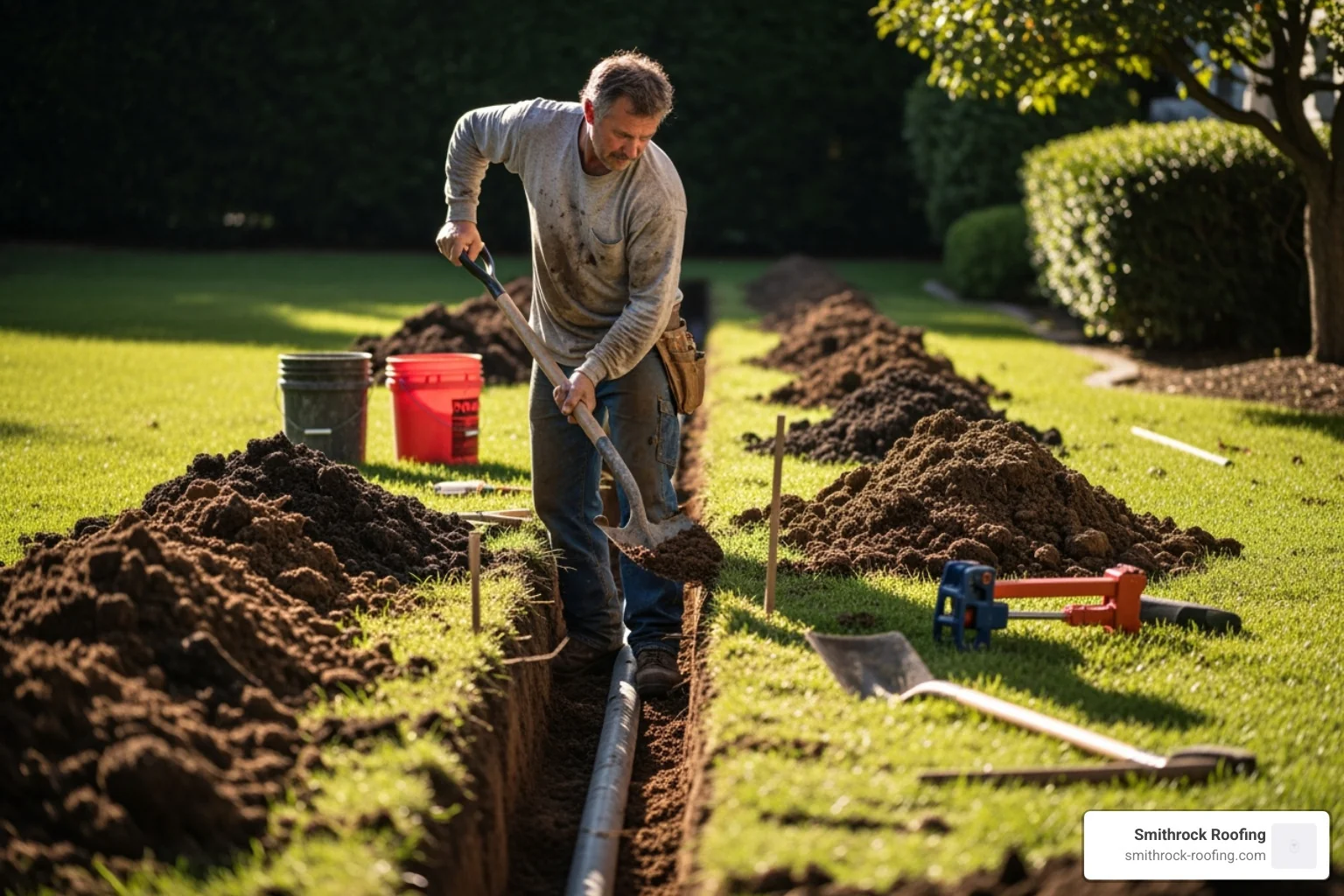
Trenching depth and distance play a huge role in labor costs. Most drainage systems need trenches between 8 and 24 inches deep, and longer pipe runs naturally require more time and equipment. A system that needs to carry water 100 feet from your house costs significantly more than one that only goes 30 feet.
Soil conditions can make or break your budget. Sandy loam soil is a dream to work with — it digs easily and drains well. Clay soil, on the other hand, is tough to excavate and may require special equipment. Rocky soil is the worst-case scenario, sometimes requiring jackhammers or specialized tools.
Accessibility issues around your property add time and complexity. If contractors can’t get equipment close to the work area, or if they need to work around delicate landscaping, mature trees, or tight spaces, expect higher labor costs.
Utility line considerations require extra caution and planning. Working around existing water, gas, or electrical lines slows down installation and may require hand-digging in certain areas.
Cleanup and restoration often get overlooked in initial estimates, but they can add $500 to $2,000 to your project cost. This includes repairing damaged landscaping, reseeding grass, and hauling away excess soil.
The materials you choose significantly impact both upfront costs and long-term performance. PVC pipe costs $3 to $6 per foot and offers excellent durability for most applications. Rigid plastic pipe runs $4 to $8 per foot and provides superior strength for challenging installations. Corrugated plastic pipe is the budget option at $2 to $5 per foot, but it’s more prone to crushing and clogging over time.
Beyond the main pipes, you’ll need various components that add to the total cost. Catch basins range from $20 to $130 each, depending on size and quality. Drain fittings cost $3 to $10 each, and you’ll need gravel for proper drainage at $15 to $75 per yard.
Property grading often requires additional work costing $500 to $3,000, but it’s absolutely essential for proper water flow away from your foundation. Without correct grading, even the best drainage system won’t work effectively. Think of it as the foundation for your drainage system — you can’t skip this step and expect good results.
The pipe running underground from your downspouts to the discharge point is what makes a gutter underground drainage system actually work. Getting this part right — the right pipe type, the right depth, the right slope — determines whether your system lasts 15 years or 40.
Drainage pipe installation is more involved than most homeowners expect. It’s not simply a matter of burying a pipe and calling it done. The trench has to be excavated to the correct depth, the pipe bed has to be prepared properly, the slope has to be consistent from start to finish, and the connections at both ends — where the downspout feeds in and where water exits — have to be secure and watertight. Each of these steps requires experience and attention to detail that separates a system that performs for decades from one that fails within a few years.
Not all pipe is created equal, and the choice matters more than most homeowners realize.
Solid PVC pipe is the preferred option for most residential drainage pipe installation. It’s rigid, smooth on the inside (which helps water move quickly without debris catching), and highly resistant to crushing under the weight of soil. At $3 to $6 per foot, it costs a bit more than corrugated alternatives but is well worth the investment for longevity.
Corrugated flexible pipe is widely available and less expensive, but its ridged interior surface can trap debris and sediment over time, leading to clogs. It’s also more susceptible to crushing if not bedded correctly. We generally recommend solid PVC for any system we install.
Perforated pipe is used specifically in French drain applications, where the goal is to collect groundwater from the surrounding soil as well as carry it away. It’s not the right choice for a standard downspout discharge line, where you want water to stay in the pipe until it reaches the discharge point.
Drainage pipe should be buried deep enough to avoid damage from lawn equipment and freeze-thaw cycles — typically 8 to 18 inches below grade in most NC Triad applications. The pipe must also maintain a consistent downward slope toward the discharge point, usually at least 1% grade (that’s a 1-inch drop for every 8 feet of run). Get the slope wrong and water will sit in the pipe, inviting sediment buildup and eventually clogging the system.
Where the pipe actually lets water out matters just as much as the pipe itself. Common discharge options include:
Each option has its place depending on your property layout and local regulations. A professional assessment takes the guesswork out of choosing the right one.
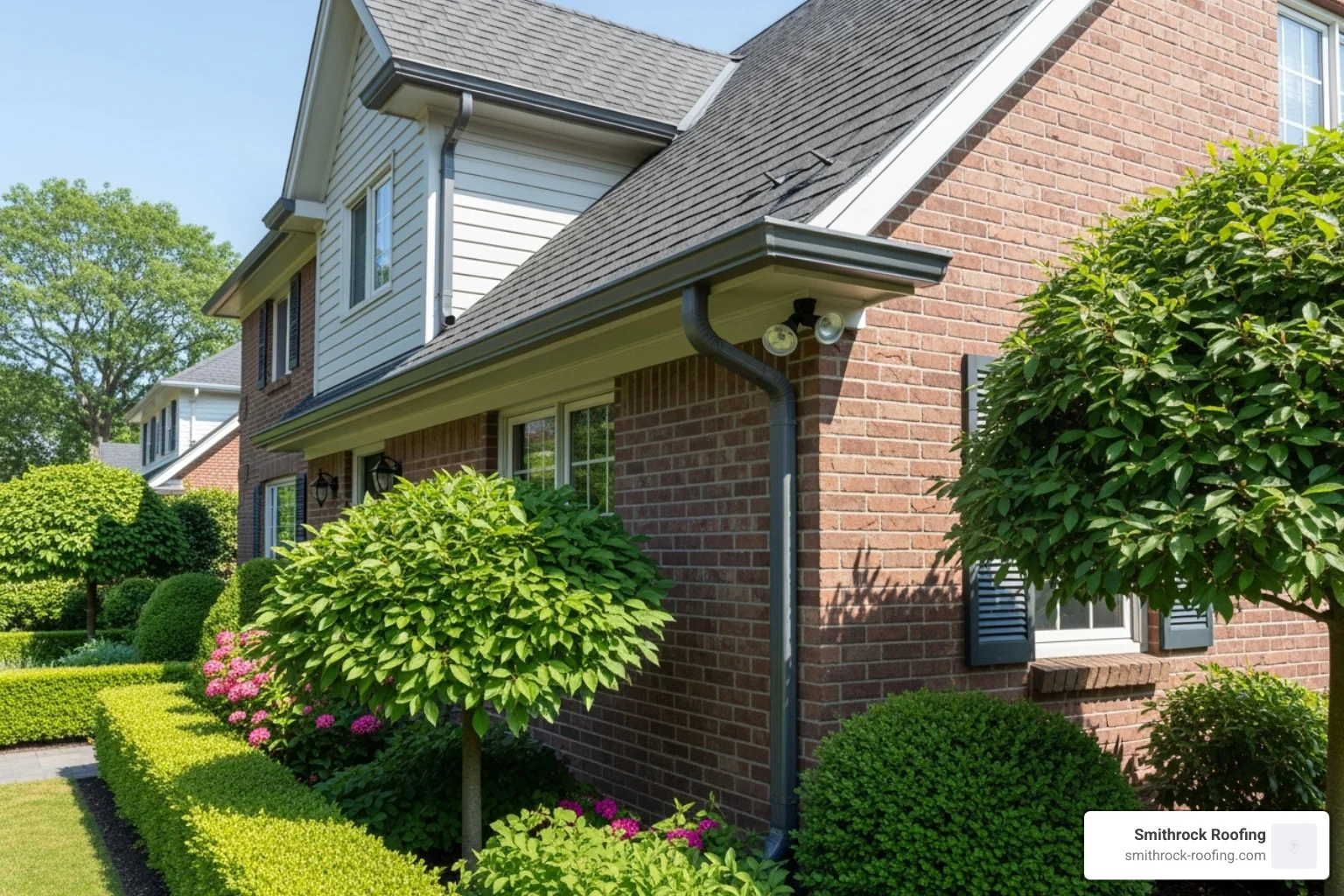
Here’s the truth about gutter maintenance: spending a little time and money on regular upkeep saves you thousands in major repairs later. When you understand typical repair costs, you’ll see why proper drainage installation and maintenance are such smart investments.
Most homeowners don’t think about their gutters until something goes wrong. But by then, what could have been a simple fix becomes an expensive emergency. The good news is that regular maintenance prevents most serious problems from developing in the first place.
Downspout problems are among the most common service calls we handle — and fortunately, they’re usually among the more affordable repairs when caught early.
Downspout repairs typically run $100 to $400, depending on what’s gone wrong. The most common issues include:
The pattern worth noting: most downspout repair costs stay manageable when problems are addressed promptly. Let a clog or separated joint go through a full wet season and the damage downstream — to your foundation, landscaping, or underground drain line — can cost far more to fix than the original repair.
Gutter section problems get more expensive. Leaky gutters cost $150 to $500 to repair, while sagging gutters — often caused by poor drainage and water backup — can run $200 to $600 to fix properly. When gutters sag, it’s usually because they’ve been holding too much water for too long.
Re-sealing joints becomes necessary when gutters develop leaks from corrosion, rust, or damage from debris buildup. This repair typically costs $150 to $500, but it’s often preventable with regular maintenance.
The pattern here is clear: most expensive repairs happen because water isn’t flowing properly through your system. That’s exactly why investing in proper drainage installation prevents these costly problems.
Smart homeowners know that regular maintenance extends your drainage system’s life and keeps repair costs low. The cost to install gutter drainage systems properly upfront pays for itself when you avoid these recurring repair expenses.
Bi-annual inspections are your best defense against expensive surprises. Check your entire system at least twice yearly, especially after heavy storms. Look for clogs, damage, or areas where water isn’t flowing correctly. Catching problems early means smaller repair bills.
Debris removal might seem obvious, but it’s the maintenance task most homeowners skip. Keep gutters and downspouts clear of leaves, twigs, and other debris that cause backups. When water can’t flow freely, it backs up and creates the conditions for expensive damage.
System flushing should happen annually. Run water through your entire drainage system to ensure proper flow and identify potential problems before they become major issues. This simple step helps you spot clogs or damage early.
Professional cleaning makes sense if you’re not comfortable doing the work yourself. Professional gutter cleaning typically costs $150 to $300 — far less than the repair costs you’ll face if you skip maintenance entirely.
The bottom line? A well-maintained drainage system can last 15 to 40 years with minimal repair costs. Skip the maintenance, and you’ll be dealing with expensive repairs every few years instead.
One question that comes up more than you might expect: who actually does this work? And it’s a fair one, because gutter drainage sits at the intersection of a few different trades.
For most residential underground gutter drainage installations — burying downspout extensions, installing catch basins, connecting pipe to a discharge point — a qualified exterior contractor or gutter specialist is the right call. These contractors handle the work regularly, understand how gutter systems function as a whole, and can evaluate your downspouts, gutters, and drainage needs in a single visit.
Larger or more complex drainage projects — particularly those involving tie-ins to municipal storm systems, significant grading changes, or French drain systems across a wide area — may bring in a landscaping contractor or site drainage specialist as well.
What about plumbers? Homeowners sometimes wonder how much plumbers charge to install roof drains or gutter drainage. Licensed plumbers are typically involved when a drain connects to an interior plumbing system or a roof drain that ties into the building’s internal drainage stack. For exterior underground gutter drainage that discharges away from the home’s foundation — the type most homeowners need — a plumber isn’t usually required. That work falls squarely in the exterior contractor’s wheelhouse. If you have a flat roof with interior roof drains, though, that’s a different conversation, and a plumber would typically handle or oversee that installation.
The short answer for most NC Triad homeowners: start with an experienced exterior contractor who specializes in gutters and drainage. They’ll tell you honestly if any portion of the project requires a different trade.
Here’s the golden rule for gutter drainage: water should flow at least 10 feet away from your foundation. But honestly, that’s just the minimum — the farther, the better for your home’s protection.
Your local building codes might have specific requirements, so it’s worth checking with your city or county. Some areas require 15 feet or more, especially if you have clay soil that doesn’t drain well.
Here’s what makes underground systems so much better than those basic splash blocks: underground pipes can route water 100 feet or more away from your foundation. Compare that to traditional above-ground extensions that only reach 10-20 feet, and you can see why the cost to install gutter drainage underground is worth every penny.
The key is making sure water doesn’t have any chance to flow back toward your home or create new pooling problems elsewhere on your property.
Proper gutter drainage means water moves efficiently from your roofline, through your gutters, down your downspouts, and away from your foundation — without pooling, overflowing, or soaking the soil against your home’s walls.
A properly functioning system has gutters pitched correctly toward the downspouts (typically about a quarter inch of drop per 10 feet of gutter), downspouts sized to handle the roof drainage area they serve, and a discharge point — whether above or below ground — that releases water well away from the foundation. There should be no standing water near the house within an hour or two after rain stops. If there is, something in the system isn’t doing its job.
A downspout drain — sometimes called an underground downspout extension — is the simpler of the two. It connects directly to one downspout and runs a single buried pipe to a discharge point, typically 10 to 30 feet from the house. It handles the water from that one downspout only.
A full underground gutter drainage system may connect multiple downspouts into a network of buried pipes, incorporate catch basins to collect surface runoff, and route all of that water to a single or multiple discharge points. These systems are better suited to larger homes, properties with significant grading challenges, or situations where surface water from the yard is contributing to the problem in addition to roof runoff.
For many homes in the NC Triad, a well-designed downspout drain installation at each downspout is all that’s needed. For others, a more comprehensive system makes sense. A professional evaluation is the best way to determine what your specific property actually requires.
We get this question a lot, and we understand the appeal of saving money on labor costs. But here’s the honest truth: DIY drainage installation is risky business for most homeowners.
Complex planning is the first hurdle. You need to calculate proper slopes (typically 1-2% grade), locate underground utilities, and often obtain permits. Get the slope wrong, and your system won’t work properly.
Specialized tools are expensive. You’ll need trenching equipment, pipe cutting tools, and grading equipment that most homeowners don’t own. Renting these tools can cost $200-500 per day.
Mistakes get expensive fast. Poor grading, wrong pipe materials, or improper connections can cause water to back up or pool in the wrong places — and the repair cost often exceeds what professional installation would have cost in the first place.
Safety is a real concern. Excavation work involves risks from cave-ins, accidentally hitting utility lines, and operating heavy equipment without proper training.
Professional installation ensures your system works correctly from day one and typically comes with warranties protecting your investment. When you consider the cost to install gutter drainage professionally versus the cost of fixing DIY mistakes, professional installation usually wins.
Your home gives you plenty of warning signs when your drainage system isn’t working properly. The trick is knowing what to look for.
Water pooling near your foundation after rain is the most obvious red flag. If you see standing water within 10 feet of your house, your current system isn’t doing its job.
Foundation issues like cracks, settling, or white chalky deposits (efflorescence) on basement walls often indicate water management problems. These problems only get worse over time.
Overflowing gutters during moderate rainfall suggests your downspouts can’t handle the water volume. This often happens when underground systems get clogged or weren’t properly sized initially.
Eroded landscaping around your downspout discharge points shows water is hitting the ground with too much force or volume. Proper drainage systems should release water gently.
Damp basement conditions or mold and mildew growth near your foundation are serious warning signs. These problems indicate water is finding its way where it shouldn’t be.
If you’re noticing any of these issues, it’s time to consider upgrading your drainage system. The sooner you address these problems, the less expensive they’ll be to fix.
Costs in the NC Triad area are generally in line with national averages for this type of work. For a single underground downspout drain installation — connecting one downspout to a buried pipe that routes water safely away from your foundation — expect to pay in the $150 to $350 range. Homes that need multiple downspouts connected, or that have challenging soil or access conditions, will fall higher in the overall project range.
The best way to get an accurate number for your home is a professional on-site evaluation. Every property is a little different, and a walk-around with an experienced contractor gives you a real number based on your actual conditions — not a ballpark pulled from a national average.
A gutter underground drainage system is a network of buried pipes and collection points that takes water from your downspouts and carries it beneath the surface to a safe discharge location away from your home. Instead of water spilling out at the base of a downspout and soaking the soil around your foundation, it enters a catch basin or direct pipe connection and travels underground — out of sight and well away from anywhere it can cause damage.
These systems typically consist of four main components: the inlet (usually a catch basin or direct downspout connection), the underground pipe run (most commonly solid PVC), any additional collection points along the route, and the outlet or discharge point where water exits safely. A well-designed system is gravity-fed, requires no power to operate, and works automatically every time it rains.
For homes across Winston-Salem, Greensboro, High Point, and the surrounding Triad, where heavy spring and summer storms can drop significant rainfall in short periods, a properly sized underground system is one of the most reliable ways to keep that water moving away from your home quickly and consistently.
When you step back and look at the numbers, the cost to install gutter drainage systems makes perfect sense as a home protection strategy. Think about it this way: spending $800 to $5,700 on proper drainage now saves you from facing foundation repairs that can hit your wallet for $2,300 to $6,800, or basement waterproofing that runs a whopping $4,500 to $15,500.
Underground drainage systems are simply better at protecting your home than those basic above-ground extensions. They move water much farther from your foundation, keep your yard looking neat and tidy, and require less maintenance over time. It’s like having a silent guardian working 24/7 to protect your biggest investment.
At Smithrock Roofing, we’ve seen how proper water management transforms homes across Winston-Salem, Greensboro, High Point, Kernersville, Clemmons, King, and throughout the NC Triad. Our team brings 60+ combined years of exterior experience to every gutter and drainage evaluation, and our A+ BBB rating reflects the honest, no-pressure approach we take with every homeowner. We’re not here to sell you more than you need — we’re here to tell you what your home actually requires and do the work right the first time.
Professional installation gives you something you can’t get from a DIY approach: peace of mind. When we install your system, you know it’s going to work correctly from the very first rainstorm. With proper maintenance, a professionally installed drainage system becomes a long-term solution that protects your home for 15 to 40 years.
Here’s the thing about water damage — it doesn’t announce itself with a big dramatic moment. It’s the slow, steady damage that happens over months and years that really costs homeowners. Foundation cracks, basement flooding, and structural problems all start small and grow into expensive headaches.
Don’t wait until you’re dealing with water in your basement or cracks in your foundation walls. Investing in proper gutter drainage now means you’re taking control of the situation before it becomes a crisis. Your future self will thank you when your neighbors are dealing with water damage and you’re sitting comfortably in your dry, protected home.
Contact us for a professional gutter evaluation and let us design a drainage solution that’ll keep your home safe and dry for decades to come. Because when it comes to protecting your home, you deserve a system that works as hard as you do.

Smithrock Roofing © Copyright 2026 • All Rights Reserved • Privacy Policy • Maintained by Mongoose Digital Marketing