
Gutter installation for homes is not just an aesthetic addition; it is a critical project for protecting your property’s structural integrity and value from the persistent threat of water damage. Without a properly installed and functioning gutter system, every rainfall becomes a potential assault on your home, allowing water from your roof to damage your foundation, siding, basement, and landscaping in ways that can be both costly and difficult to repair.
Quick Answer: What You Need to Know About Gutter Installation
A gutter system is your home’s first and most important line of defense against rain and melting snow. Without gutters, water cascades directly off the roof and saturates the ground immediately surrounding your foundation. This creates a host of serious problems over time. The constant splashing will stain your siding with mud and promote the growth of mold and mildew. More critically, the water-logged soil around your foundation can lead to significant structural issues. The soil expands when saturated and contracts when dry, exerting immense pressure on your foundation walls, which can lead to cracks and long-term instability. This moisture can also easily find its way into your basement or crawl space, leading to flooding, property damage, and hazardous mold growth.
Properly installed gutters prevent these expensive headaches. They act as a perimeter defense system, catching the runoff and directing it through downspouts to a safe distance from your home. This protects not only your foundation and basement but also your siding, windows, doors, and even your landscaping by preventing soil erosion and over-watering of plants near the house. Furthermore, by eliminating standing water around your property, you also reduce breeding grounds for mosquitoes and deter other pests like termites and carpenter ants that are attracted to damp wood.
According to the U.S. Environmental Protection Agency (EPA), the effective management of urban runoff through systems like residential gutters plays a vital role in protecting local water quality and preventing soil erosion on a larger scale. Read more on EPA. Similarly, the National Association of Home Builders (NAHB) consistently emphasizes that a complete gutter system is an essential component of comprehensive home weatherproofing and moisture management.
While many homeowners opt to hire professionals for a guaranteed outcome, gutter installation for homes can be a manageable DIY project for those with the right skills, a comprehensive set of tools, and a steadfast commitment to ladder safety. Taking on the project yourself can offer greater control over material choices and installation quality, all while saving significantly on labor costs. This guide will walk you through every step of the process, empowering you to make the best decision for your home.
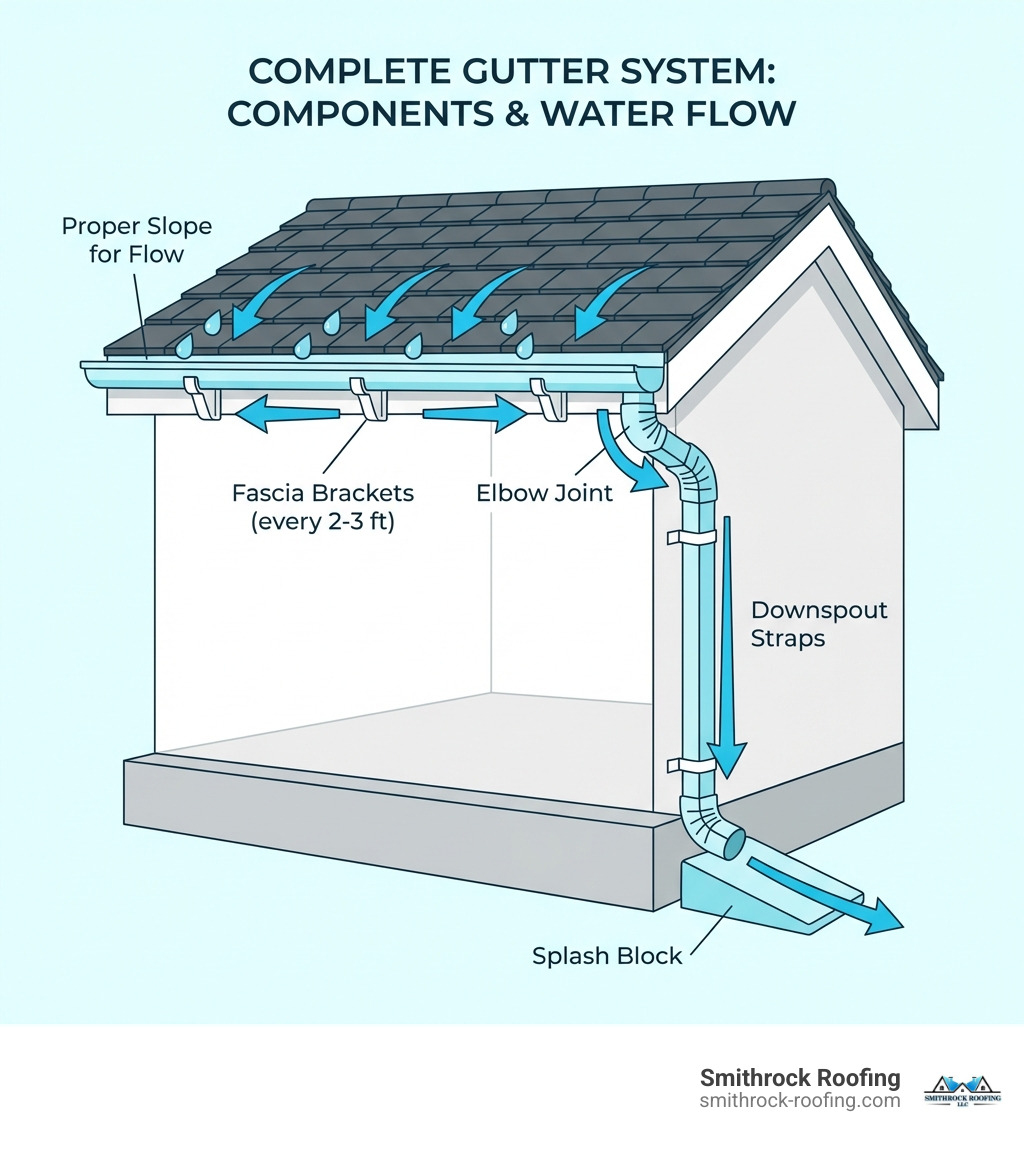
Gutter installation for homes vocabulary:
Proper planning is the blueprint for a successful gutter installation for homes. This foundational stage is where you make the critical decisions that ensure your new gutter system fits perfectly, drains efficiently, and provides maximum protection for your home in Winston-Salem, King, Clemmons, and our other North Carolina service areas for decades to come.
First and foremost, safety is paramount. Gutter installation involves working at heights, often with long and unwieldy materials. Always work with a partner who can help stabilize the ladder and handle materials. Use a sturdy, properly rated extension ladder (Type IA or IAA is recommended) placed on level ground. Always maintain three points of contact (two feet and one hand, or two hands and one foot) on the ladder, and never overreach. Be acutely aware of your surroundings, especially overhead electrical lines; stay at least 10 feet away from power lines at all times.
Before you purchase a single component, perform a thorough inspection of your home’s fascia and soffit. The fascia is the board that runs along the roofline where the gutters will be mounted. Probe it with a screwdriver, especially at corners and seams, to check for soft spots indicating rot or water damage. Any compromised wood must be completely removed and replaced with solid, sound lumber. Attaching new gutters to rotten fascia is a recipe for failure, as the fasteners will not hold and the entire system could collapse under the weight of water or debris. Also, ensure your roof has a proper drip edge installed, which is a metal flashing that directs water from the roof shingles directly into the gutter, preventing it from running behind the gutter and rotting the fascia.
Your home’s specific features, such as roof pitch, total roof area, and surrounding landscaping, will heavily influence your installation plan. A steep roof pitch causes water to flow faster and in greater volumes, potentially requiring larger gutters or more robust hangers. The size of your home determines the total linear footage of gutters needed and, more importantly, the number of downspouts required for adequate drainage. The National Association of Home Builders (NAHB) provides excellent guidelines for these technical considerations. Read more on NAHB.
Selecting the right material is a critical decision that balances durability, cost, maintenance, and aesthetics. Each material has distinct advantages and disadvantages.
| Gutter Material | Durability | Maintenance | Lifespan | Aesthetics |
|---|---|---|---|---|
| Vinyl | Fair (can crack/warp) | Low | 10-20 years | Plastic look, various colors |
| Aluminum | Good (dent-prone) | Low | 20-30 years | Wide range of colors, seamless options |
| Steel | Excellent (rust-prone) | Moderate (paint) | 20-30 years | Strong, industrial look |
| Copper | Superior (patina) | Very Low (no paint) | 50+ years | Distinctive, develops green patina over time |
Vinyl gutters are the most budget-friendly option and are very lightweight, making them a popular choice for DIY installers. They are rust-proof and come in sections that snap together easily. However, their drawbacks are significant: vinyl can become brittle and crack in extreme cold, and it can warp or sag in prolonged high heat and direct sunlight. The seams can also leak over time as the material expands and contracts.
Aluminum gutters are the most popular choice in the U.S., offering an excellent balance of affordability, durability, and low maintenance. They are lightweight, will not rust, and come with a factory-applied finish in a vast array of colors. The most significant advantage is their availability in seamless form, which are custom-extruded on-site to eliminate seams and potential leak points. The primary downside is that aluminum is prone to denting from ladders or heavy impacts. For best performance, choose a thicker gauge, such as .032-inch, over the standard .027-inch.
Steel gutters are exceptionally strong and rigid, making them an ideal choice for regions with heavy snowfall, ice, or frequent high winds. Galvanized steel is coated with zinc to prevent rust, but scratches in this coating can lead to corrosion. They are much heavier than aluminum and often require professional installation. Galvalume is a premium steel option with a zinc-aluminum alloy coating that offers superior corrosion resistance.
Copper gutters represent the pinnacle of quality and aesthetics. They are extremely durable, will never rust, and can last for 50 to 100 years with minimal maintenance. Instead of paint, copper develops a beautiful blue-green patina over time, which is highly sought after for historic and high-end homes. The main disadvantages are the very high material cost and the need for specialized installation, as seams and joints must be expertly soldered.
Beyond materials, you must choose a gutter profile. K-style gutters are the most common residential profile, featuring a flat back for easy mounting to the fascia and a decorative front that resembles crown molding. They can carry more water than a half-round gutter of the same width. Half-round gutters offer a traditional, semi-circular U-shape, often preferred for historic or European-style homes. They are less prone to corrosion but often require more specialized brackets.
Standard residential gutters are 5 or 6 inches wide. For most homes, 5-inch K-style gutters are sufficient. However, homes with large or steep roofs, or those located in areas with intense rainfall like North Carolina, will benefit from oversized 6-inch gutters and larger 3×4-inch downspouts to handle the increased water volume and prevent overflow.
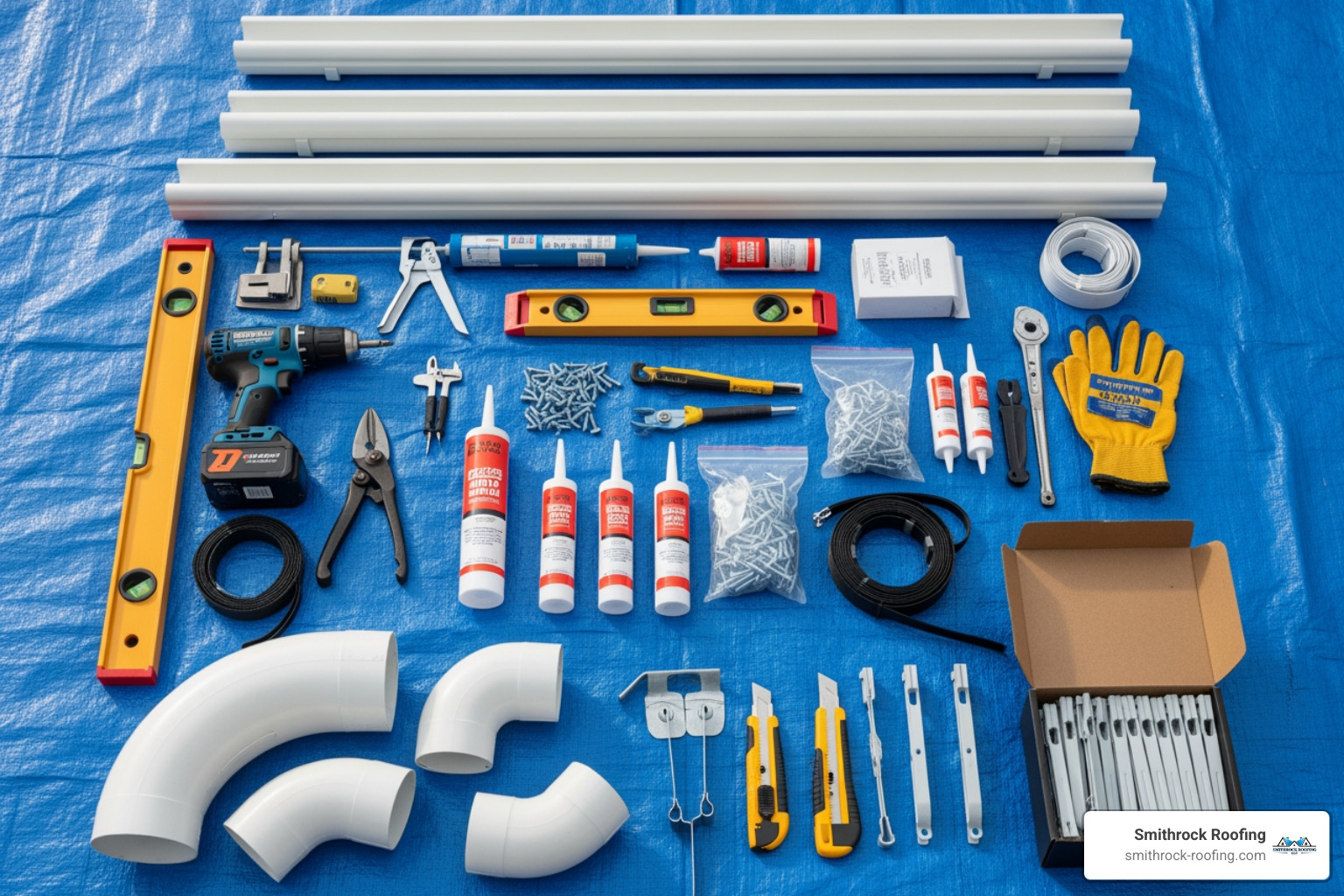
Having every tool and all materials on-site before you begin ensures a smooth, professional gutter installation for homes.
Tools We’ll Need:
Materials We’ll Need:
Accurate measuring and a clear layout plan are the final steps before installation. Measure the linear footage of all fascia runs that require gutters. Sketch a simple diagram of your home’s roofline, marking these measurements. Remember, gable ends (the triangular parts of the wall) do not get gutters.
Next, plan your downspout locations. You need one downspout for every 30-40 feet of gutter. For any run longer than 40 feet, it’s best to pitch the gutter from the middle down to a downspout at each end. When placing downspouts, consider landscaping, walkways, and driveways. The goal is to direct water at least 5-10 feet away from the foundation without creating icy patches or eroding garden beds. Calculate the total number of inside and outside corners (miters), end caps, and elbows you’ll need. It’s wise to purchase about 10% extra material to account for mistakes. For a high-tech approach, services like GutterScope can provide precise aerial measurements of your home.
With your comprehensive plan complete, materials gathered, and safety protocols in mind, it’s time for the hands-on process of gutter installation for homes. This stage requires precision and patience. Always prioritize safety by working with a partner, especially when maneuvering long gutter sections at height, and never attempt to work in wet or windy conditions.
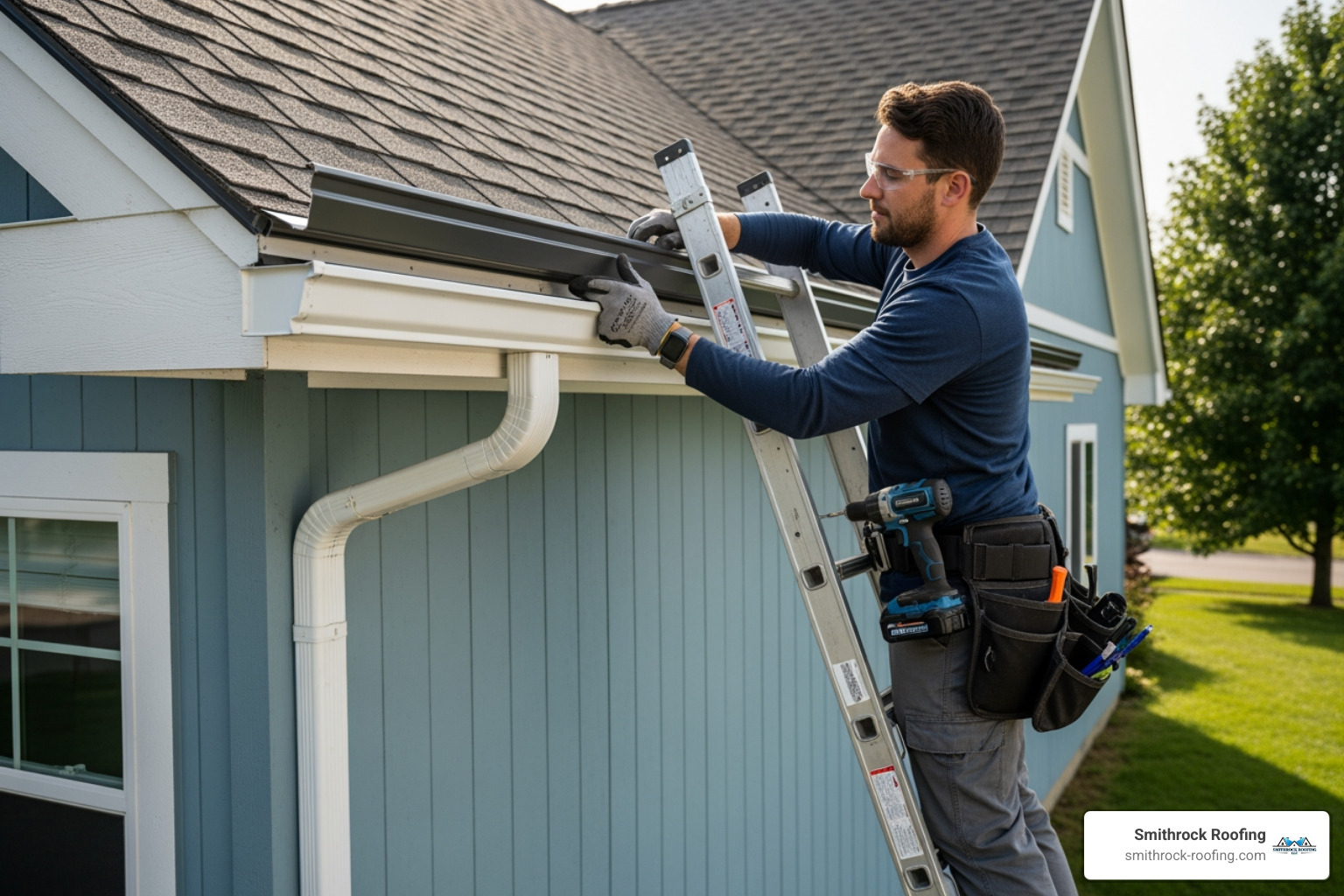
Begin by carefully removing the old gutters. If they are held by spikes and ferrules, use a pry bar and hammer to work the spikes out. For systems with brackets, simply unscrew them. Old gutters can be surprisingly heavy with trapped debris, so have your partner help you lower each section safely to the ground. Once removed, take this opportunity to perform a final, thorough inspection of the fascia and soffit. Scrape away any peeling paint and check again for rot. Any damaged wood must be repaired or replaced now to provide a solid anchor for your new system. This is a critical step for the longevity and performance of your new gutters. Consider the Cost of New Fascia, Soffit, and Guttering as part of your budget if significant repairs are needed. Finally, properly dispose of the old materials; aluminum gutters can often be sold for scrap metal.
Proper slope, or pitch, is the most critical element for a functional gutter system. Gutters need a slight downward slope—at least ¼-inch for every 10 feet of run—to ensure water flows toward the downspouts and doesn’t pool. At the end of the fascia run farthest from the planned downspout location, mark the high point of the gutter, typically about 1 ¼ inches below the drip edge. Next, go to the downspout location and mark the low point. To calculate this, determine the length of the run in feet, divide by 10, and multiply by ¼ inch. For example, a 30-foot run needs a drop of ¾ inch (30/10 * ¼). Add this drop to your initial measurement below the drip edge. Snap a chalk line between the high and low points to create a perfectly sloped installation guide. For runs over 40 feet, find the center, mark it as the high point, and slope the gutters down to a downspout at each end.
Measure your fascia runs and cut the gutter sections to length. For the cleanest cuts on aluminum, use a miter saw with a fine-toothed carbide blade (be sure to wear safety glasses). A hacksaw will also work. For runs that require joining two sections, create an overlap of 4 to 8 inches, ensuring the overlapping piece is on the “downhill” side so water flows over the seam, not into it. Before joining, clean the overlapping surfaces with rubbing alcohol. Apply a generous bead of high-quality polyurethane gutter sealant along the inside of the seam. Press the sections together firmly and secure the overlap with at least two pop rivets on the sides and back of the gutter—never on the bottom, as this creates a potential leak point. To attach end caps, apply sealant to the inside edge of the cap, press it on firmly, and secure with a rivet or color-matched screw.
With your gutter sections assembled, it’s time to install the support hangers. Hidden hangers are the modern standard, providing a clean look and excellent strength. Space the hangers every 2 to 3 feet along the fascia. In areas with heavy snow or ice, reduce the spacing to every 18-24 inches for added support. For maximum strength, drive the long gutter screws through the fascia board and directly into the rafter tails behind it. You can usually find rafter tails by looking for the nail heads in the fascia. With the hangers installed on the gutter section, lift it into place with your partner. Snap the back of the gutter into the hangers and align the top edge with your sloped chalk line. Drive the screws to secure the hangers to the fascia, ensuring the system is stable and maintains the correct pitch.
The final stage is creating the drainage path. At the lowest point of each gutter run, mark the center of your downspout outlet on the bottom of the gutter. Using a drill and a 4-inch hole saw, carefully cut the opening for the outlet. File any sharp edges. Apply a thick ring of sealant around the hole on the inside of the gutter, then insert the downspout outlet (also called a drop outlet) from the top and secure it tightly with several pop rivets. Now, assemble the downspout. You will typically use two elbows at the top to create an ‘S’ shape that transitions from the outlet to the wall of your house. Crimp the lower end of each downspout and elbow section so it fits snugly inside the next piece, ensuring water cannot leak out of the joints. Attach the vertical downspout to the wall with straps every 4 to 6 feet. Finally, attach one last elbow at the bottom to direct water onto a splash block or into a downspout extension, carrying it safely away from your foundation. For more details, see our guide on Gutter and Downspout Installation.
After your gutter installation for homes is complete, a proactive approach to maintenance is essential for ensuring long-term performance and protection. A well-maintained system will extend its lifespan, prevent costly water damage, and keep your Exterior Gutters functioning optimally through every season.
Regular cleaning is the single most crucial aspect of gutter maintenance. Clogged gutters are ineffective gutters. Plan to clean them at least twice a year—once in the late spring after trees have dropped their seeds and pollen, and again in the late fall after leaves have fallen. If your home is surrounded by tall trees, more frequent cleaning may be necessary. You can remove debris by hand (while wearing gloves), with a gutter scoop, or even with a leaf blower or wet/dry vac equipped with extension wands. After removing the large debris, flush the gutters and downspouts with a garden hose to clear out any remaining sediment and confirm that water is flowing freely. During these cleanings, perform a quick inspection. Look for any signs of sagging, loose hangers, or sealant that is cracking or pulling away at the seams. Addressing these minor issues promptly can prevent them from turning into major problems.
Common Gutter Problems and Solutions:
For more repair insights, see our Gutter Repair Winston Salem Guide.
Gutter guards are an excellent upgrade for any gutter installation for homes, new or existing. These systems cover the gutter trough to block leaves, twigs, and other debris while allowing water to flow in. The benefits are significant:
There are several types of gutter guards, each with pros and cons:
Gutter guards are a smart investment in the longevity of your gutter system and the protection of your home. Learn more on our Gutter Guard Installation page.
Deciding between a DIY project and hiring a professional for gutter installation for homes depends on your skills, tools, time, and the complexity of the job.
A DIY approach can be rewarding if:
However, precision is absolutely key. Small mistakes in slope, sealing, or hanger placement can lead to leaks and system failure, negating all your hard work.
When to Hire a Professional:
We strongly recommend hiring a professional for:
Ultimately, the goal is a high-performing gutter system that protects your home. Learn about our Gutter Installation Services.
Here are detailed answers to some of the most common questions homeowners have about gutter installation for homes.
Recognizing the signs of a failing gutter system is crucial to preventing expensive home damage. While a single leak might be repairable, multiple issues often signal that a full replacement is the most cost-effective solution. Look for these key indicators:
The correct slope is non-negotiable for a functional system. The industry standard and minimum requirement is a slope of ¼-inch for every 10 feet of gutter run. For a 40-foot run, this translates to a full 1-inch drop from the high end to the low end where the downspout is located.
Seamless gutters are considered the modern standard for professional installations, and for good reason. Unlike traditional sectional gutters that come in 10-foot pieces, seamless gutters are manufactured on-site using a specialized roll-forming machine. A professional crew measures your roofline and extrudes a single, continuous piece of aluminum gutter to that exact length. The only seams are at the corners and downspout outlets.
Yes, they are absolutely worth it. The primary advantage is the drastic reduction in potential leaks. Seams are the weakest point in any gutter system. By eliminating them along straight runs, you create a stronger, more durable, and far more reliable system that requires less maintenance over its lifespan. The clean, continuous look is also aesthetically superior.
Yes, but it presents significant challenges and safety risks. Installing gutters on a steep-pitch roof is a job best left to professionals. The primary concern is safety; the angle of the roof makes ladder placement difficult and increases the risk of a serious fall. Professionals use specialized safety equipment, such as roof jacks, safety harnesses, and ropes, to work securely on steep surfaces. They also have the experience to properly anchor the gutters to withstand the faster-moving water that comes off a steep roof. For homes in Kernersville, Clemmons, or other areas we serve with challenging rooflines, hiring an insured professional is a wise investment in safety and quality workmanship.
This comprehensive guide has walked you through every critical aspect of gutter installation for homes, from initial planning and material selection to the step-by-step installation process and long-term maintenance. We hope it has empowered you with the knowledge to understand the vital role a high-quality gutter system plays in protecting your home’s value and structural integrity. A properly installed and maintained gutter system is not an expense but a fundamental investment—a shield against the costly consequences of uncontrolled water damage, including foundation repairs, basement flooding, wood rot, and landscape erosion.
Whether you decide to take on the challenge as a DIY project or entrust it to seasoned professionals, the end goal is the same: a flawless system that captures every drop of rainwater from your roof and directs it safely away from your home. The key takeaways are to choose the right materials for your climate and budget, ensure a precise slope for proper drainage, secure the system firmly to sound fascia, and commit to regular cleaning and maintenance.
At Smithrock Roofing, we are dedicated experts in complete exterior solutions, specializing in high-quality seamless gutter systems for homes throughout Winston-Salem, King, Clemmons, Lewisville, Pilot Mountain, and our other North Carolina service areas. If you need a new installation, a full replacement, or simply expert advice on the best solution for your property, our experienced team is here to help. After any new installation, be sure to perform a final check during the next heavy rain. Watch the system work, confirming there are no leaks and that water is flowing smoothly through the downspouts. This final confirmation is your peace of mind that your home is protected.
Don’t wait for water damage to become a reality. An overflowing or failing gutter system is a direct threat to your home’s foundation. Contact us for professional Gutter Installation services today, and let us help you safeguard your most valuable asset with a durable and effective gutter system.

Smithrock Roofing © Copyright 2026 • All Rights Reserved • Privacy Policy • Maintained by Mongoose Digital Marketing