Why Choosing the Right Underground Pipe Matters
A downspout drain pipe carries rainwater from your gutters away from your home’s foundation. Choosing the right pipe material is crucial to prevent costly water damage and ensure a dry, stable foundation.
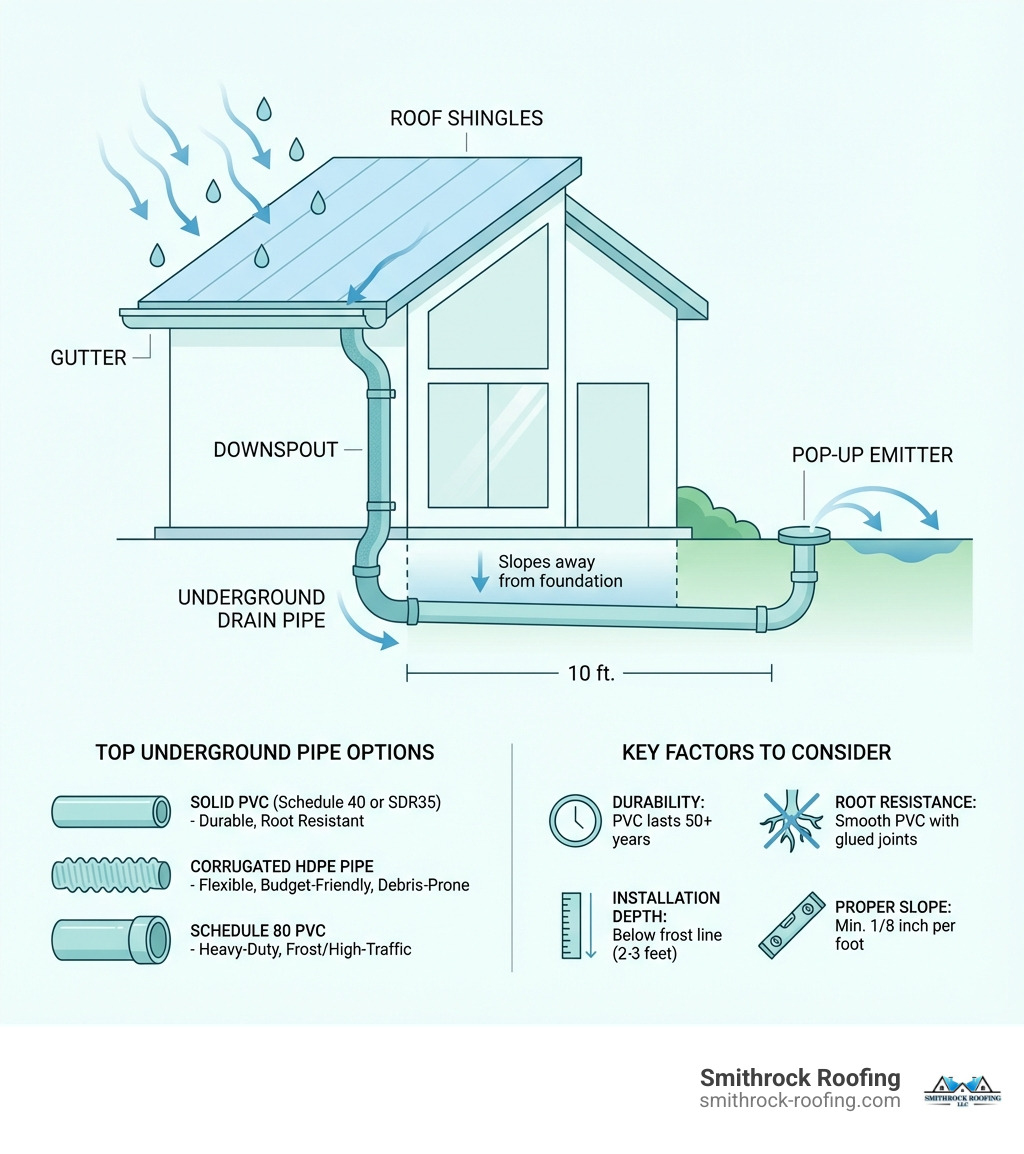
Top Underground Downspout Drain Pipe Options:
- Solid PVC (Schedule 40 or SDR35) – Best for long-term durability and root resistance
- Corrugated HDPE Pipe – More flexible and budget-friendly but prone to debris buildup
- Schedule 80 PVC – Heavy-duty option for areas with frost heave or high traffic
Key Factors to Consider:
- Durability – PVC lasts 50+ years; corrugated may need replacement sooner
- Root Resistance – Smooth PVC with glued joints prevents root intrusion
- Installation Depth – Must be below frost line in cold climates (typically 2-3 feet)
- Proper Slope – Minimum 1/8 inch per foot for gravity drainage
Water damage costs homeowners billions annually, often starting with rainwater pooling near the foundation due to poor downspout drainage.
During a storm, gutters collect immense amounts of water. Without proper underground drainage, this water pools near your foundation, causing erosion, flooding, cracks, and landscape damage.
The pipe you choose determines if your system lasts for decades or fails in a few years. Soil conditions, climate, roots, and installation depth are all key factors in your selection.
This guide covers everything you need to know about underground downspout drain pipes, from selecting materials and sizing your system to best installation practices for long-lasting performance.

Why Your Downspout Drainage System is Your Home’s First Line of Defense
A home’s drainage system is often overlooked until problems arise. However, your downspout drainage system is critical for your home’s health, especially in North Carolina areas like Winston-Salem, Clemmons, and Kernersville, which see significant rainfall.
A downspout’s primary purpose is to channel water from your gutters to the ground, safely away from your foundation. This simple function is your home’s first line of defense against numerous potential issues.

The Critical Role of a Downspout
During a heavy downpour, your roof collects a massive volume of water. Without gutters and downspouts, this water would saturate the ground around your foundation. These vertical pipes use gravity to transport rainwater from the gutters down the side of your house. This protects your foundation, fascia, and siding from water damage like rot and stains. Downspouts are essential for managing and directing water effectively. To learn more, explore our comprehensive gutter services.
The Dangers of Improper Drainage
When a downspout system fails, the consequences can be severe, especially in North Carolina’s rainy climate:
- Structural Damage: Water pooling around your foundation creates hydrostatic pressure, forcing water into basements or crawlspaces. Over time, this can compromise your foundation’s integrity, leading to costly repairs.
- Mold and Mildew Growth: Persistent moisture in basements or crawlspaces creates ideal conditions for mold and mildew, which pose health risks and cause odors.
- Pest Infestations: Damp soil attracts pests like termites, ants, and rodents, which can enter your home through a compromised foundation.
- Eroded Landscaping: Uncontrolled water flow from a downspout can erode topsoil, damage plants, and create trenches in your yard.
- Saturated Soil: Persistently wet soil can destabilize patios and walkways and harm trees and shrubs.
- Ice Hazards in Winter: In winter, pooled water can freeze, creating dangerous ice patches on walkways and driveways.
These dangers show why an effective downspout system is a crucial investment in your home’s health and value.
Planning Your System: Sizing, Materials, and Placement
A well-designed downspout system requires careful planning. You must calculate your roof’s drainage needs, select the right materials, and strategically place downspouts to handle heavy North Carolina rainfall.

Choosing Your Downspout Type and Material
Downspouts are an integral part of your home’s exterior, needing to be both functional and visually appealing. They are mainly round or rectangular; the choice is often aesthetic, depending on your home’s style.
The material you choose impacts durability, lifespan, and maintenance. Common options include:
- Aluminum: The most popular choice, aluminum is lightweight, durable, rust-resistant, and comes in many colors. It can last for decades with proper care.
- Vinyl (PVC): A cost-effective, lightweight, and easy-to-install DIY favorite. It’s rust-proof but can become brittle and is less impact-resistant than metal.
- Steel: Galvanized or coated steel offers superior strength and impact resistance. It’s heavier and can rust if the coating is damaged.
- Copper: The premium choice for its exceptional durability, corrosion resistance, and unique aesthetic. Copper develops a beautiful patina and can last 100 years or more.
Lifespans vary by material: vinyl (20-30 years), aluminum (20-50 years), steel (30-50 years), and copper (50+ years). Consider both upfront cost and long-term value.
How to Calculate the Right Downspout Size
Correct downspout sizing is crucial to prevent overflowing gutters during heavy rain. Sizing depends on roof area, rainfall intensity, and gutter size.
Here’s a general guideline for downspout capacity based on roof area:
- A 2-inch rectangular downspout can handle water from approximately 600 sq. ft. of roof area.
- A 3-inch diameter downspout can carry water from approximately 600 sq. ft. to 1,200 sq. ft. of roof area.
- A 4-inch diameter downspout can handle the water from approximately 1,200 sq. ft. of roof area.
- A 5-inch diameter downspout can handle 2,000 sq. ft. of roof area.
A four-inch diameter downspout is common and sufficient for most homes in areas like High Point and Greensboro, NC. It’s vital to match downspout size to your gutter size (e.g., a 5-inch gutter needs a 3-inch downspout; a 6-inch gutter needs a 4-inch one). For more details, visit our gutter installation services page.
Determining Downspout Placement
Strategic placement is as vital as size to avoid overwhelming any single point. A good rule of thumb is one downspout for every 30 to 40 feet of gutter, often one at each corner of the house. Other factors include:
- Roof Area and Pitch: Larger or steeper roofs require more or larger downspouts to handle increased water flow.
- High-Flow Valleys: Areas where roof valleys terminate may need larger or additional downspouts to manage concentrated water flow.
- Adding Downspouts to Existing Gutters: Frequent overflows signal a need for more or larger downspouts. An extra one can be added to a long gutter run to improve drainage.
Proper selection and placement are critical. We follow standards like those from the National Renewable Energy Laboratory (NREL) to ensure systems are sized correctly for the drained area, providing peace of mind for homeowners in Pinnacle and Rural Hall, NC. You can review these standard work specifications for more information.
The Ultimate Guide to Underground Downspout Drain Pipe Selection
After water flows down the downspout, an underground downspout drain pipe must carry it away from the foundation. Burying pipes improves aesthetics, protects the foundation by moving water farther away, and eliminates tripping hazards. Selecting the right pipe material is critical for long-term performance, especially considering root intrusion, soil conditions, and the North Carolina climate.
Solid PVC Pipe (Schedule 40 & SDR35)
Solid PVC (Polyvinyl Chloride) pipes are the gold standard for underground drainage, offering excellent durability and a lifespan often exceeding 50 years.
- Schedule 40 PVC: This heavy-duty, rigid pipe is strong and crush-resistant, ideal for areas with ground settlement or heavy loads. Its smooth interior ensures optimal flow and resists debris buildup.
- SDR35 PVC: A thinner-walled yet robust and cost-effective option. It uses the same fittings as Schedule 40 and has a smooth interior that prevents clogs and root intrusion when joints are glued.
A key advantage of solid PVC is its resistance to root intrusion. Properly glued, watertight joints create a sealed path that roots struggle to penetrate, which is vital for homes in treed areas like Pilot Mountain or Danbury, NC.
Corrugated High-Density Polyethylene (HDPE) Pipe
Corrugated HDPE pipe, with its ribbed exterior, is another option for underground drainage.
- Flexibility: Its main advantage is flexibility, allowing it to bend around obstacles without extra fittings, which can speed up installation.
- Lower Material Cost: Corrugated pipe typically has a lower upfront material cost.
- Ease of Installation: Its flexibility makes it easier to handle and lay in trenches.
However, corrugated pipe has significant drawbacks. The ribbed interior traps debris, leading to clogs. It’s less durable than solid PVC, susceptible to crushing, and its joints are more vulnerable to root intrusion. Its shorter lifespan and higher maintenance make it less ideal for long-term solutions.
Key Considerations for Your Underground Downspout Drain Pipe
Proper planning and installation are crucial for your underground system’s effectiveness.
- Installation Depth: In North Carolina, pipes should be buried deep enough (e.g., 2-3 feet) to protect them from surface activity and potential freezing. Sufficient cover also protects PVC pipes from crushing.
- Proper Slope for Gravity Flow: A continuous slope is non-negotiable. The International Residential Code (IRC) specifies a minimum slope of 1/8 inch per foot to ensure gravity carries water away and prevents standing water.
- Connection to the Downspout: The transition from the vertical downspout to the underground pipe must be seamless and watertight, typically using a specialized adapter.
- Discharge Point: Common discharge methods include pop-up emitters (discreet covers that release water on the surface), daylighting (extending the pipe to an open area), or connecting to a French drain or dry well.
| Feature | Solid PVC (Schedule 40/SDR35) | Corrugated HDPE Pipe |
|---|
| Durability | Excellent; highly resistant to crushing, long lifespan | Good; susceptible to crushing, shorter lifespan |
| Flexibility | Rigid; requires fittings for bends | High; easily steers obstacles |
| Installation | More labor for fittings; precise trenching | Easier to lay; less precise trenching |
| Root Resist. | Excellent with glued, watertight joints | Poor; joints are less secure, ribbed interior can trap roots |
| Flow/Clogs | Smooth interior, excellent flow, minimal clogging | Ribbed interior can trap debris, prone to clogging |
| Cost | Higher material cost | Lower material cost |
Installation and Maintenance for a Long-Lasting System
After selecting your downspout drain pipe material, meticulous installation and consistent maintenance are key. This ensures your system functions flawlessly for decades, protecting homes in Winston-Salem, King, and other NC locations.
Best Practices for a Flawless Installation
Adhering to best practices is paramount for both DIY and professional jobs. Extending downspouts underground requires more precision than a simple surface installation.
- Achieving Proper Slope: A minimum slope of 1/8 inch per foot is essential. Use levels and string lines to ensure a continuous downward grade.
- Trenching and Bedding: Dig a trench wide and deep enough for the pipe and desired slope. A base layer of gravel or sand provides stability and improves drainage.
- Attaching to the House: Securely fasten the downspout to the house every 4 to 8 feet with appropriate straps to prevent it from pulling away.
- Sealing Joints: For underground PVC, gluing all joints with PVC cement is critical to create a watertight seal that prevents leaks and root intrusion.
- Directing Water Away: The pipe must extend at least 5 to 10 feet from the foundation to prevent soil saturation.
- Backfilling: After laying the pipe, carefully backfill the trench, compacting the soil in layers to prevent settling.
For complex systems or to ensure professional-grade results, we recommend consulting experts. Our team specializes in gutter and downspout installation and can ensure your underground system is installed correctly.
Essential Downspout and Drain Pipe Accessories
Several accessories can maximize the efficiency and longevity of your system:
- Splash Blocks: Simple barriers placed under a downspout to disperse water and prevent erosion.
- Flexible Extensions: Accordion-style pipes that temporarily extend the discharge point.
- Downspout Diverters: Devices that redirect water into a rain barrel for sustainable water collection.
- Leaf Filters and Strainers: Installed in the gutter outlet, they prevent debris from clogging downspouts and underground pipes.
- Cleanouts: Accessible openings in the pipe that allow for easy removal of clogs, especially useful for underground systems.
- Pop-up Emitters: Discreet discharge points that pop up with water pressure to release water safely away from the home.
Recommended Maintenance for Your Downspout Drain Pipe
Even a perfect system requires regular maintenance to prevent clogs and ensure efficient drainage.
- Cleaning Frequency: Clean gutters and downspouts once or twice a year, especially in the fall, to remove debris and prevent blockages.
- Annual Inspection: Inspect the entire system for loose connections, damage, erosion, or leaks.
- Signs of Clogs: Look for overflowing gutters, water backing up, or pooling near the foundation. A non-opening pop-up emitter also indicates a clog.
- Flushing the System: After cleaning, flush the system with water to ensure it flows freely. Use a cleanout to clear any slow-draining pipes.
Burying downspouts improves aesthetics and safety but can make installation and repairs more complex. With proper materials and maintenance, the benefits usually outweigh the drawbacks. If you suspect a problem, our team can help with gutter repair near you.
Beyond Basic Drainage: Enhancing Your System and Recognizing Failure
Your downspout system can do more than prevent water damage; it can aid in water conservation and boost curb appeal. Understanding these applications and spotting signs of failure is crucial for homeowners in Advance and Wallburg, NC.
Enhancing Your Downspout Drainage System
Your downspout system can be a key part of a sustainable home.
- Using Diverters for Garden Irrigation: A downspout diverter can channel rainwater into a rain barrel. This collected water is perfect for gardening and helps conserve water.
- Directing Water to Rain Gardens: You can direct runoff into rain gardens, which absorb and filter stormwater, replenishing groundwater and reducing strain on storm drains.
- Reducing Stormwater Runoff: Managing rainwater on your property reduces pollution and erosion in local waterways, contributing to a healthier environment.
Downspouts vs. Decorative Alternatives: What to Consider
While functional downspout drain pipes are the focus, it’s worth considering aesthetic alternatives like rain chains.
- Functionality vs. Aesthetics: Rain chains are beautiful, artistic alternatives to downspouts, but their primary strength is visual appeal, not function.
- Water Handling Capacity: Downspouts are superior for handling heavy rainfall. Rain chains can be overwhelmed by large water volumes, causing splashing and ground saturation.
- Suitability for Heavy Rainfall: In North Carolina’s climate, a functional downspout system is the most practical and protective choice. Rain chains are better suited for smaller roof sections or as decorative elements.
- Installation Differences: Downspouts are secured to the house for efficient water funneling. Rain chains hang freely and require a basin below to prevent erosion.
The choice depends on your priority: maximum protection (downspouts) or visual appeal (rain chains). For robust protection, we recommend traditional downspouts.
Lifespan, Repairs, and When to Call a Professional
Even the best systems require attention to last. Material lifespans vary: vinyl (20-30 years), aluminum (20-50 years), steel (30-50 years), and copper (50-100+ years). Underground PVC can last 50+ years, while corrugated pipe has a shorter lifespan of 10-25 years.
- Signs of Wear and Tear: Watch for sagging gutters, leaking joints, erosion near the foundation, visible damage (dents, cracks, rust), persistent clogs, and water in your basement or crawlspace.
- When to Call a Professional: Minor fixes like re-securing a loose strap can be a DIY job. However, for major issues like sagging gutters, improper slope, or recurring water problems near the foundation (especially with an underground downspout drain pipe), professional help is essential. These problems require specialized tools and expertise to diagnose and repair correctly. For more guidance, consult our gutter repair guide.
Conclusion
The journey of rainwater from your roof away from your foundation is critical, and the underground downspout drain pipe is a key component. We’ve explored how downspouts protect your home’s structure, prevent water damage, and aid in water conservation.
Choosing the right pipe material is crucial. Solid PVC stands out for its durability and root resistance, making it a preferred long-term choice. While flexible and cheaper, corrugated HDPE is more prone to clogs and crushing, making it less ideal for buried applications.
Proper installation—with adequate slope, watertight connections, and strategic discharge points—is the linchpin of an effective system. Diligent maintenance will ensure your system protects your home for decades.
At Smithrock Roofing, we understand the drainage challenges faced by homeowners in North Carolina, from Pfafftown to Belews Creek. We’re committed to providing high-quality gutter and downspout solutions that safeguard your investment.
Protect your home with our expert gutter services