When a storm rolls through, and if you’ve lived in our area for any length of time, you know these storms don’t ask permission, the damage it leaves behind can feel overwhelming. A limb through the roof. Shingles scattered across the yard. A water stain spreading across your ceiling faster than you’d like to admit. In those first moments, the questions pile up just as fast as the damage: How bad is this, really? Do I need someone out tonight? What do I do right now?
This guide is written to answer those questions honestly and completely. Not to sell you on a phone call, but to give you the practical knowledge that lets you make smart decisions under pressure, the kind of decisions that protect your home, support your insurance claim, and help you avoid the mistakes that turn a manageable repair into a much larger problem.
The instinct after storm damage is to reach for the phone immediately. That’s not wrong, but spending two or three minutes doing a safe, ground-level assessment first will make every conversation you have afterward more productive.
What you can assess safely from the ground or from inside:
What you should never do after storm damage:
Once you have a basic picture of what you’re dealing with, you can have a much more informed conversation with an emergency roofing contractor about severity, urgency, and next steps.
Need a hand with this in Winston-Salem, Greensboro and the NC Triad? Call (336) 971-0464 or request a free estimate. Honest answers, no pressure.
One of the most consistent gaps in how emergency roof repair is discussed online is the absence of a real, concrete answer to the question homeowners are actually asking: How fast does this get worse if I wait?
The answer is faster than most people expect, and it follows a fairly predictable progression once water breaches the roof membrane.
| Timeframe | What Is Happening Inside Your Home |
|---|---|
| 0–1 Hours | Active water intrusion begins saturating attic insulation; the insulation’s R-value (its ability to resist heat transfer) drops immediately, even before visible interior damage appears |
| 1–6 Hours | Drywall ceiling boards begin absorbing moisture; paint bubbles and ceiling texture softens; wood framing members begin taking on water |
| 6–24 Hours | Roof deck boards (OSB or plywood) begin to swell; OSB is particularly vulnerable and begins delaminating faster than plywood under sustained moisture exposure |
| 24–48 Hours | Wood moisture content can exceed the 20% threshold at which mold spore germination becomes viable, per EPA guidelines; this is the critical window |
| 48–72 Hours | Active mold colony formation becomes possible in warm, humid conditions, a real concern in NC Triad summers; structural lumber shows early signs of degradation in persistently wet areas |
| Beyond 72 Hours | Compounding risk to electrical components, insulation, structural framing, and finished interior surfaces; remediation costs escalate significantly alongside repair costs |
The takeaway is straightforward: a roof breach that goes unaddressed overnight in warm, humid North Carolina weather is not simply a repair delayed, it is a larger repair in progress. This is why emergency temporary stabilization, even before a full repair can be scheduled, is worth taking seriously.
You will see “emergency tarping” listed on nearly every roofing company’s website. What most of those listings don’t tell you is that a poorly installed tarp can actively make your situation worse, causing additional shingle damage, allowing water pooling on a compromised deck section, and in some cases, creating new leak paths that didn’t exist before.
Here is what a professionally installed emergency tarp actually looks like, and why each element matters.
Coverage area: The tarp must extend at least 3–4 feet beyond the edges of the damaged zone on all sides. This ensures water is directed away from the breach rather than channeling toward it along the tarp’s edge. A tarp that only covers the visible damage area is undersized for the job.
Fastening method: Tarp edges should be secured using 2×4 wooden battens that are fastened through the tarp into the roof structure. This distributes load across the full edge of the tarp rather than concentrating stress at isolated anchor points. Bungee cords, sandbags, and loose weights, the quick-and-easy alternatives, are not adequate in any meaningful wind event.
The wind sail problem: A tarp fastened only at corners or perimeter points with loose weights creates a sail effect in wind. As wind gets beneath the tarp surface, it generates upward pressure that lifts shingles and can pull granules off surrounding undamaged areas. After a significant storm, this kind of secondary damage can be difficult to distinguish from the original event when an adjuster is assessing your claim.
Pitch considerations: On steeper roof pitches, generally above a 6:12 slope, meaning the roof rises 6 inches for every 12 inches of horizontal run, a batten-and-screw fastening system is the only method that reliably holds under sustained load. Friction-based or gravity-weighted systems will fail on steep pitches.
Water pooling risk: On lower-pitch sections, an improperly draped tarp can create a depression that collects standing water. That concentrated weight, applied to an already compromised deck section, adds structural stress exactly where the roof is most vulnerable.
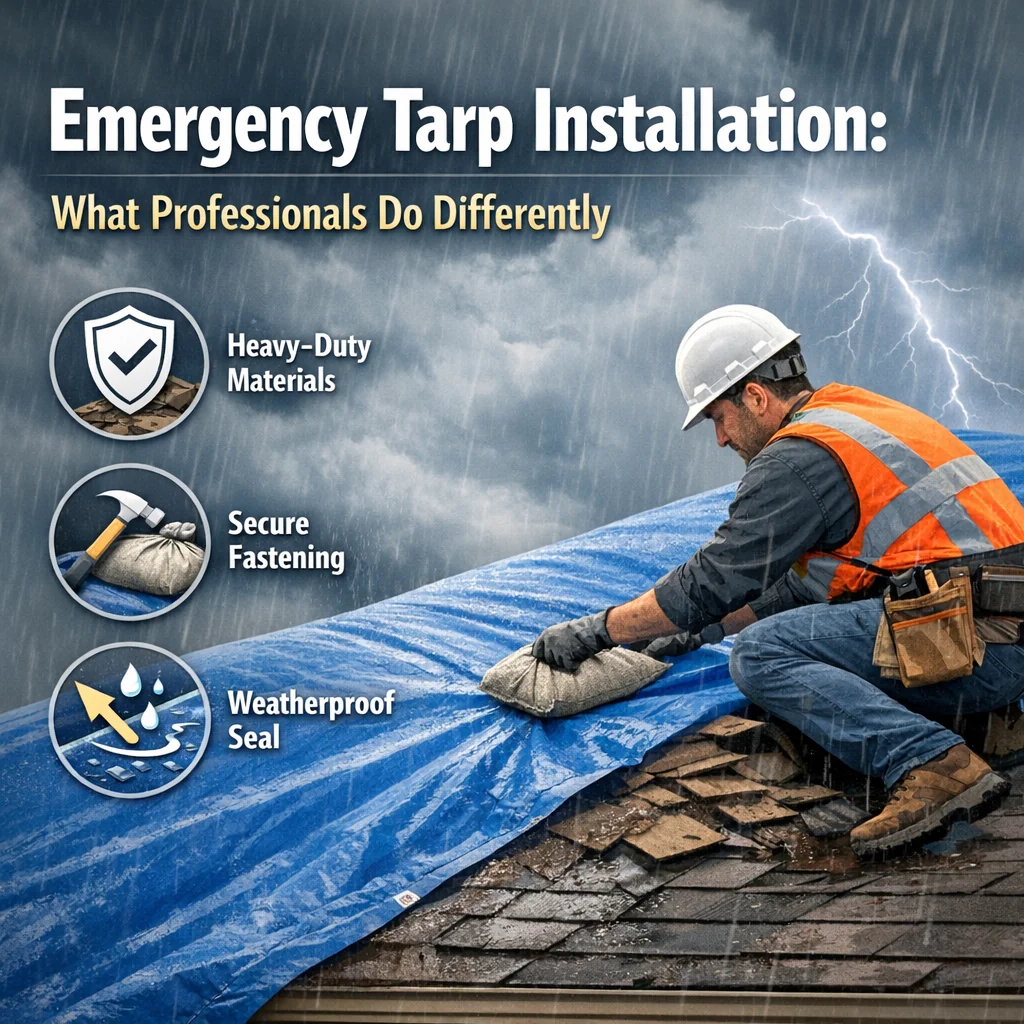
When speaking with any emergency roofing contractor, it is entirely reasonable to ask: “How will you secure the tarp, and what materials will you use to do it?” A contractor who gives you a vague answer, or who can’t explain why wooden battens are preferable to sandbags, is telling you something worth knowing before you authorize any work.
Surface damage gets the attention, missing shingles, cracked flashing, visible punctures. The roof deck beneath those shingles is where the real story is told, and it’s the factor most emergency roofing content completely ignores.
The deck is the structural layer that the entire roofing system sits on. In most NC Triad homes built in the last few decades, that deck is OSB (oriented strand board). OSB is a reliable material under normal conditions, but it is meaningfully more sensitive to moisture intrusion than traditional plywood. When water penetrates through a breach and reaches the OSB, it begins absorbing moisture and swelling along the seams where panels meet. Once delamination begins, the layers of compressed wood fiber begin to separate, the deck loses its ability to hold fasteners properly, which means any shingles installed over it will not be anchored the way they should be.
Here is the practical implication: a shingle repair installed over delaminated OSB decking is a temporary fix that is likely to fail, often within the same storm season. The shingles may look correct from the ground, but the fastener pull-through resistance in swollen, delaminated OSB is significantly reduced. The next storm with meaningful wind doesn’t have to be severe to lift those shingles. For a deeper look at how wind damage to shingles progresses and when it crosses from cosmetic to structural, that breakdown is worth reviewing before you authorize any repair.
A thorough emergency assessment should always include an evaluation of deck condition in and around the damaged zone. If a contractor’s emergency inspection focuses only on the surface layer without any assessment of the deck beneath, that is a gap worth asking about directly: “What does the deck look like in the damaged area, and how does that affect what you’re recommending?”
Nearly every roofing company website mentions that they help with insurance claims. Very few explain what actually determines whether a claim is approved, paid in full, or reduced, and a significant part of that answer has nothing to do with the contractor. It has to do with what you document, in what order, before anyone sets foot on your roof.
Step 1, Photograph everything before touching anything.
Use your phone to photograph all visible exterior damage and all interior damage, ceiling stains, wet insulation visible in the attic, water on the floor, before you move any furniture, place any buckets, or cover any surfaces. Your phone’s camera embeds timestamp and location data in every image. Insurance adjusters use this metadata to verify when damage was documented relative to the storm event. Images taken after cleanup begins are harder to tie clearly to the original event.
Step 2, Cross-reference NOAA storm data.
The National Oceanic and Atmospheric Administration maintains a publicly accessible storm events database that records hail size, wind speed, and storm timing by location and zip code. When your documentation timestamp aligns with a verified NOAA weather event for your area of Guilford, Forsyth, or Davidson County, your claim narrative is significantly more straightforward for an adjuster to process. This is public information your insurer already has access to, making sure your documentation aligns with it works in your favor.
Step 3, Document interior damage separately and thoroughly.
Interior damage documentation is one of the most commonly missing elements in storm claims and one of the most commonly underpaid. Take video of all affected interior areas, ceiling, attic space, any rooms with visible moisture, and narrate what you’re seeing as you walk through. Video is harder to misinterpret than still photographs and provides a more complete record of the extent of damage at the time of the event.
Step 4, Understand your policy’s prompt notice requirement.
Most homeowner’s insurance policies include a provision requiring the policyholder to provide prompt notice of a covered loss. The definition of “prompt” varies by policy, but the principle is consistent: delayed reporting gives an insurer grounds to reduce or, in some cases, deny a claim. If you’ve experienced roof damage, notify your insurer as soon as practical, even before you have a contractor assessment in hand. You can always update the claim with additional documentation; you cannot undo a reporting delay.
Step 5, Get a written scope before authorizing work.
Any emergency repair authorization you sign should specify that the contractor will produce a written damage scope formatted to be compatible with Xactimate, the industry-standard software that insurance adjusters use to process repair cost estimates. When a contractor’s documentation is already in the format your adjuster’s workflow requires, the claims process moves faster and with less back-and-forth. This is a simple question to ask upfront: “Will your written scope be compatible with what my adjuster needs?” For a detailed walkthrough of the full roof insurance claim process and what to expect at each stage, the article on getting what you deserve from a roof insurance claim covers this in depth.
After a significant storm in the Winston-Salem, Greensboro, or High Point area, contractors begin appearing quickly, some local, some not. The urgency you feel is real, but it is also the exact condition that makes homeowners vulnerable to contractors who don’t deliver what they promise. Here is how to evaluate quickly and effectively.
Licensing and insurance:
Ask for the contractor’s North Carolina roofing license number and proof of general liability insurance and workers’ compensation coverage. A legitimate contractor will have this information readily available and will not hesitate to provide it. Work performed by an unlicensed contractor or an uninsured crew creates liability exposure for you as the homeowner if something goes wrong on your property.
Local presence:
Ask where the company’s physical office is located. After major storm events, out-of-state “storm chasers” move into affected markets, collect deposits, and in some cases disappear before work is completed or before warranty claims can be honored. A contractor with an established local presence, an office in the Triad, local crew members, a verifiable track record with area homeowners, is accountable in a way that a transient operation is not.
After-hours dispatch specificity:
The claim of “24/7 availability” covers a wide range of actual operational capacity. Ask specifically: “If I call at 10 p.m., will a crew come out tonight, or will someone call me back in the morning?” The honest answer to that question tells you more than the marketing language does.
Tarp installation method:
As discussed above, ask how they will secure the tarp and what materials they’ll use. The answer tells you whether the person you’re speaking with actually understands emergency stabilization or is simply repeating a service category from a list.
Written documentation:
Confirm that any emergency work authorization you sign includes a commitment to a written scope of damage that can be used in your insurance claim process. Verbal estimates and informal agreements create ambiguity that is difficult to resolve once a crew has been on your roof.
Manufacturer certifications:
Certifications from shingle manufacturers, such as CertainTeed’s ShingleMaster credential, require contractors to meet standards for installation quality, crew training, and business practices. These are not honorary titles; they involve verification. A certified contractor has been vetted in ways a non-certified one has not.
Most emergency roofing content treats all roofs as equivalent. In practice, the emergency response protocol varies meaningfully depending on the roofing system involved, and the NC Triad has a genuine mix of residential roof types.
The most common roof type in the region. Emergency response centers on stabilizing the breach with a properly installed tarp, assessing deck condition in and around the damaged zone, and identifying whether the damage is isolated or part of a broader pattern of wind-related failure across the field of shingles. Older shingles that have lost significant granule coverage are more likely to sustain widespread wind damage in the same storm that causes an isolated puncture elsewhere.
Found on some residential additions, sunrooms, and porches in Triad-area homes, as well as on commercial structures. Membrane roofing systems, EPDM rubber, TPO, respond differently to storm damage than shingle systems do. Punctures, seam failures, and pooling water are the primary concerns. Standard tarping protocols designed for pitched roofs do not translate directly to flat membrane systems, where water management and membrane adhesion are the governing issues. A contractor assessing a flat roof emergency should have specific experience with membrane systems, not just pitched roofing.
Metal roofing systems are increasingly present in the Triad, including standing seam panels and exposed-fastener profiles. Storm damage to metal roofs often presents as panel seam separation, fastener pull-through, or flashing failure at penetrations and ridges rather than the surface punctures more common with shingles. Emergency assessment for metal roofing requires familiarity with panel locking systems and thermal expansion behavior.
Less common but present in older and higher-end residential properties across the Winston-Salem and Greensboro areas. Both materials are significantly more fragile than asphalt shingles during emergency access, walking on wet cedar shake or tile without appropriate care causes additional damage. Emergency response for these roof types requires specific knowledge of the material and ideally access to matching materials for any temporary repairs that involve surface patching rather than tarping alone.
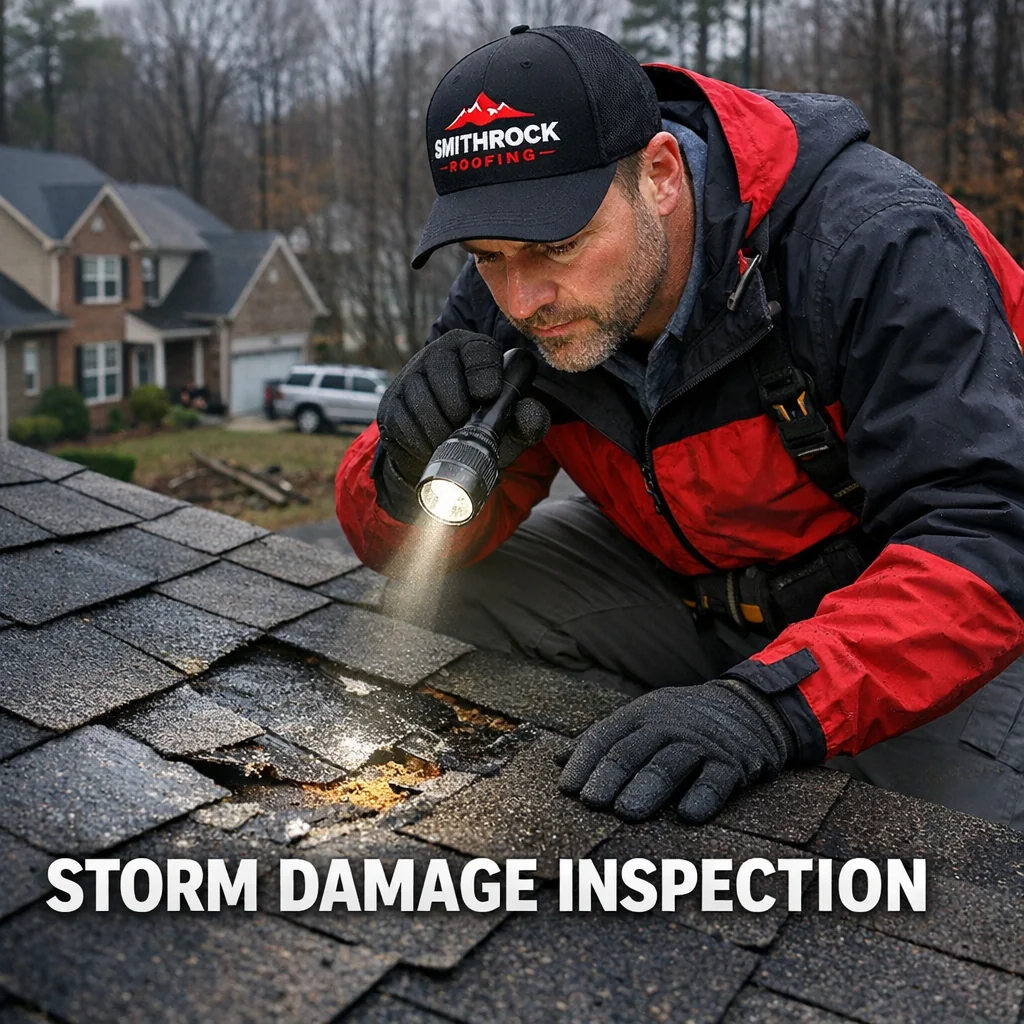
A professional emergency inspection is not a quick glance at the most obvious damage. Here is what a thorough assessment should cover:
The result of a proper inspection is not just a verbal summary, it is a documented assessment that describes where the damage is, how deep it goes, what the deck condition is, and what temporary and permanent repair will require. That documentation matters both for your own understanding and for your insurance claim.
Our area’s climate creates specific roofing challenges that contractors without local experience are not always prepared for. Summers bring sustained heat, high humidity, and afternoon thunderstorms that can be severe and fast-moving. Winters bring ice events that, while less frequent than in more northern climates, cause concentrated damage when they occur, particularly ice dam formation along lower roof edges and in valleys where shingle edges are most exposed.
Contractors who work in this region year-round understand the seasonal damage patterns, know which neighborhoods have tree canopy exposure that elevates storm damage risk, and have established relationships with local suppliers that matter when replacement materials need to be sourced quickly. That local knowledge is not a marketing point, it is a practical advantage when your roof needs attention and timing matters. Smithrock’s roofing services in Winston-Salem are built around exactly this kind of year-round regional familiarity.
Roof emergencies are stressful, and they tend to happen at the worst possible times, late at night, during a second storm, on a weekend when you’re least prepared. The homeowners who navigate them best are the ones who walk into the situation with enough knowledge to ask the right questions, document what matters, and recognize the difference between a contractor who is genuinely capable and one who simply arrived first.
If you’re dealing with storm damage anywhere in the Winston-Salem, Greensboro, High Point, Kernersville, Clemmons, Rural Hall, or King area, Smithrock Roofing is ready to help, with the experience, certifications, and local knowledge to do it right, not just fast.
Response time depends on the scale of storm damage across the area and the contractor’s availability, but a reputable emergency roofing company should be able to deploy a crew for temporary stabilization, tarping, leak containment, and initial assessment, within hours of your call for active, severe damage situations. Permanent repairs follow after a full inspection and, in many cases, after your insurance adjuster has reviewed the damage. In isolated damage situations outside of widespread storm events, response times are typically faster.
Most standard homeowner’s insurance policies cover sudden, storm-related roof damage caused by wind, hail, falling trees, and similar events. What policies generally do not cover is damage that results from deferred maintenance or normal wear over time. Documenting the damage thoroughly, with photographs, contractor reports, and a clear timeline, gives your claim the strongest possible foundation. Contact your insurance provider as soon as possible after damage occurs to understand your specific coverage and begin the claims process.
A temporary repair is designed to stop active water intrusion and protect the structure while a full assessment and permanent solution are planned. This typically involves tarping compromised sections, applying emergency sealants around damaged flashing, and securing any displaced or missing shingles. A permanent repair addresses the underlying structural and material issues, replacing damaged decking, installing new shingles or sections, and restoring flashing and drainage systems to their intended condition. Skipping the permanent repair after a temporary fix is one of the most common mistakes homeowners make following storm damage.
After significant storm events, opportunistic contractors often move through affected neighborhoods offering rapid repairs at unusually favorable terms. Warning signs include pressure to sign a contract immediately, requests for large upfront cash payments, no verifiable local business address, lack of a roofing license issued by the state of North Carolina, and an inability to provide references from local customers. A legitimate, established contractor will encourage you to verify their credentials, will provide a written estimate, and will not disappear once payment clears.
When your roof is damaged and every hour of delay means more water inside your home, you need a contractor with the local knowledge, proper licensing, and genuine experience to respond correctly, not just quickly. Smithrock Roofing has built its reputation across Winston-Salem and Greensboro by treating emergency calls with the same care and craftsmanship that goes into every planned project, because homeowners in difficult situations deserve nothing less. If you’re facing storm damage or an active roof emergency anywhere in the NC Triad, we’re ready to help, Contact Smithrock Roofing today to get the process started.
Need a local pro? Learn more about our roofing services in King.

Smithrock Roofing © Copyright 2026 • All Rights Reserved • Privacy Policy • Maintained by Mongoose Digital Marketing