When Storms Strike: Understanding the Threat to Your Home
Residential roof storm damage is one of the most common and costly problems a homeowner can face. Severe weather events, from violent thunderstorms to hurricanes, put your home’s primary shield—the roof—to the ultimate test. According to industry data, wind and hail alone account for a staggering 34.3% of all property damage insurance claims, representing billions of dollars in repairs annually. When you’re standing in the aftermath of a storm, the path forward can seem unclear and overwhelming. This guide is designed to provide a clear, step-by-step plan.
Immediate Actions After Storm Damage:
- Ensure Safety Above All: Your first priority is the well-being of your family. Stay far away from any downed power lines, as they can be live and lethal. Avoid the temptation to climb onto your roof for a closer look; a storm-damaged roof can be structurally unsound and incredibly slippery.
- Document Everything Thoroughly: Before you move or touch anything, document the damage. Use your smartphone to take extensive photos and videos of all visible damage from the safety of the ground. This evidence is the foundation of a successful insurance claim.
- Contact Your Insurance Company: Report the damage to your insurance provider as soon as it is safe to do so. All policies have time limits for filing claims, and starting the process quickly is crucial for a timely resolution.
- Call a Professional Roofer: A licensed and reputable roofing contractor should be your next call. They can perform a safe, detailed inspection, identify damage you might miss, and install temporary protections to prevent the situation from worsening.
- Mitigate Further Damage: While waiting for your roofer, take reasonable steps to prevent more damage. This includes covering exposed areas with tarps (a job best left to professionals) to stop water from entering your home and causing catastrophic secondary issues.
Your roof is your home’s first and most important line of defense against the elements. Even a well-maintained roof can sustain significant damage when faced with high winds, driving rain, or large hail. This unpredictability is a fundamental reality of homeownership.
The stakes are incredibly high. In 2022 alone, the NOAA National Centers for Environmental Information recorded 4,436 major hail events across the country. The damage isn’t always as obvious as a gaping hole. Subtle signs, such as an accumulation of asphalt granules in your gutters, new water stains on your ceiling, or a sudden, unexplained spike in your energy bills, can all point to a compromised roof.
This comprehensive guide will walk you through every stage of dealing with residential roof storm damage. You will learn how to identify both obvious and hidden damage, effectively document it for your claim, navigate the complexities of the insurance process, and make the critical decision between repairing and replacing your roof.
Acting with speed and precision is the key to protecting your family, your financial investment, and your peace of mind. A small leak left unaddressed can quickly escalate into major structural rot, widespread mold growth, and thousands of dollars in additional repairs.

Handy residential roof storm damage terms:
Understanding and Identifying Residential Roof Storm Damage
When powerful storms roll through North Carolina communities like Winston-Salem and Greensboro, they often leave a trail of destruction. Your roof, being the most exposed part of your home, bears the brunt of this assault. Understanding how to identify the various forms of residential roof storm damage is the critical first step toward recovery, as much of the most serious damage can be hidden from plain sight.
Common Types of Storm Damage
Storms are complex weather events that can inflict damage in multiple ways. Understanding the specific type of damage your roof has sustained helps in diagnosing the problem accurately and formulating the correct repair strategy.
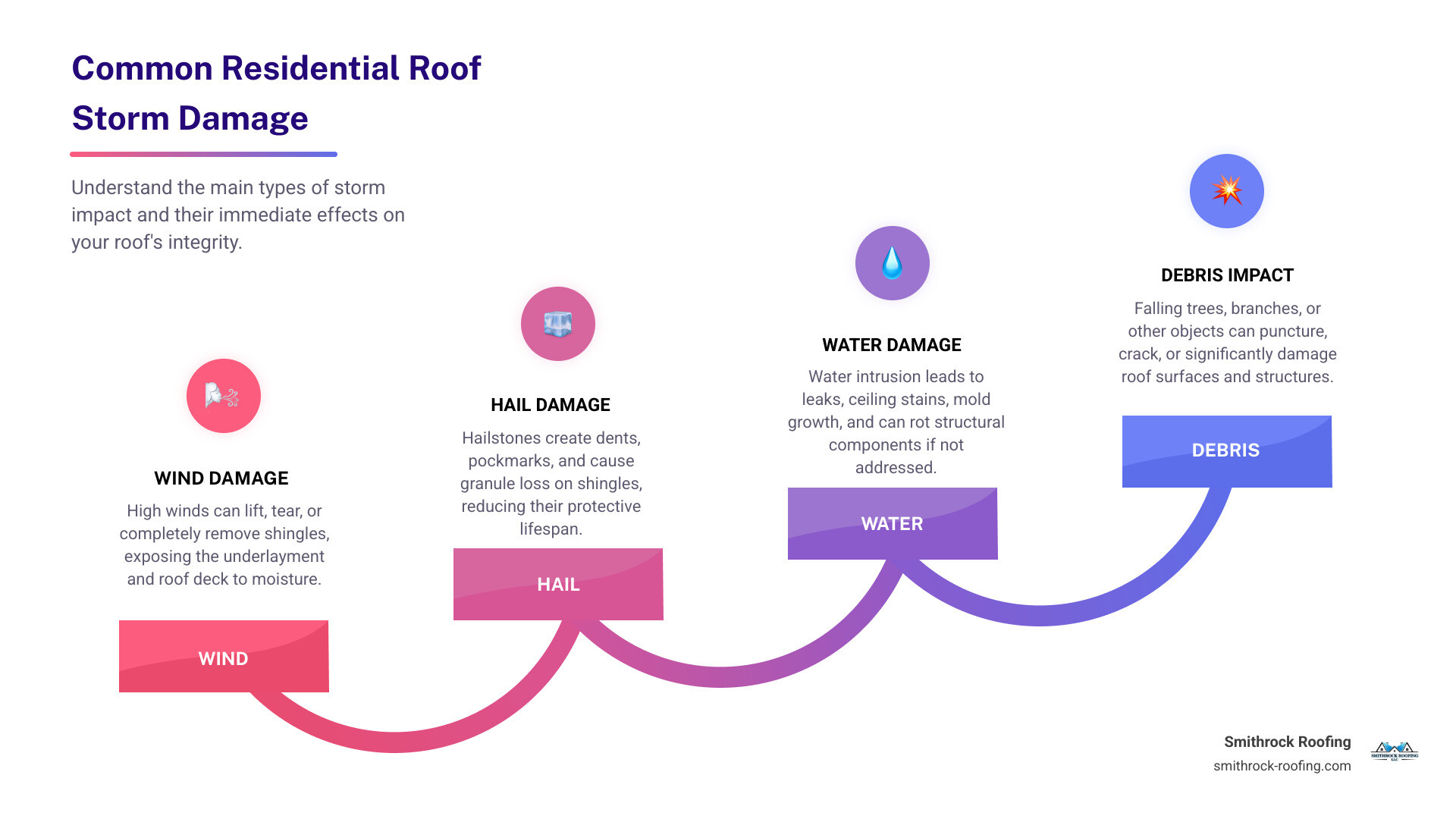
Wind Damage: As a prevalent form of residential roof storm damage, high winds pose a multifaceted threat. Wind doesn’t just blow shingles off; it creates a powerful uplift pressure (similar to an airplane wing) that can break the sealant strip that bonds shingles together. Once this seal is broken, shingles can flap, crease, and eventually tear away, exposing the vulnerable underlayment. This compromised seal is a primary entry point for wind-driven rain. Signs include obviously missing shingles in your yard, as well as curled, creased, or lifted shingles, particularly along the roof’s edges, hips, and ridges where wind forces are strongest. Learn more about wind damage to roof shingles.
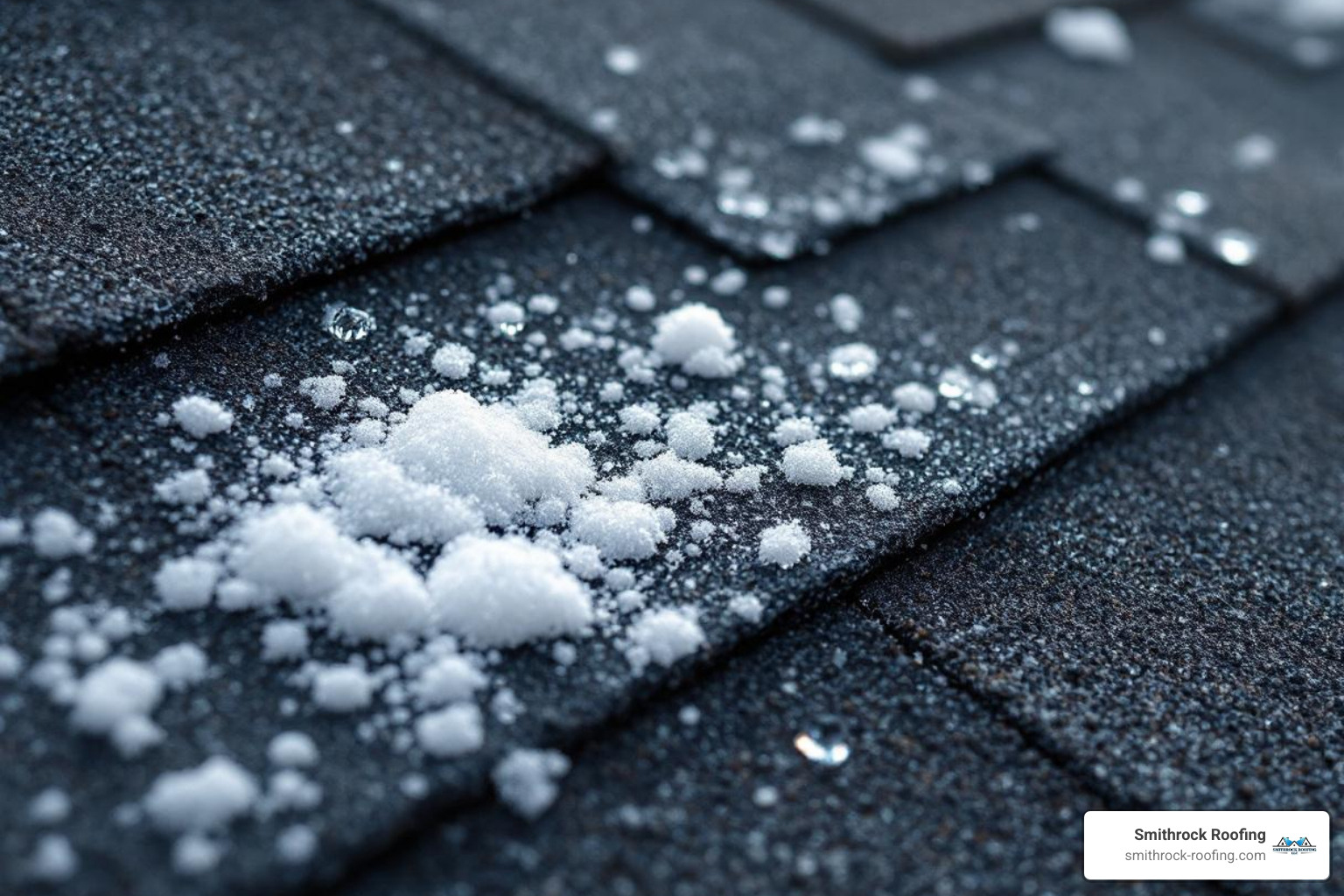
Hail Damage: Hail is a significant threat, acting like a barrage of hammers on your roof. Hailstones can cause visible pockmarks, dents, and cracks in shingles, vents, and flashing. However, the most insidious damage is often less obvious. On asphalt shingles, hail impacts can cause “bruising,” which fractures the underlying fiberglass mat without necessarily breaking the surface. This weakens the shingle and leads to premature failure. A more common sign is the loss of the protective ceramic-coated granules. These granules shield the asphalt from UV radiation; when they are knocked off, the sun rapidly deteriorates the shingle, drastically shortening your roof’s lifespan. Our hail damage roofers are trained to spot these subtle but critical signs.
Water Damage: Heavy, driving rain is a storm’s most obvious weapon. When wind or hail has already compromised your roof by creating openings, water can seep in, leading to immediate interior leaks. Furthermore, intense rainfall can overwhelm your gutter system. If gutters are clogged with leaves and debris, water dams up and flows back underneath the edge of your shingles, a process that can lead to rot in the fascia boards and roof decking. This persistent moisture can lead to mold, structural decay, and costly interior repairs. Prevent these issues with our guide to roof leaks in Winston Salem: prevention tips for homeowners.
Debris Impact: High winds can turn unsecured objects into dangerous projectiles. Falling tree branches are a primary cause of devastating residential roof storm damage, but other items like airborne patio furniture or construction materials can also cause significant harm. A heavy impact can create deep gouges, punctures that go straight through the decking, or even crack the underlying rafters and trusses. This type of structural damage requires immediate professional attention as it compromises the entire roof system.
Snow and Ice Dams: While less frequent in North Carolina areas like Lewisville, winter storms present their own unique challenges. The sheer weight of heavy, wet snow can stress the roof structure beyond its design limits. More commonly, freeze-thaw cycles create ice dams. This occurs when heat escaping from your attic melts the underside of the snowpack. The meltwater runs down the roof until it reaches the cold eave, where it refreezes, forming a dam of ice. This dam blocks proper drainage, causing water to pool behind it and work its way up under the shingles, leading to leaks that damage insulation, ceilings, and walls.
Key Signs of Residential Roof Storm Damage on the Exterior
After a storm passes and it’s safe to go outside, a careful inspection from the ground can reveal a wealth of information. Remember, climbing on a potentially damaged and wet roof is extremely dangerous and should be left to trained professionals. A visual inspection from the ground, perhaps aided by binoculars, can uncover these crucial clues.

Here are the key signs of exterior residential roof storm damage to look for:
- Missing Shingles: The most obvious sign of severe wind damage. Finding shingles or pieces of shingles in your yard or on your driveway is a clear indication that your roof’s integrity is compromised.
- Curled, Torn, or Creased Shingles: Wind can lift shingles and bend them back, creating a permanent crease that breaks the fiberglass mat. Curled edges are also a sign that the shingle’s seal has been broken and it is vulnerable to being torn off completely.
- Granule Loss in Gutters: Check your gutters and downspout splash blocks after a hailstorm. A large accumulation of shingle granules (they look like coarse, dark sand) is a strong indicator of widespread hail damage and an aging roof.
- Dented Gutters, Flashing, and Vents: Metal components are a great barometer for hail. If your soft metal gutters, downspouts, and roof flashing show visible dents, it’s highly likely your shingles have sustained damage as well, even if it’s not as visible.
- Damaged Roof Vents and Covers: Check for cracked plastic vents or dented metal vent covers and pipes. This is another easy-to-spot sign that the storm was severe enough to damage other, less obvious parts of your roof.
- Debris on the Roof: Don’t underestimate the significance of a large branch or other debris lying on your roof. It may be hiding a puncture or structural damage beneath it.
- Unusual Patterns or Discoloration: Hail damage on shingles doesn’t always look like a dent. It can appear as random dark spots or bruised-looking areas where the granules have been knocked loose, exposing the dark asphalt below.
Exterior Inspection Points from the Ground:
- Walk the Perimeter: Circle your entire house, viewing the roof from different angles and distances to get a complete picture.
- Scan Your Yard and Landscaping: Look carefully for any fallen shingle pieces, bits of metal fascia, or gutter sections.
- Use Binoculars: For a closer, safer look, use binoculars to inspect higher roof slopes, the chimney, and vents for subtle signs of damage.
- Inspect Gutters and Downspouts: Look for dents, sections that have pulled away from the house, and check the outlets for granule accumulation.
- Examine Siding, Windows, and Screens: Damage to these areas (dents in siding, torn screens) can indicate the intensity and direction of the storm, providing context for potential roof damage.
Telltale Signs of Damage Inside Your Home
Sometimes, the first indication of residential roof storm damage doesn’t appear outside, but inside your home. These internal clues are urgent warnings, as they often mean water has already breached your roof’s defenses and is actively causing damage.
Here’s what to look for indoors:
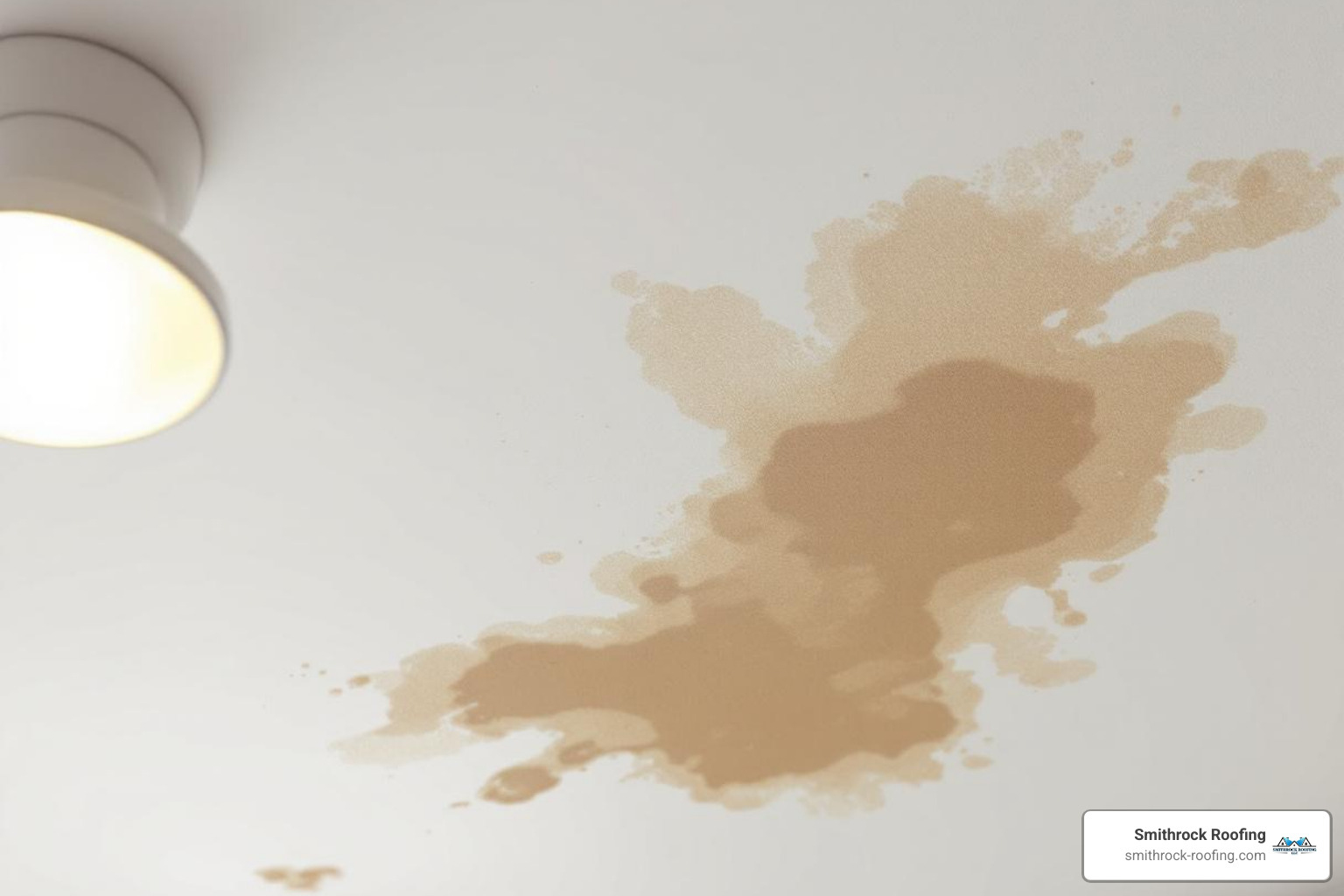
- Ceiling Water Stains: Discolored, brownish rings or dark spots on your ceilings or walls are the classic sign of a roof leak. They may appear small at first but can grow quickly with subsequent rainfall.
- Sagging or Bubbling Ceiling: A sagging, bulging, or bubbling area in your drywall or plaster ceiling is a sign of significant water accumulation. This is a serious structural hazard that requires immediate attention, as a ceiling collapse could be imminent.
- Active Leaks in the Attic: After a storm, safely check your attic with a flashlight. Look for drips, puddles on the floor, dark stains on the wood framing, or damp, compressed insulation. Even a small, slow drip can cause extensive rot and mold over time. Our guide on roof leaks in Winston Salem: prevention tips for homeowners offers further insights.
- Light Coming Through the Roof Boards: If you are in your attic and can see any daylight coming through the roof deck, you have an obvious hole in your roof. This is a direct entry point for water, pests, and drafts.
- Damp or Clumped Insulation: Wet insulation is ineffective. Check the insulation in your attic for dampness or matting. This not only indicates a leak but also means your home is losing energy.
- Unexplained Energy Bill Spikes: A sudden, sharp increase in your heating or cooling costs can be an indirect sign of roof damage. A compromised roof deck or wet insulation allows conditioned air to escape, forcing your HVAC system to work much harder to maintain a comfortable temperature.
Your Immediate Post-Storm Action Plan
Discovering potential residential roof storm damage can be a stressful experience, but having a clear and immediate action plan is your best tool for preventing further issues, ensuring your family’s safety, and setting the stage for a smooth repair and insurance process.
Prioritize Safety First
Before you assess damage or make a single phone call, you must ensure the area is safe. The aftermath of a severe storm is fraught with hidden dangers.
- Downed Power Lines: Treat every downed wire as if it is live and extremely dangerous. Keep a minimum distance of 30 feet, warn others to stay away, and report it immediately to your local utility company and emergency services. Never attempt to move a wire yourself.
- Unstable Structures: If your home has suffered major structural damage (e.g., a tree has fallen on it, a wall is bowing), it could be unstable. Listen for new or unusual creaking or popping sounds. If you have any doubts about the building’s integrity, evacuate immediately and stay out until it has been declared safe by a professional.
- Flooding and Water Risks: Avoid walking through standing water, both inside and outside your home. It can conceal sharp debris, displaced wildlife, or be electrically charged from submerged power lines or household wiring. Follow FEMA emergency guidance for comprehensive storm and flood safety protocols.
- When to Evacuate: If local authorities issue an evacuation order for your area due to flooding, gas leaks, or other hazards, follow their instructions without delay. Have a predetermined evacuation plan and emergency kit ready before storm season begins.
- Never Climb on Your Roof: This point cannot be overstated. A storm-damaged roof is a treacherous environment. Shingles can be loose and slippery, and the underlying decking could be weakened and unable to support your weight. Leave all on-roof inspections and temporary repairs to trained professionals who have the proper safety equipment, such as harnesses and fall protection.
Document Everything
Thorough and immediate documentation is the single most important step you can take to support your insurance claim for residential roof storm damage. Your goal is to create a comprehensive record of your property’s condition right after the storm.
- Take Abundant Photos and Videos: Use your smartphone to capture the damage from every possible angle. Start with wide shots of your entire property to establish context, then move to medium shots of each side of the house. Finally, take detailed close-ups of specific damage points: missing shingles, dented gutters, cracked siding, damaged vents, and any interior water stains or leaks. Video is also excellent; a slow walk-around of your property while narrating what you see can be very powerful.
- Note the Date and Time: Your phone’s camera will automatically embed this metadata into the image files, but it’s also wise to keep a written log. Note the date and time the storm occurred and the date and time you discovered and documented the damage.
- Don’t Move Debris Yet: If a large tree limb is on your roof, take pictures of it in place before it is removed. This demonstrates the cause and potential severity of the impact.
- Keep a Communication Log: Start a dedicated notebook or digital file to record every interaction related to the storm damage. Log all phone calls and emails with your insurance company, adjusters, and contractors. Note the date, time, the person’s name, and a summary of what was discussed.
- Find Your “Before” Photos: If you have any recent photos of your home from before the storm, they can be invaluable. These images provide a clear baseline of your roof’s prior condition, making it difficult for an insurer to argue that the damage was pre-existing.
- For more guidance, GAF, a leading roofing manufacturer, offers excellent advice on what to do after a storm damages your roof.
Mitigate Further Damage
After ensuring safety and documenting the scene, your insurance policy requires you to take reasonable steps to prevent the damage from getting worse. This is known as “mitigating damages,” and it’s where emergency roof repair services become essential.
- Professional Roof Tarping: If your roof has a hole or is actively leaking, it needs to be covered with a waterproof tarp immediately. This is a critical step to prevent rainwater from pouring into your attic and home, which can lead to catastrophic damage to insulation, drywall, electrical systems, and framing. This task should be performed by a professional emergency roofer who can install the tarp securely without causing additional damage to your roof.
- Protecting Interior Belongings: If you have an active leak, move valuable furniture, electronics, and personal items out of the affected area. Use buckets to catch dripping water and place plastic sheeting on the floor to protect your flooring and subfloor from water damage.
- The Operation Blue Roof Program: In the event of a major hurricane or tornado that results in a federal disaster declaration, you may be eligible for the U.S. Army Corps of Engineers’ Operation Blue Roof program. This program provides and installs temporary blue plastic sheeting on damaged roofs for eligible homeowners at no cost, allowing them to stay in their homes while arranging for permanent repairs. Check your eligibility on the USACE website if you are in a federally declared disaster area.
Navigating the Insurance Claim Maze
Filing an insurance claim for residential roof storm damage can feel like entering a maze of paperwork, jargon, and negotiations. However, by understanding the process and your policy, you can navigate it effectively and ensure you receive the fair compensation you are entitled to. We aim to demystify this process for homeowners throughout our North Carolina service areas.
The Insurance Process for Residential Roof Storm Damage
While specifics can vary between providers, the claim process generally follows a standard sequence of events. Knowing these steps helps you manage expectations and stay proactive.
- Step 1: Contacting Your Provider: After you’ve ensured your family’s safety and thoroughly documented the damage, your first call should be to your insurance company’s claims department. Do this promptly, as most policies have specific deadlines for reporting a claim. Have your policy number handy, along with the photos and notes you’ve already taken.
- Step 2: Filing the Official Claim: The insurance representative will assign you a claim number and walk you through the formal process of filing your claim. This may involve filling out forms and submitting your initial documentation (photos, videos, etc.) through an online portal or email.
- Step 3: The Insurance Adjuster’s Inspection: Your insurer will assign an adjuster to your case. This person’s job is to inspect your property and determine the extent and cause of the residential roof storm damage. They will schedule a visit to your home in areas like High Point or Advance. It is highly advantageous for you to have your chosen roofing contractor present during this inspection. Your roofer can act as your advocate, pointing out damage the adjuster might overlook and discussing local building codes and standard repair practices.
- Step 4: Reviewing the Adjuster’s Report and Estimate: After the inspection, the adjuster will create a detailed report, often called a “scope of loss,” which lists the damages they identified and provides a cost estimate for repairs. Review this document meticulously. Compare it with your contractor’s estimate. If there are discrepancies or missing items (like flashing, underlayment, or debris removal), question the adjuster and have your contractor provide supporting evidence for a revised estimate (a “supplement”).
- Step 5: Understanding Your Policy Details: Before you agree to any settlement, be sure you fully understand your policy. Key terms to know are your deductible (the amount you pay out-of-pocket) and your coverage limits. Be aware that some policies have a separate, higher deductible for named storms or hurricanes.
ACV vs. RCV: Understanding Your Payout
One of the most critical aspects of your policy is how it calculates your payout for residential roof storm damage. The difference between Actual Cash Value (ACV) and Replacement Cost Value (RCV) can mean thousands of dollars in out-of-pocket expenses for you.
| Payout Type | Description | Impact on Homeowner |
|---|
| Actual Cash Value (ACV) | This policy covers the cost to replace the damaged roof minus depreciation. Depreciation is the value your roof has lost over time due to age, wear, and tear. | You receive a single check for the depreciated value of your old roof. This means you will be responsible for paying the difference between that amount and the full cost of a brand-new roof. For an older roof, this out-of-pocket expense can be substantial. |
| Replacement Cost Value (RCV) | This policy covers the full, current cost to replace the damaged roof with new materials of similar kind and quality, without a deduction for depreciation. | This is the more favorable policy. You typically receive the payout in two installments. The first check is for the ACV. After you complete the repairs and submit the final invoice from your contractor, the insurer releases the remaining amount (the recoverable depreciation). This process ensures your only major out-of-pocket cost is your deductible. |
Depreciation Explained with an Example: Imagine your 12-year-old asphalt shingle roof has a typical 25-year lifespan and costs $15,000 to replace today. The roof has lost roughly 48% of its value to depreciation ($7,200).
- With an ACV policy, you would receive a check for $7,800 ($15,000 – $7,200 depreciation). You would have to pay your deductible plus the $7,200 in depreciation out-of-pocket.
- With an RCV policy, you would first receive a check for $7,800. After you pay your contractor the full $15,000 and submit the invoice, your insurer sends a second check for the $7,200 in recoverable depreciation.
How Policy Type Affects Your Out-of-Pocket Cost: As the example shows, an ACV policy forces you to pay for the portion of your roof’s life that was already “used up.” An RCV policy, on the other hand, makes you whole again by covering the full roof replacement cost, making it the far superior option for handling significant residential roof storm damage in areas like Greensboro or Winston-Salem.
The Critical Decision: Repair vs. Replace?
After the storm has passed and the initial chaos has subsided, you’re faced with a major decision regarding your residential roof storm damage: should you opt for a targeted repair or a full roof replacement? This isn’t just a financial choice; it’s about the long-term safety and integrity of your home. We help homeowners in communities like Kernersville and Clemmons weigh the factors to make the most informed decision.
Assessing the Extent of the Damage
A professional assessment is key, but understanding the factors involved will empower you to have a more productive conversation with your contractor.
- Age of the Roof: This is often the most significant factor. An asphalt shingle roof that is already 15-20+ years old is nearing the end of its expected lifespan. Older shingles become brittle and are more susceptible to widespread damage. Attempting to repair one section can cause surrounding shingles to crack or break (an effect known as “zippering”), making a simple repair ineffective. On an older roof, a full replacement is often the wisest investment.
- Widespread vs. Localized Damage: If the damage is confined to a small, specific area—for instance, a few shingles blew off one corner—a professional repair may be sufficient. However, if the damage is widespread, such as pockmarks from hail across multiple slopes or wind damage scattered across the entire roof, a replacement is almost always the more economical and reliable long-term solution. A common rule of thumb is if more than 25-30% of the roof is damaged, replacement is the recommended course.
- Structural Integrity: Damage that extends beyond the shingles to the underlying roof deck or framing is a serious concern. Punctures from debris, cracked rafters, or water-damaged, spongy decking indicate a compromised structure. In these cases, a simple repair is merely a band-aid on a much larger problem. A thorough inspection, including inside the attic, is critical to assess the structural health of your roof system.
- Number of Previous Repairs and Layers: A roof that has already been patched multiple times may be a poor candidate for another repair. Each patch introduces new seams and potential points of failure. Furthermore, if your roof already has two layers of shingles (the maximum allowed by most building codes), any new damage necessitates a complete tear-off and replacement.
- The Professional Assessment: Ultimately, the most reliable way to decide is through a thorough inspection by a qualified, trustworthy roofer. Our experts can get on the roof safely, perform a detailed analysis of the shingles, underlayment, decking, and flashing, and provide an unbiased assessment of your residential roof storm damage. We will explain your options clearly, helping you understand the pros and cons of roof repair vs replacement in Winston Salem: what homeowners need to know.
The High Cost of Delaying Repairs
Procrastination is the enemy of a healthy roof. Delaying action on residential roof storm damage, even if it seems minor, can set off a chain reaction of problems that are far more expensive and hazardous to fix.
- Mold and Mildew Growth: Even a small, slow leak introduces persistent moisture into your attic and wall cavities. This creates the perfect dark, damp breeding ground for toxic black mold and mildew. Mold remediation is a specialized and costly process, and airborne spores can cause serious respiratory problems, allergies, and other health issues for your family.
- Structural Rot and Decay: Water is wood’s worst enemy. Unaddressed moisture will slowly but surely lead to wood rot in your roof deck, support trusses, and the framing of your home. This compromises the structural integrity of your entire house, turning a roofing problem into a major construction project that can cost tens of thousands of dollars to repair.
- Compromised and Ruined Insulation: When attic insulation gets wet, it compresses and loses its R-value (its ability to resist heat flow). It becomes completely ineffective at insulating your home, leading to skyrocketing utility bills. Furthermore, wet insulation rarely dries out properly and becomes a breeding ground for mold, requiring complete removal and replacement.
- Exponentially Higher Future Repair Costs: Ignoring a small problem guarantees it will become a big one. A leak that could have been fixed by replacing a few shingles can, over time, destroy a 4×8 sheet of roof decking. If that decking is left to rot, it can compromise the rafter it’s attached to. The cost escalates at each stage. What might have been a few hundred dollars in repairs can easily become a multi-thousand-dollar structural rebuild.
- Potential for Catastrophic Failure: In the most extreme cases, unaddressed structural damage from a storm can weaken the roof to the point of collapse. The added stress of a heavy snowfall or another storm could be the final straw, leading to a devastating and life-threatening failure.
- For any sign of a leak, prompt action is non-negotiable. We offer expert roof leak repair Winston Salem services to stop these escalating issues in their tracks.
Proactive Protection & Choosing Your Contractor
While we can’t control the weather, homeowners are not powerless against storms. Proactive maintenance can significantly strengthen your roof’s defenses, and choosing the right professional partner is the most important decision you’ll make when residential roof storm damage does occur in areas like Pilot Mountain and Trinity.
How to Prepare Your Roof for Storm Season
Prevention is always the best and most cost-effective defense. Taking these steps before storm season can save you significant stress and expense down the road.
- Schedule Regular Professional Roof Inspections: The single best thing you can do is have your roof professionally inspected annually, ideally before the spring storm season. A trained eye can spot subtle issues like loose flashing, cracked pipe boots, or failing sealant that could become major entry points for water during a storm. This small investment extends your roof’s life and prevents costly emergencies. Learn more in our guide to the benefits of regular roof inspections.
- Trim Overhanging Trees and Limbs: Tree branches hanging over your roof are potential projectiles. In high winds, even healthy limbs can snap and fall, causing punctures or significant structural damage. Proactively trim back any branches that are dead, weak, or encroaching on your roofline.
- Clean Your Gutters and Downspouts Religiously: Gutters are a critical part of your roofing system. When they are clogged with leaves and debris, they cannot channel water away from your home. Water will back up, overflow, and seep under the shingles at the eaves, leading to rot in the fascia and roof decking.
- Secure or Repair Loose Shingles: If a visual inspection from the ground reveals any shingles that are lifting, curling, or have broken free, have them repaired or secured promptly. A single loose shingle is an invitation for wind to get underneath, creating a peeling effect that can strip a large section of your roof.
- Review Your Insurance Policy Annually: Don’t wait for a storm to find out what your policy covers. Before the season starts, pull out your policy and review your coverage for wind and hail. Understand your deductible (is it a flat rate or a percentage of your home’s value?), and confirm whether you have an ACV or RCV policy. If your coverage is inadequate, speak with your agent about upgrading it.
- For more comprehensive preparation strategies, the federal government’s Ready.gov site offers invaluable resources on hurricane preparedness.
Finding a Trustworthy Roofing Contractor
In the chaotic aftermath of a storm, the demand for roofers skyrockets, attracting both reputable professionals and opportunistic “storm chasers.” Choosing the right contractor to handle your residential roof storm damage is paramount to a successful recovery. You need a reliable, experienced, and local partner.
Here’s a checklist for vetting a potential roofing contractor:
- Must Be Licensed and Fully Insured: This is non-negotiable. Verify that the contractor holds a valid license in North Carolina. Ask for proof of both general liability insurance (to protect your property from accidents) and workers’ compensation insurance (to protect you from being sued if one of their employees is injured on your property). A contractor without both puts you at enormous financial risk.
- Established Local Reputation: Choose a contractor with a permanent physical office and a long history in your community, such as Winston-Salem. Local companies are accountable, familiar with local building codes, and will be there to honor their warranty years down the road. Be wary of contractors with out-of-state license plates who show up immediately after a storm.
- Check Reviews and Ask for Local References: Look at their reviews on Google, the Better Business Bureau (BBB), and other third-party sites. More importantly, ask for a list of recent local customers you can contact. Speaking directly with past clients is the best way to gauge their professionalism and quality of work. Use our Winston Salem roofers guide to find reputable local pros.
- Demand a Detailed, Written Estimate: Never accept a verbal quote. A professional contractor will provide a detailed, itemized estimate that clearly outlines the full scope of work, the specific materials to be used (brand and type), labor costs, permit fees, and cleanup procedures. Avoid any contractor who pressures you to sign a contract on the spot.
- Understand the Warranty: Ask for details on both the material warranty (from the manufacturer) and the workmanship warranty (from the contractor). Be aware that most manufacturer warranties, like GAF’s, specifically exclude damage from hail or severe weather. The contractor’s workmanship warranty is what covers you against installation errors. While GAF-certified contractors are independent businesses, their certification is a strong indicator of quality and training. You can review GAF contractor information for more details.
- Experience with Storm Damage and Insurance Claims: A contractor who specializes in storm damage is an invaluable asset. They understand how to document damage in a way that insurance companies recognize and can effectively communicate with your adjuster to ensure all legitimate damage is included in the claim, maximizing your coverage.
Frequently Asked Questions about Roof Storm Damage
Homeowners from Pfafftown to Tobaccoville often have similar questions when dealing with the complexities of residential roof storm damage. Here are detailed answers to some of the most common inquiries we receive.
How much damage does a roof need for a full replacement?
There is no single percentage or magic number, as the decision is based on a combination of factors. However, a full replacement is generally warranted when:
- Damage is Widespread: If damage from wind or hail is present on multiple slopes of the roof, repairs become impractical and less cost-effective than a full replacement. Insurers often approve replacement when damage is systematically found across the roof.
- The Roof’s Age is a Factor: If an asphalt shingle roof is over 15-20 years old, it’s near the end of its functional lifespan. The shingles are likely brittle, and even if the storm damage is localized, the roof is a poor candidate for repair. Most insurance companies will opt to replace an old roof rather than pay to repair it, only to have it fail for other reasons shortly after.
- Multiple Leaks or Structural Issues: If the storm has caused leaks in several locations or if there is evidence of damage to the underlying roof deck (the wood sheeting), a replacement is necessary to address the system-wide failure.
- Building Code Requirements: Some local building codes mandate that if a certain percentage (e.g., over 25%) of a roof is repaired, the entire roof must be brought up to the current code, which often necessitates a full replacement.
- A professional assessment from a trusted roofer is the best way to determine if the damage justifies a replacement and to provide the necessary documentation for your insurance claim.
Can I repair my own storm-damaged roof?
While the DIY spirit is admirable, we strongly advise against attempting to repair a storm-damaged roof yourself for several critical reasons:
- Extreme Safety Risks: Roofing is one of the most dangerous professions. Working on a sloped, potentially wet, and structurally compromised surface without proper safety equipment (harness, ropes, fall protection) can lead to catastrophic falls and serious injury or death.
- Risk of Causing More Damage: Without the proper knowledge and tools, it’s very easy to cause more harm than good. Walking on damaged shingles can grind away granules, and improper nailing can create new leaks.
- Voiding Warranties: Most roofing material warranties and any existing workmanship warranties will be immediately voided if you perform unauthorized repairs. This leaves you with no recourse if the materials fail prematurely.
- Complicating Insurance Claims: Your insurance company expects repairs to be done to a professional standard. If they determine that your DIY repairs were improper or worsened the damage, they may deny your claim or any future claims related to that area of the roof.
- Lack of Professional Expertise: A professional roofer is trained to see the subtle signs of damage you might miss. They understand the entire roofing system and can ensure repairs are done correctly to protect your home’s long-term integrity. For peace of mind, rely on expert roof repair services.
How long does a roof storm damage insurance claim take?
The timeline for a residential roof storm damage claim can vary significantly, from a few weeks to several months. Key factors include:
- The Scale of the Storm Event: After a major, widespread storm hits an area like Winston-Salem or Greensboro, insurance companies are inundated with claims. This creates a backlog, and it can take longer for an adjuster to be assigned and scheduled for your inspection.
- Your Insurance Provider: Each company has its own internal processes, staffing levels, and response times. Some are simply more efficient than others.
- The Completeness of Your Documentation: A claim with clear, thorough documentation (photos, notes, contractor’s estimate) is much easier and faster to process than one with missing information.
- The Complexity of the Claim: A straightforward claim for wind damage may be settled quickly. A more complex claim involving hail, structural issues, and disagreements between the contractor’s and adjuster’s estimates will take longer due to negotiations and potential re-inspections.
- Patience and persistent, polite follow-up are essential. Keep your claim number handy and check in with your adjuster or agent regularly for status updates.
What if my insurance claim is denied?
Don’t panic. A denial is not always the final word. First, ask your insurer for a written explanation detailing the specific reason for the denial. If you believe the denial is unjust, you can request a second inspection with a different adjuster. You can also hire a public adjuster, who works for you (not the insurance company) to assess the damage and negotiate on your behalf, though they take a percentage of the final settlement. Your roofing contractor can also provide additional evidence to support your claim and appeal the decision.
My neighbor got a new roof from the same storm, but my claim was denied. Why?
This is a very common and frustrating situation. Several factors can lead to this outcome. The direction of the storm, trees, and surrounding buildings can mean that one roof takes a direct hit from wind or hail while a neighboring one is largely spared. The age and condition of the roofs also play a huge role; an older, more brittle roof will sustain more damage from the same impact than a newer one. Finally, different insurance companies and even different adjusters within the same company can have varying standards for what constitutes replaceable damage.
Your Partner in Storm Recovery
Facing residential roof storm damage is an overwhelming and stressful part of homeownership, especially in a place like North Carolina where severe weather is a fact of life. The wind, rain, and hail can leave you feeling vulnerable and unsure of what to do next. However, as this guide has shown, damage does not have to become a disaster. With a clear head, prompt action, thorough documentation, and the right professional help, you can navigate the recovery process successfully.
We’ve walked through the critical steps: from the initial post-storm safety checks and documentation to understanding the subtle signs of hidden damage inside and out. We’ve demystified the insurance process, explaining the crucial difference between ACV and RCV policies, and provided a framework for making the vital decision between repairing and replacing your roof. Most importantly, we’ve emphasized that proactive preparation and choosing a trustworthy, local roofer are your most powerful tools for protecting your home.
Your home is more than just a building; it’s your sanctuary and one of your largest investments. When its primary shield is compromised, you need a partner you can trust to restore it with expertise and integrity.
If you are in the Winston-Salem area and are dealing with the aftermath of a storm, you don’t have to go through it alone. The certified, experienced professionals at Smithrock Roofing are here to provide a comprehensive, no-obligation inspection and restore your roof—and your peace of mind. Contact us today for expert roofing services and let us be your partner in recovery.