When something goes wrong with your roof, the instinct is to fix it fast and move on. That’s completely understandable — a leak or missing shingles is stressful, and every day without a solution feels like another day your home is exposed. But home roofing repair is one of those areas where moving fast without moving smart can cost you far more in the long run.
After 60 combined years of working on roofs across Winston-Salem, Greensboro, High Point, Kernersville, and the wider NC Triad, we’ve seen the full spectrum: repairs done right the first time that hold for decades, and “repairs” that were really just a can of sealant and a hope. The difference between those two outcomes usually comes down to understanding what a quality repair actually involves — not just at the surface, but through every layer of the roof system.
This guide is written for homeowners who want to make confident, informed decisions. We’re going to cover the real causes of roof failure, what separates a lasting repair from a temporary fix, and what to look for in both a contractor and an estimate. By the end, you’ll know more about home roofing repair than most people who’ve already had work done.
Most roofing content will tell you what gets repaired — shingles, flashing, gutters, valleys. Very little of it explains why these components fail in the first place. That distinction matters, because treating a symptom without understanding the cause is how you end up calling a roofer for the same leak two years in a row.
Your roof isn’t a single layer — it’s a system. From the inside out, a typical asphalt shingle roof consists of:
When a roof leaks, the failure often originates in one layer but is discovered in another. Water entering through compromised flashing at a chimney, for example, may travel several feet along the deck before dripping through your ceiling — making the visible wet spot an unreliable guide to the actual problem location.
North Carolina’s climate gives roofs a genuine workout. The Triad sees hot, humid summers, occasional ice storms and freeze-thaw cycles in winter, and a consistent run of severe thunderstorms that bring wind, hail, and driven rain. Here’s how those conditions translate into specific failure patterns:
Thermal cycling and shingle degradation. Asphalt shingles expand and contract with temperature changes. Over time, this cycling loosens the factory-applied sealant strips that bond one shingle course to the next. Once those seals weaken, wind uplift can lift shingle tabs, expose nails, and allow water infiltration. In the Triad, where summer surface temperatures on a dark roof can exceed 150°F and winter nights regularly dip below freezing, this cycling is aggressive.
Wind damage and improper nailing. High-wind events are the leading cause of sudden, visible shingle loss in this region. But here’s what most homeowners don’t know: shingles blown off by wind are often the result of improper installation — specifically, nails placed outside the manufacturer’s designated nailing zone. Every shingle manufacturer specifies an exact nailing band — typically a narrow horizontal strip across the shingle — and fasteners placed above or below that zone significantly reduce wind resistance. A properly nailed shingle on a quality roof should survive 110+ mph winds. One installed with high nails or too few fasteners may lift in a 50 mph gust.
Flashing failure. This deserves its own section, and we’ll cover it in depth shortly. But understand that flashing is statistically the #1 source of residential roof leaks, and it fails for reasons that have nothing to do with shingle condition.
Ice dams. While less common in the Triad than in more northern climates, ice damming does occur during our periodic winter ice events. When warm air from the living space rises into the attic and heats the deck, snow on the roof melts and runs toward the cold eave — where it refreezes. The backed-up ice forces water under the shingles, bypassing the entire surface system. The fix isn’t just removing ice — it’s correcting attic insulation and ventilation. For a deeper look at this process, our article on how to get rid of ice dams walks through the root causes and lasting solutions.
Aging and UV degradation. Over time, UV radiation breaks down the asphalt binders in shingles, causing granule loss, surface cracking, and reduced flexibility. Once granule coverage drops significantly, the shingle no longer adequately sheds water or reflects heat. This is a gradual process, but it accelerates dramatically on south- and west-facing slopes in the Triad’s sunny climate.
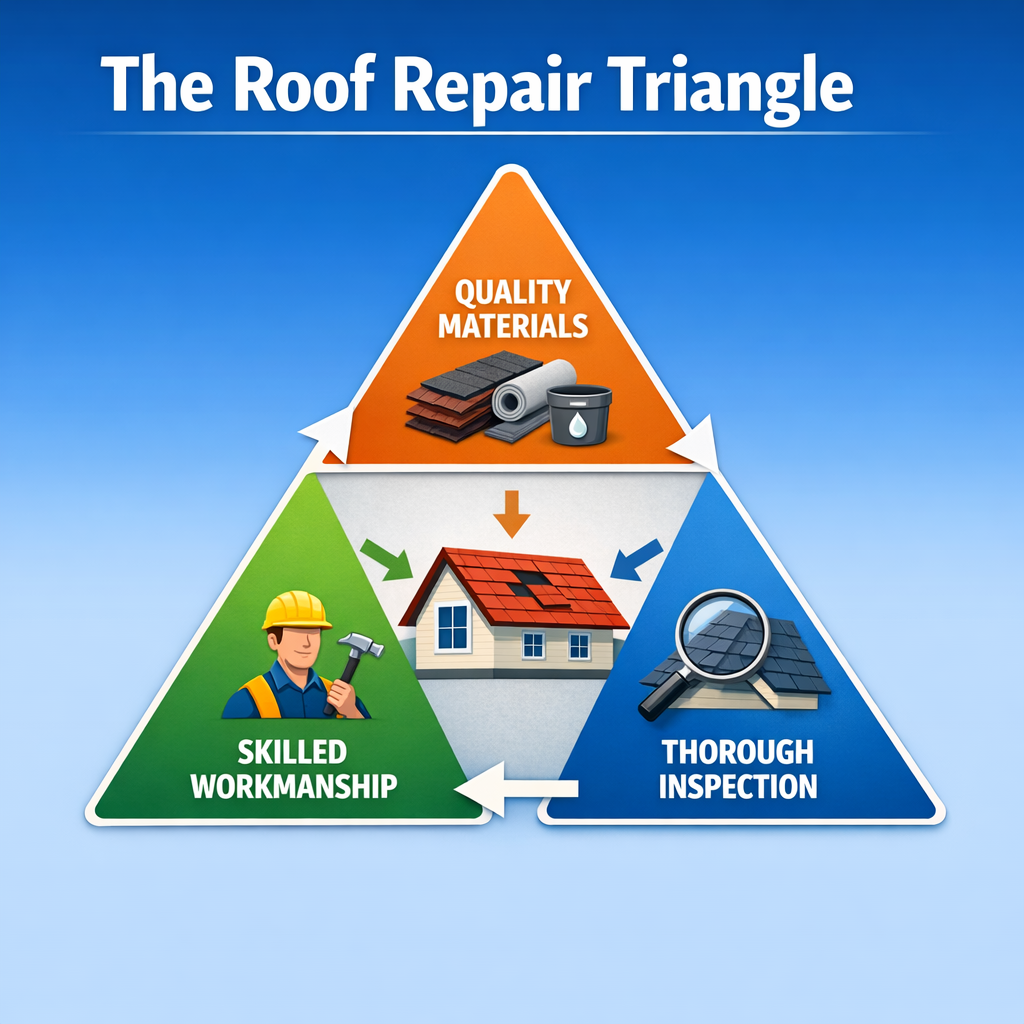
Here’s a concept we apply to every repair we evaluate, and it’s something no competitor in this industry seems to talk about plainly: a roofing repair is only as durable as its three interdependent components.
Think of it as a triangle with three equal sides:
Fix one side of the triangle while ignoring the others, and the repair will fail — usually within one or two seasons, and often in a slightly different location that makes the original contractor appear blameless.
Here’s a real-world example of how this plays out: a homeowner notices a leak near their chimney. A surface-only contractor replaces a few shingles around the chimney and applies sealant to the existing flashing. The leak stops — for about four months. Then it returns, slightly lower on the ceiling. What happened?
The original repair addressed the surface material but ignored two things: the step flashing at the chimney sides was improperly lapped and had been allowing water to wick underneath for years, saturating the underlayment in that zone. And the deck beneath the chimney saddle had developed early-stage rot from prolonged moisture exposure. New shingles over wet, compromised underlayment and softened sheathing don’t have a solid substrate to seal against — water finds its way through regardless.
A proper repair in that scenario would have involved removing the shingles in the affected zone, inspecting the deck, replacing any compromised sheathing, installing new ice-and-water shield as underlayment in the vulnerable area, reinstalling correctly lapped step flashing, and then re-shingling. That’s more work — but it’s the repair that actually lasts.
If we had to choose the single most important thing to understand about roof leaks, it would be flashing. Not shingles — flashing.
Flashing is the system of thin metal (typically galvanized steel or aluminum) installed at every point where the roof plane meets a vertical surface or changes direction. This includes:
Flashing fails in two fundamental ways: material failure and installation failure.
Material failure is straightforward — metal corrodes over time, particularly at sealant joints where moisture collects. Rubber pipe boots degrade in UV exposure and eventually crack. These are wear-related failures that happen even on well-installed roofs.
Installation failure is more common and more frustrating. This occurs when:
The difference between step flashing and counter flashing is worth understanding because they serve entirely different functions. Step flashing is the series of small L-shaped metal pieces that interleave with each shingle course up the side of a chimney or wall — they direct water laterally off the vertical surface and onto the shingle below. Counter flashing is the cap that covers the top of the step flashing and is embedded into the masonry or cladding above — it prevents water from getting behind the step flashing in the first place. Both must be present and properly integrated for the system to work.
When a contractor proposes to “seal the flashing” around your chimney, ask specifically whether the step flashing is being replaced or whether sealant is being applied over existing metal. Sealant over old, corroded step flashing buys six to twelve months at best — it is not a repair, it is a delay. Our article on chimney flashing repair covers exactly why these leaks keep returning and what a proper fix actually involves.
The roof deck is the component homeowners think about least and contractors mention least — which is exactly why it causes so many repeat failures.
Your roof deck is the structural platform everything else sits on. On most homes built in the NC Triad in the last 40 years, that means OSB (oriented strand board) panels. Older homes may have plywood, or in some cases, skip sheathing (individual boards with gaps between them, common under wood shakes).
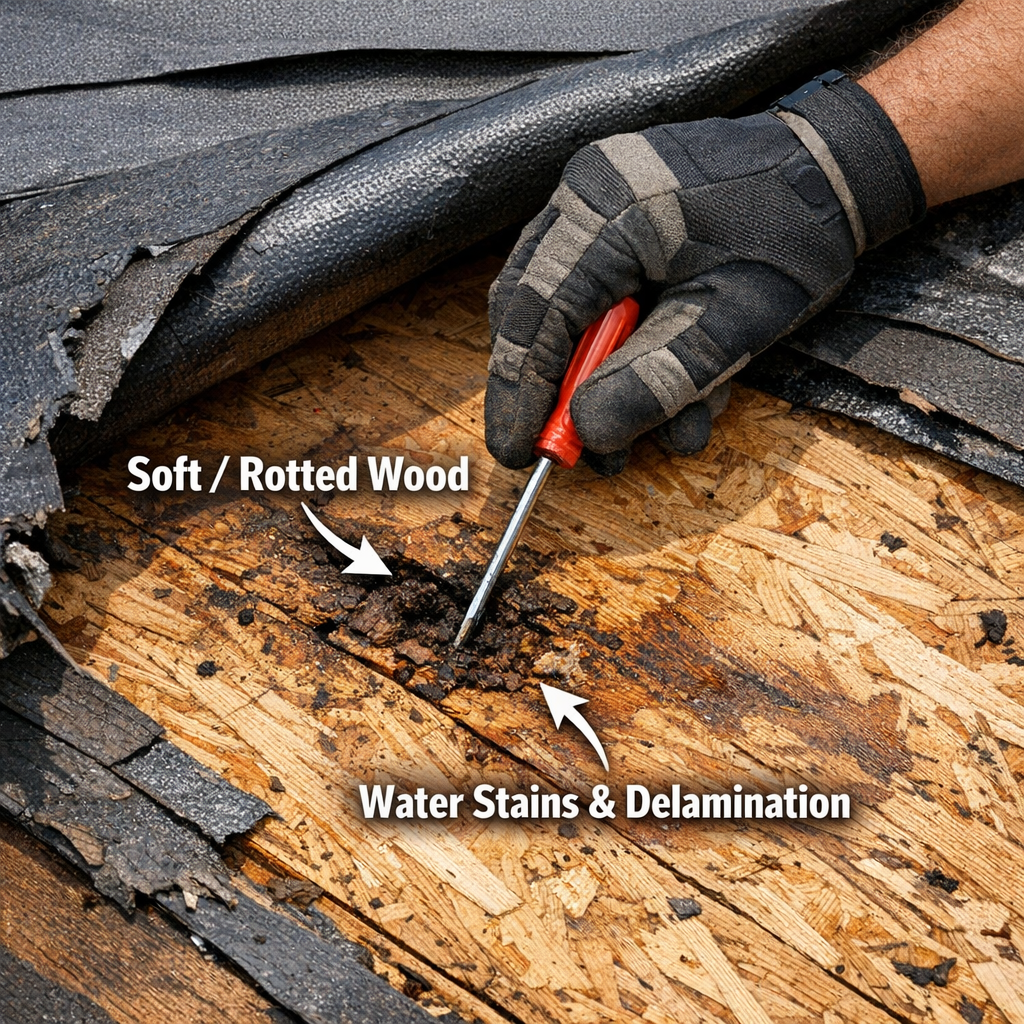
OSB is strong and cost-effective, but it has one significant vulnerability: sustained moisture exposure causes it to swell, delaminate, and eventually rot. Once that process starts, it does not reverse. A section of deck that has been absorbing water from a slow flashing leak for two or three years may feel structurally sound from the surface but have the structural integrity of wet cardboard in its core layers.
From inside your attic, look for:
From the exterior, a contractor doing any repair should probe suspect areas with a screwdriver or awl — good OSB will resist penetration, while degraded material will compress or puncture easily.
If deck damage is found, the repair isn’t optional — it’s essential. Installing new shingles and underlayment over compromised decking is like putting new flooring over a rotted subfloor. The surface may look fine for a season, but the substrate will continue to deteriorate beneath, ultimately causing the repair to fail and potentially creating a structural issue.
One of the most commonly repeated pieces of roofing advice — “spring and fall are the best times for roof work” — is accurate but rarely explained. Understanding the reason behind it helps you make smarter decisions about timing a repair.
Asphalt shingles have factory-applied sealant strips on their underside. When shingles are installed and exposed to heat — specifically, surface temperatures above approximately 50°F — those strips activate and bond the shingle to the course below it. This sealing process is what gives the installed roof its wind resistance rating.
In cold weather (below 40°F), two problems emerge:
This doesn’t mean roof repairs should never happen in winter — emergency repairs obviously can’t wait for a warm front. But it does mean that cold-weather repairs require a contractor who accounts for these factors: using hand-sealing techniques, selecting materials rated for low-temperature application, and documenting the approach in case warranty questions arise later.
In the NC Triad, late September through November and March through May represent the most favorable windows for non-emergency repairs — temperatures are consistently in the range where shingles seal reliably, and severe storm season hasn’t yet peaked.
After a storm event, many homeowners receive a repair — and then receive the same call back six months later with another repair proposal. Sometimes that’s a sign of a dishonest contractor. But sometimes it reflects a genuine distinction that wasn’t explained clearly: the difference between a temporary emergency repair and a permanent code-compliant repair.
A temporary repair is exactly what it sounds like. Emergency tarping, applied roof cement over exposed nail heads, or partial shingle replacement done immediately after storm damage is often intentionally temporary — designed to stop active water intrusion while a proper assessment is completed, an insurance claim is processed, or materials are ordered. There is nothing wrong with this approach when it’s disclosed and documented clearly.
A permanent repair must meet code requirements, use manufacturer-specified materials and fasteners, address the underlayment in the affected zone, and be installed in conditions that allow proper sealing. In North Carolina, roofing work is subject to the North Carolina State Building Code, which incorporates provisions of the International Residential Code (IRC) governing material standards, fastener requirements, and re-covering limitations.
The problem arises when a temporary repair is presented — or billed — as a final solution. This is one of the most common sources of homeowner frustration after storm events, and it’s entirely avoidable with clear communication upfront. Before any work begins, ask your contractor directly: “Is this repair permanent, or is it a temporary measure?” Get the answer in writing.
A roofing repair estimate is a legal document. It defines what work will be done, with what materials, to what standard — and it’s the only recourse you have if the work is done improperly. Yet most homeowners accept estimates that wouldn’t pass basic scrutiny because they don’t know what to look for.
Here’s what a legitimate, detailed repair estimate should include — and what a red-flag estimate looks like by comparison:
| Estimate Element | What a Strong Estimate Includes | What a Vague Estimate Says |
|---|---|---|
| Materials | Manufacturer name, product line, color, and SKU or spec sheet reference | “Shingles to match existing” |
| Underlayment | Whether underlayment in the repair zone will be replaced, and what product | Not mentioned |
| Flashing | Whether existing flashing will be reused, repaired, or replaced; what metal type | “Seal flashing as needed” |
| Nailing specifications | Fastener type, count per shingle, and nailing zone reference | Not mentioned |
| Deck inspection | Language committing to inspect the deck and address any damage found | Not mentioned |
| Debris removal | Explicit inclusion of haul-off and disposal | Not mentioned or vaguely implied |
| Warranty | Labor warranty term, manufacturer warranty applicability, and what voids each | “Guaranteed workmanship” |
| Scope limitations | Clear statement of what is and is not included | Not mentioned |
A vague estimate protects the contractor. A detailed estimate protects you. If you receive an estimate that says “replace damaged shingles, seal affected area” without any of the specifics above, you have no contractual basis to demand that underlayment is replaced, that deck damage is repaired, or that the correct flashing method is used. The contractor can technically fulfill that estimate with a tube of sealant and three shingles and consider the job complete.
When comparing estimates from multiple contractors, don’t compare totals — compare scope. The estimate that explicitly commits to a full underlayment replacement, new step flashing, and a deck inspection in the repair zone is not the same job as one that says “repair shingles near chimney,” even if the totals look similar.
For additional guidance on evaluating contractors, the National Roofing Contractors Association (NRCA) maintains homeowner resources that outline professional standards for the industry.
Here’s something that surprises almost every homeowner going through a partial repair: even when your contractor sources the exact same manufacturer, product line, and color code as your existing shingles, the repair will look different from the rest of your roof — sometimes noticeably so.
This isn’t a sign of a bad repair. It’s a material science reality, and understanding it helps you set realistic expectations and ask better questions.
Granule coverage changes with age. New asphalt shingles have a dense layer of mineral granules embedded in the surface. These granules provide UV protection and give the shingle its color. During the first 12 to 18 months after installation, shingles shed a portion of their initial granule load — this is normal and expected, and it’s why you see granules in your gutters after a new roof is installed. Aged shingles have already been through this process. New shingles in the repair zone will appear slightly different in texture until they’ve weathered to a similar state.
Color lots change between manufacturing runs. Even within the same product line and color name, shingles produced in different manufacturing runs can have subtle color variations. A shingle batch installed ten years ago and a batch purchased today may have slightly different pigment blends.
UV exposure alters surface appearance. A decade of UV exposure changes the surface characteristics of asphalt shingles in ways that no new product can replicate. Fading, oxidation, and granule settling all contribute to the “lived-in” look of an aged roof that new shingles simply don’t have.
A contractor with real experience managing this problem will:
Beyond appearance, there’s a functional consideration: new shingles in a repair zone have not yet activated their sealant strips relative to the aged shingles around them. The thermal properties differ slightly, which can create minor differential expansion stress at the boundary of the repair zone during the first season. A properly installed repair with correctly torqued fasteners manages this without issue — but it reinforces why nailing specifications in the estimate matter.
Every roofing contractor in the Triad will tell you they’re licensed and insured. In North Carolina, that’s not a selling point — it’s the legal baseline to operate. What separates contractors who consistently deliver quality repairs from those who don’t comes down to factors that go well beyond licensure.
Here’s what actually distinguishes a high-quality roofing contractor:
Manufacturer certification levels. Roofing manufacturers offer tiered certification programs for contractors who meet training, installation volume, and quality assurance requirements. CertainTeed’s PREMIER ShingleMaster certification, for example, is among the most rigorous in the industry — it requires demonstrated installation proficiency, training completion, and ongoing quality verification. Contractors who hold these certifications can offer extended manufacturer warranty coverage that non-certified contractors simply cannot provide.
Documented warranty terms. A labor warranty from a roofing contractor is only as good as the contractor’s business longevity and the specific language of the warranty document. Ask: what does the labor warranty cover, and what voids it? Is it transferable if you sell the home? Is it backed by a manufacturer program or just the contractor’s word? You can review the specifics of our coverage on our warranty page.
Verifiable local reputation. BBB rating, Google reviews, and community tenure are meaningful signals — not because they’re impossible to game, but because sustained, high-volume positive reviews over years are difficult to fabricate. A contractor with 300+ five-star reviews over a decade of operation in a specific community has a track record that speaks to consistent performance.
Job-site standards. How a contractor runs a job site tells you a great deal about how they run a repair. Are materials staged carefully? Is the surrounding property protected from falling debris? Is the site cleaned up daily or left in disarray? These are operational discipline signals that translate directly to workmanship quality.
No discussion of home roofing repair is complete without addressing attic ventilation — yet it’s almost entirely absent from competitor content.
Here’s why it matters: your attic ventilation system is directly connected to the longevity of every roofing material above it. Inadequate ventilation allows heat and moisture to build up in the attic space, which causes shingles to overheat from below, accelerates adhesive breakdown, and promotes deck moisture that leads to the rot and sheathing failures we described earlier.
In North Carolina, where summer attic temperatures can reach extreme levels without proper airflow, a roof that is well-repaired but poorly ventilated will degrade faster than one that is aging naturally with proper ventilation in place.
If your roof has experienced recurring issues — shingles losing granules prematurely, flashing sealant failing repeatedly, or unexplained moisture in the attic — ventilation should be part of the diagnostic conversation. Specifically: Does the attic have balanced intake (soffit vents) and exhaust (ridge or gable vents)? Is insulation blocking airflow at the eaves? Has the ventilation design been evaluated against the attic square footage?
A repair that doesn’t account for a ventilation problem isn’t addressing the full system — and the full system is exactly what determines whether your repair lasts five years or twenty-five.
At Smithrock Roofing, we’ve built our reputation across Winston-Salem, Greensboro, High Point, Kernersville, Clemmons, Rural Hall, and King by doing the kind of work that holds up — not just to the next inspection, but to the next decade of NC weather.
Our approach to every repair starts with an honest assessment of all three components of the repair triangle: the surface, the substrate, and the water management system. We document what we find, explain it clearly, and give you a detailed written estimate that specifies materials, methods, and scope so you know exactly what you’re getting. No vague language, no scope surprises.
As CertainTeed PREMIER ShingleMaster Master Certified contractors, we’re able to offer manufacturer-backed warranty coverage that adds a genuine layer of protection beyond our own 5-year labor warranty. And because we’ve been doing this work in this community for a long time, our reputation is accountable to our neighbors — not just our business metrics.
If you’re dealing with a leak, storm damage, or just a roof that isn’t performing the way it should, we’re glad to take a look and give you a straightforward answer. No pressure, no inflated scopes — just honest guidance from people who know this work inside and out.
As roofing materials, inspection technology, and weather patterns continue to evolve, here are three specific steps homeowners in the Triad region should consider heading into 2026:
1. Schedule a Post-Winter Ventilation and Substrate Assessment
Spring is the ideal window to evaluate how your roof and attic system performed through the cold months. Ice, freeze-thaw cycling, and prolonged moisture exposure can stress decking and ventilation pathways in ways that aren’t visible from the ground. A documented assessment — not just a visual glance — gives you a clear baseline before summer storm season arrives.
2. Upgrade to Impact-Resistant Shingles If Your Roof Is Due for Replacement
Class 4 impact-resistant shingles have become an increasingly practical choice for NC homeowners dealing with hail and high-wind events. If you’re facing a repair scope that covers a significant portion of your roof, have an honest conversation with your contractor about whether a full replacement with impact-rated material makes more long-term sense than a patchwork approach. The calculus often shifts more than homeowners expect.
3. Request a Written Repair Scope Before Signing Anything
In 2026, vague verbal estimates remain one of the leading causes of scope disputes and callback frustration. Before any contractor touches your roof, request a written scope that specifies the materials by product line, the square footage addressed, the flashing and water management work included, and the warranty terms — both labor and manufacturer. If a contractor resists putting it in writing, treat that as information.
The answer depends on the extent of damage, the age of your existing shingles, and the condition of the substrate beneath them. A repair makes strong sense when damage is localized, the surrounding shingles are still performing well, and the decking is sound. When damage covers a large portion of the roof, when the decking shows widespread moisture compromise, or when the shingles are approaching the end of their rated lifespan, replacement often delivers better long-term value. An honest contractor will walk you through both options and explain the reasoning — not default to the higher ticket.
The most common reason a repaired roof leaks again is that the original repair addressed only the visible surface symptom without diagnosing the underlying cause. Faulty or improperly integrated flashing, inadequate attic ventilation driving moisture from the inside out, and failing step flashing along dormers or walls are all issues that surface repairs won’t resolve on their own. A thorough repair looks at the full system — not just the shingle that appeared damaged.
A properly executed repair — using materials matched to your existing roof system, correctly installed flashing, and sound substrate beneath — should last many years without recurring issues. There is no universal number because longevity depends on the materials used, the quality of workmanship, and whether the root cause of the damage was addressed. A repair backed by a clear labor warranty from an accountable local contractor gives you a meaningful baseline for what to expect.
Most standard homeowner’s insurance policies do cover sudden, storm-related roof damage — including wind, hail, and falling debris — subject to your deductible and policy terms. What policies generally don’t cover is damage resulting from deferred maintenance or normal wear over time. If you’ve had a recent weather event and suspect damage, a documented inspection from a reputable contractor gives you the evidence needed to support a claim accurately. Always work with a contractor who documents findings honestly rather than one who inflates scope to chase insurance payouts.
When your roof needs attention — whether it’s a persistent leak, storm damage, or something that just doesn’t look right — the quality of the diagnosis matters as much as the quality of the repair itself. Smithrock Roofing has earned the trust of homeowners across Winston-Salem and High Point by treating every project as a systems problem, not a surface fix, and by standing behind the work with the kind of accountability that only comes from being genuinely invested in this community. If you’re ready for a straight answer and a repair that lasts, Contact Smithrock Roofing and let’s take a look together.

Smithrock Roofing © Copyright 2026 • All Rights Reserved • Privacy Policy • Maintained by Mongoose Digital Marketing