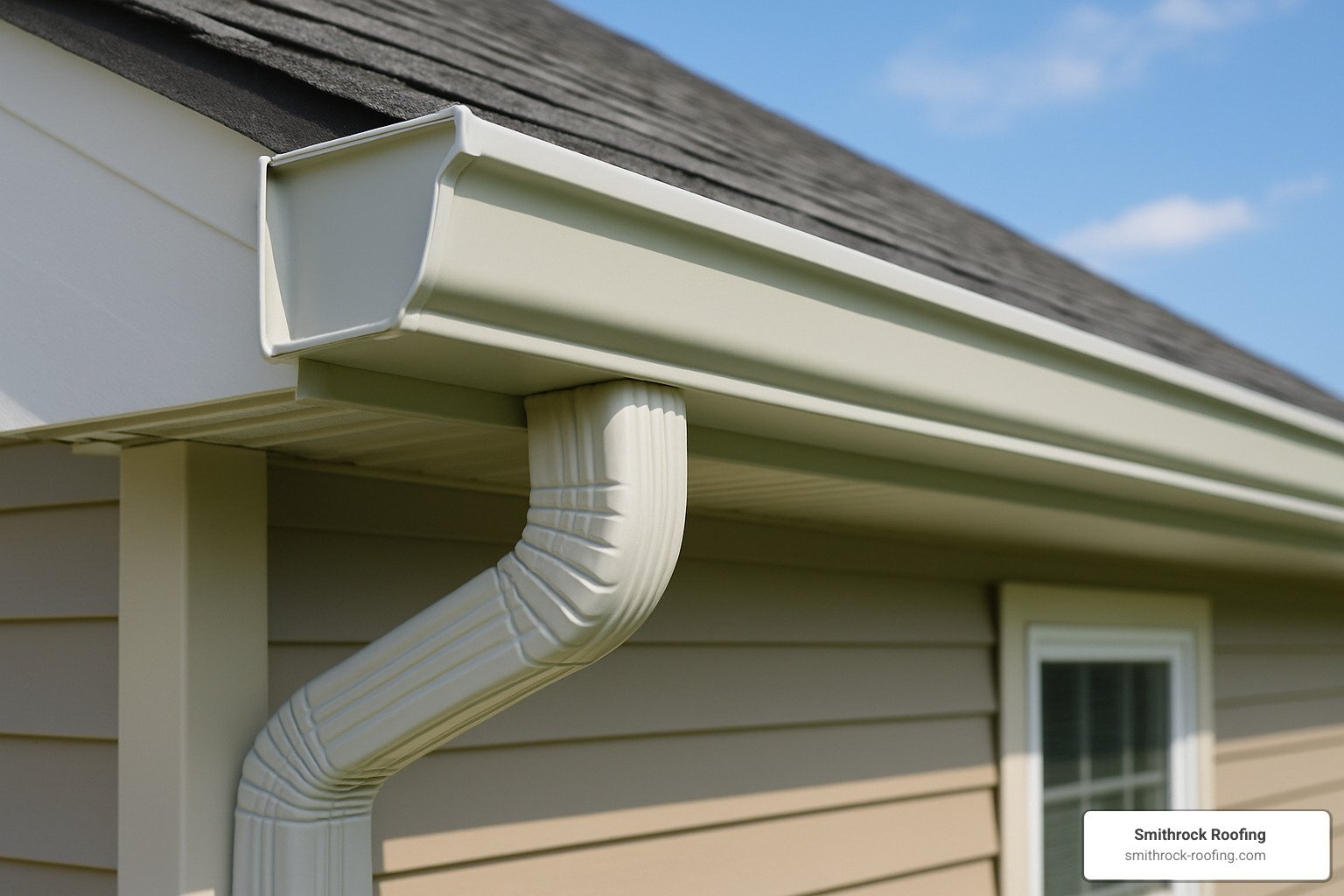
Gutters Greensboro NC: What Homeowners Must Know

What Greensboro Homeowners Need to Know About Gutters (That Most Contractors Won’t Tell You)

Most homeowners don’t think about their gutters until something goes wrong — water pouring over the edges during a summer storm, paint peeling off the fascia, or a damp crawl space that keeps coming back no matter what you do. It’s easy to treat gutters as an afterthought, a simple trough that catches rain and routes it away. But for homes in Greensboro and across the NC Triad, that mindset is exactly what leads to expensive, preventable damage.

Here’s the reality: gutters in this part of North Carolina face a specific combination of stressors — intense convective storms, a heavy tree canopy dropping multiple debris types, and a red clay soil base that reacts to water in ways that amplify every mistake a gutter system makes. The difference between a gutter system that genuinely protects your home and one that just looks like it does comes down to understanding those local conditions, not just installing something and calling it done.

At Smithrock Roofing, we’ve been working on homes across the Triad long enough to know which problems show up repeatedly, which “solutions” create new problems, and what homeowners in neighborhoods from Irving Park to Kernersville actually need to make informed decisions about their gutter systems. This guide is built around that experience — practical, specific, and aimed at giving you a clear picture before you make any decisions.


Why Greensboro’s Weather Makes Gutter Sizing More Important Than You Think

It’s Not About Annual Rainfall — It’s About Storm Intensity

Greensboro receives roughly 43 to 46 inches of rainfall per year, which sounds manageable. But annual totals don’t tell the story that matters most for your gutter system. What actually pushes gutters past their limits is rainfall intensity — how much water falls per hour during a single storm event.

The Piedmont Triad is well-known for its convective summer thunderstorms. These systems can drop 1 to 2 inches of rain in under 30 minutes, creating a surge of water across your roof that most gutter systems simply weren’t designed to handle at that rate. When intensity exceeds a gutter’s flow capacity, water doesn’t politely wait — it overshoots the gutter edge entirely, landing exactly where it would have landed if there were no gutter at all.

This explains something a lot of Greensboro homeowners find confusing: overflow during heavy storms even when their gutters are clean and fully functional. The gutter isn’t clogged. It isn’t damaged. It’s just undersized for the conditions it’s regularly asked to handle.

How Gutter Sizing Actually Works

Contractors who size gutters based on “standard practice” rather than your specific home and local storm data are making an educated guess at best. The correct approach uses three variables:

  • Roof drainage area — the square footage of roof surface draining into a given gutter run, which factors in both horizontal footprint and roof pitch
  • Roof pitch multiplier — steeper roofs shed water faster, increasing the effective drainage area and therefore the required gutter capacity
  • Local peak rainfall intensity — referenced from NOAA’s Intensity-Duration-Frequency (IDF) data for the Piedmont region, which captures the real-world storm rates that matter for system design

A standard 5-inch K-style gutter handles a certain maximum drainage area at a given rainfall intensity. When your roof is steep, large, or drains into a single long gutter run, a 6-inch K-style gutter may be the correct choice — not because it looks more substantial, but because the math demands it.

Why Gutters Overflow in Greensboro


Greensboro’s Red Clay Soil: Why Gutter Failures Cost More Here

What the Soil Under Your Lawn Is Actually Doing

Guilford County sits on the Piedmont Plateau, and the soil composition throughout most of the Greensboro area runs heavily toward red clay. That matters enormously for homeowners, and it’s something almost no gutter contractor talks about.

Red clay soil has very low permeability. When water discharges near your foundation — whether from an overflowing gutter, a downspout that terminates too close to the house, or a splash block sitting on settled ground — that water doesn’t absorb quickly and disperse. It pools. Then it moves laterally, following the path of least resistance, which in older Greensboro neighborhoods is frequently toward the house rather than away from it.

This lateral movement generates hydrostatic pressure against basement walls and crawl space foundations. In sandy or loam-heavy soils, the same water volume would largely absorb and dissipate before building significant pressure. In red clay, it doesn’t. The result is moisture intrusion that shows up weeks after a storm, often misattributed to roofing or plumbing problems rather than traced back to a gutter system that discharged water in the wrong place.

There’s a second mechanism at work, too. Red clay expands when it becomes saturated and contracts as it dries out. Every cycle of gutter overflow or improper discharge followed by a dry period puts your foundation soil through an expansion-contraction cycle. Over years, this creates progressive foundation movement — settling, cracking, and shifting that builds gradually and is easy to miss until it becomes significant and expensive to address.

Neighborhoods Where This Risk Is Highest

Homes built between the 1950s and 1980s in established Greensboro neighborhoods represent a large portion of the housing stock we work on. Areas like Irving Park, Sherwood Forest, Starmount, Fisher Park, and College Hill frequently feature crawl space foundations rather than full basements or slab construction. Crawl spaces are particularly vulnerable to the moisture accumulation patterns that red clay soil creates, because the air gap under the living space traps humidity and creates ideal conditions for wood rot and mold once moisture intrusion begins.

If your home has a crawl space and sits on a lot with any history of drainage challenges, the performance of your gutter system is directly connected to what’s happening under your floors.


The Part of Your Gutter System Nobody Talks About: Downspout Discharge

Where Most Water Damage Actually Starts

Ask most homeowners where their downspouts terminate, and you’ll get a vague answer. Ask most gutter companies, and they’ll tell you their gutters are properly installed — and technically, they may be right. But a perfectly functioning gutter that discharges water poorly is still a problem waiting to express itself.

The International Residential Code establishes minimum distances for downspout discharge from foundations, but code compliance and genuine protection aren’t always the same thing. In established Greensboro neighborhoods — particularly older lots in areas like Sunset Hills, Lindley Park, and Westerwood — grading conditions often include negative grade: ground that slopes toward the house rather than away from it, the result of soil settlement, landscape modifications, and decades of natural grade changes.

On a lot with negative grade, a downspout that terminates 18 inches from the foundation with a splash block may technically meet basic standards while still directing water on a path that ends up against your foundation wall. The splash block redirects water a few feet. The grade takes it the rest of the way back.

What Proper Downspout Termination Actually Looks Like

For homes in Greensboro with clay-heavy soil, flat lots, or negative grading conditions, the correct standard isn’t a splash block from the hardware store. It’s an underground downspout extension that carries water away from the foundation and terminates at a pop-up emitter positioned at least 6 to 10 feet from the house, ideally at a point where the natural grade carries water away from the structure. Our detailed guide on burying gutter downspouts walks through exactly how this system works and what proper installation looks like.

Pop-up emitters remain closed when dry, preventing backflow and debris entry. When water pressure builds during a storm, they open and discharge at grade level at a safe distance from the foundation. In clay soil where surface runoff is slow to absorb, this system is the appropriate solution — not an upgrade, but a baseline for doing the job correctly.

This single issue — downspout termination — accounts for a disproportionate share of the moisture intrusion problems we diagnose in Greensboro homes that already have gutter systems in place. The gutters are fine. The discharge strategy isn’t.


Gutter Materials, Construction, and What Actually Fails

Seamless vs. Sectional: The Real Explanation

Seamless gutters are consistently recommended over sectional gutters, and that recommendation is correct — but the reasoning usually stops at “no seams means no leaks,” which misses what’s actually happening mechanically.

Greensboro’s temperature range runs from roughly 20°F in winter to 95°F in summer. That’s a 75-degree swing, and it happens repeatedly across every year of a gutter’s lifespan. Metal expands when it heats and contracts when it cools. In a sectional gutter system, every lap joint where two sections connect is a point where thermal expansion and contraction cycles work on the sealant holding that joint together. Sealants degrade over time under this stress. They crack, pull away from the metal, and create gaps that let water run behind the gutter rather than through it. This isn’t a matter of installation quality — it’s a material reality that affects every sectional system eventually.

Seamless gutters eliminate field joints entirely except at corners and downspout connections, which are points that can be properly sealed and are far fewer in number. The result is a system that handles thermal movement without the cumulative sealant degradation that defeats sectional gutters over time.

Aluminum Gauge and Hanger Systems: What Separates a Lasting Installation from a Problem Waiting to Happen

Not all aluminum gutters are equal. The gauge of the aluminum — its thickness — determines how well the gutter holds its shape under debris load, ice weight in the occasional Triad ice storm, and the general mechanical stress of installation and service. Thicker aluminum maintains profile and resists denting; thinner aluminum doesn’t, and a deformed gutter collects standing water and debris rather than shedding it cleanly.

The fastener system is equally important, and it’s the failure point most often ignored in gutter discussions. Older gutter installations used spike-and-ferrule fasteners driven through the face of the gutter into the fascia board. These work initially but back out over time as wood expands and contracts seasonally, leaving gutters that sag, pull away from the fascia, and eventually separate from the house entirely.

The correct modern standard uses hidden hangers with screws rather than spikes, set at intervals no greater than 24 inches — and in some cases tighter, particularly on longer gutter runs. Hidden hangers support the gutter from the inside, bear weight without deforming the gutter profile, and the screw fastener doesn’t back out the way a spike does. This is the structural backbone of a gutter installation, and it’s worth asking any contractor specifically what fastener system they use before work begins.

Fascia Board Condition: The Prerequisite Inspection No One Mentions

There’s a step that should happen before any new gutter installation that doesn’t get nearly enough attention: a thorough inspection of the fascia boards the gutters will attach to.

Fascia boards are the horizontal boards running along the roofline where gutters mount. In homes with older gutter systems — especially systems that have been leaking at the back edge — fascia boards frequently develop wood rot from prolonged moisture exposure. Installing new gutters on rotted fascia is one of the most common callbacks in the gutter industry. The fasteners don’t hold properly, the gutter begins to sag and pull away, and within a short time the new installation has the same failure pattern as the old one.

Before new gutters go up, the fascia should be inspected and any rotted sections replaced. It’s not a complicated process, but it’s one that a thorough contractor identifies during the initial assessment rather than discovering midway through the job or leaving for you to find out later. You can learn more about what this work typically involves and what it costs in this article on fascia and soffit repair.


Gutter Guards in Greensboro: Matching the Product to the Debris

No Guard System Is Maintenance-Free

Gutter guards are marketed aggressively, and many of them work well — under the right conditions. The part that gets left out of most sales conversations is that no gutter guard eliminates maintenance entirely, and the type of guard needs to match the type of debris your specific trees produce.

Greensboro has substantial tree coverage, and the species mix matters. Common debris types in residential neighborhoods across the Triad include:

Debris TypeSourceGuard Compatibility Notes
Large oak leavesWater oak, willow oak, red oakScreen and micro-mesh handle well; reverse-curve tends to trap wet leaves
Pine needlesLoblolly, Virginia pineRequire fine micro-mesh; needles pass through or mat on screen-style guards
Sweet gum ballsSweet gum treesProblematic for most guard types; tend to lodge in openings and require manual removal
Maple seeds (helicopters)Red maple, silver maplePass through larger openings; micro-mesh with fine aperture performs best
Small twig debrisMultiple speciesAccumulates on top of all guard styles; periodic surface clearing still required

The most important takeaway: if your property has significant sweet gum coverage — a tree that’s extremely common throughout Guilford County — expect that no guard system will be fully self-sufficient. Sweet gum balls are a mechanical challenge for every product on the market, and a realistic maintenance expectation is more honest than a promise of a completely hands-off system.

Micro-mesh guards generally perform best across Greensboro’s debris mix when installed correctly. Reverse-curve systems, while well-marketed, can struggle with the combination of pine needles and small organic material that tend to mat across the curved surface and restrict flow over time. If you’re evaluating your options, this article on gutter guards takes a closer look at what different guard types actually deliver in real-world conditions.

"A close-up photo of a properly installed seamless aluminum rain gutter on a brick residential home in Greensboro, NC, showing a hidden hanger bracket visible from the front, a downspout transitioning to an underground drainage extension with a pop-up emitter at ground level, and healthy roofing fascia boards behind the gutter. The image should communicate professional installation quality and proper downspout termination in a real residential context."


Repair vs. Replace: A Framework for Making the Right Call

One of the most common questions homeowners face is whether to repair what they have or start over with a new system. There’s no universal answer, but there is a logical framework that makes the decision straightforward.

Repair makes sense when:
– The gutter material is structurally sound (no widespread corrosion, thinning, or profile deformation)
– Failure is isolated — a single leaking seam, a separated downspout connection, or a small section of sagging caused by a failed hanger
– Fascia boards are in good condition throughout
– The existing gutter sizing is adequate for the roof drainage area and local rainfall intensity
– The system is less than 10 to 12 years old and has been reasonably maintained

Replacement makes more sense when:
– The system is sectional and seams are failing at multiple points — this pattern indicates sealant degradation throughout the system, not just at visible joints
– Gutters are pulling away from the fascia in multiple locations due to widespread fastener failure
– The existing gutter size is inadequate (5-inch gutters on a steeply pitched roof or large drainage area), causing regular overflow regardless of condition
– Fascia board rot is widespread, requiring replacement of the substrate anyway
– The system is 20 or more years old and showing multiple concurrent failure modes

The honest truth is that piecemeal repairs on an aging system with widespread issues usually cost more over a three to five year window than a proper replacement done once. We tell homeowners this directly, because the right answer for your home might not be the most immediate revenue for us — and that’s the kind of conversation that reflects how we actually work.


What a Proper Gutter Inspection Should Cover

When a qualified contractor looks at your gutter system, the assessment should go well beyond checking for visible clogs. A thorough inspection includes:

  • Gutter pitch and slope — gutters should maintain a consistent slope toward downspouts, typically 1/4 inch of drop per 10 feet of run; standing water in gutters indicates slope problems
  • Hanger and fastener condition — check for backed-out spikes, loose screws, and any points where the gutter has separated from the fascia
  • Seam and joint integrity — any lap joints, corners, and downspout connections should be watertight with no visible sealant cracking or separation
  • Fascia board condition — probe for soft spots indicating rot, particularly at points where gutters have been leaking along the back edge
  • Downspout flow and termination — confirm water moves freely through all downspouts and discharges away from the foundation at an adequate distance given site grading
  • Gutter profile and shape — deformation or sagging sections that hold standing water create debris accumulation and accelerated corrosion
  • Roof-to-gutter transition — gutters should be positioned to catch water running off the roof edge cleanly, not set too far below the drip edge or too close to the roofing material

This isn’t a checklist to use as a DIY substitute for professional assessment — it’s a reference point so you know what a thorough inspection looks like and what questions to ask when a contractor walks your property.

Strategic Recommendations for 2026

As you plan your approach to gutter maintenance and upgrades in the coming year, three specific actions will position your home’s drainage system for long-term reliability:

1. Schedule a post-winter inspection before spring rains arrive.
Winter in Greensboro puts cumulative stress on gutter systems — ice weight, freeze-thaw cycling, and debris buildup from fall that went unaddressed. Getting a professional assessment in late February or early March, before the heavy spring rainfall season, gives you the clearest picture of what your system actually needs and time to address it before it matters most.

2. Consider transitioning to seamless aluminum if you’re still running sectional gutters.
Sectional systems with multiple lap joints are the primary source of most gutter leaks over time. Seamless gutters fabricated on-site to match your home’s exact dimensions eliminate the majority of those failure points. For homes in Greensboro’s older neighborhoods especially, this is frequently the most durable long-term upgrade available at the gutter level.

3. Add gutter protection to any replacement or significant repair project.
Quality gutter guards are not all equivalent — some perform well and some create new problems. When discussing any substantial gutter work, ask specifically about protection options suited to the tree canopy around your property. A pine-heavy lot has different filtration needs than a yard dominated by hardwoods dropping large leaves. Getting that match right in 2026 reduces the ongoing maintenance burden significantly.


Frequently Asked Questions

How often should gutters be cleaned in Greensboro, NC?

Most homes in Greensboro benefit from cleaning at least twice per year — once in late fall after the majority of leaves have dropped, and once in early spring to clear debris that accumulated over winter. Homes with significant tree coverage, particularly those near pine trees, often need a third cleaning in late spring when pine pollen and small debris accumulate heavily. If your gutters are overflowing during moderate rainfall, that’s a reliable sign cleaning is overdue regardless of the calendar.

What is the typical lifespan of gutters in North Carolina’s climate?

Aluminum gutters, which are the most common material used in residential installation, generally last between 20 and 30 years with proper maintenance. Greensboro’s climate — which includes hot, humid summers, occasional ice events in winter, and significant rainfall spread across the year — does accelerate wear compared to drier climates. Galvanized steel gutters have a shorter useful life due to rust susceptibility, while copper gutters can last 50 years or more. Regular cleaning and prompt seam repairs are the most significant factors in reaching the upper range of any material’s lifespan.

Do I need a permit to replace gutters in Greensboro?

In most cases, straightforward gutter replacement does not require a building permit in Greensboro. However, if the project involves significant fascia or soffit repair, structural modifications, or work connected to a larger roofing project, permit requirements may apply. A licensed contractor familiar with Guilford County requirements will be able to confirm what applies to your specific scope of work before the project begins.

How do I know if my gutters are damaging my foundation?

The most visible early indicators are water staining on the foundation walls, persistent soil erosion directly below downspout discharge points, or standing water that pools close to the house for extended periods after rain. Inside the home, unexplained moisture in a basement or crawlspace — particularly concentrated in specific areas rather than widespread — can indicate that surface drainage is directing water toward the structure rather than away from it. A gutter contractor assessing your system should also evaluate where downspouts are terminating and whether that discharge point is adequate given how your lot is graded.


Closing Thoughts

Your gutter system is one of the least visible and most consequential components protecting your home. When it functions correctly, you never think about it. When it fails gradually — which is almost always how it happens — the damage accumulates quietly until it becomes expensive. The right approach is straightforward: maintain the system you have, understand when repair is the right answer and when replacement makes more sense, and work with contractors who will tell you the difference honestly.

If you’re in the Greensboro area and want a professional assessment of your gutter system with no pressure and a straight answer about what your home actually needs, we’re ready to help.

Contact Us

Share:

Categories

Follow us

You can find us on Facebook, Instagram, and Google.
Smithrock Roofing LLC logo featuring stylized rooftops with chimneys and arched windows
Smithrock Roofing proudly services the cities of Winston-Salem, King, Clemmons, Lewisville, Pilot Mountain, East Bend, Mt. Airy, Kernersville, Siloam, Danbury, High Point, Trinity, Pfafftown, Tobaccoville, Greensboro, Walnut Cove, Belews Creek, Rural Hall, Pinnacle, Bethania, Advance, Wallburg, Horneytown, Union Cross, and Midway, NC.

Newsletter

Sign up to receive important tips, special offers, and discounts.

Smithrock Roofing © Copyright 2026 • All Rights Reserved • Privacy Policy • Maintained by Mongoose Digital Marketing